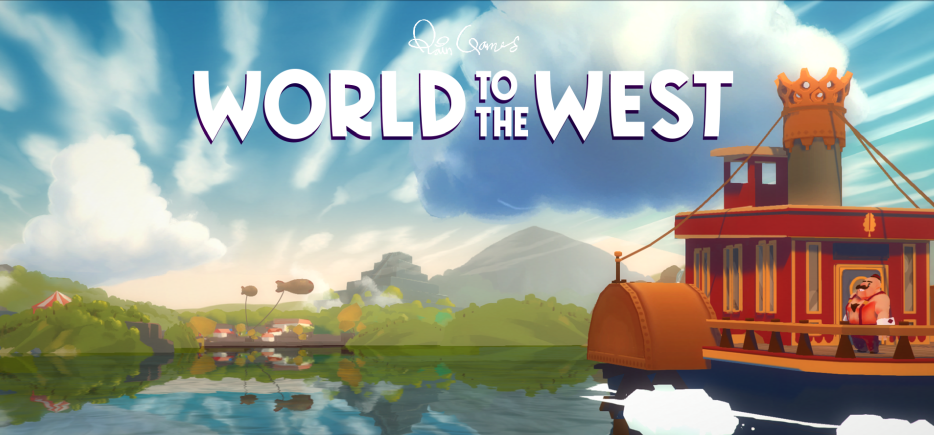
When I learned that Rain Games were fellow Norwegians, I was even more intrigued when I sat down to play World to the West. As an independent video game company, they already have the renowned 2D puzzle game Teslagrad from 2013 on their backs. Placed in the same world as the aforementioned, World to the West is an action-adventure game where you actively play with four different characters, each with their own unique story, which eventually leads them to crossing paths and working together to fulfil a mysterious quest.
World To The West Review [Nintendo Switch]
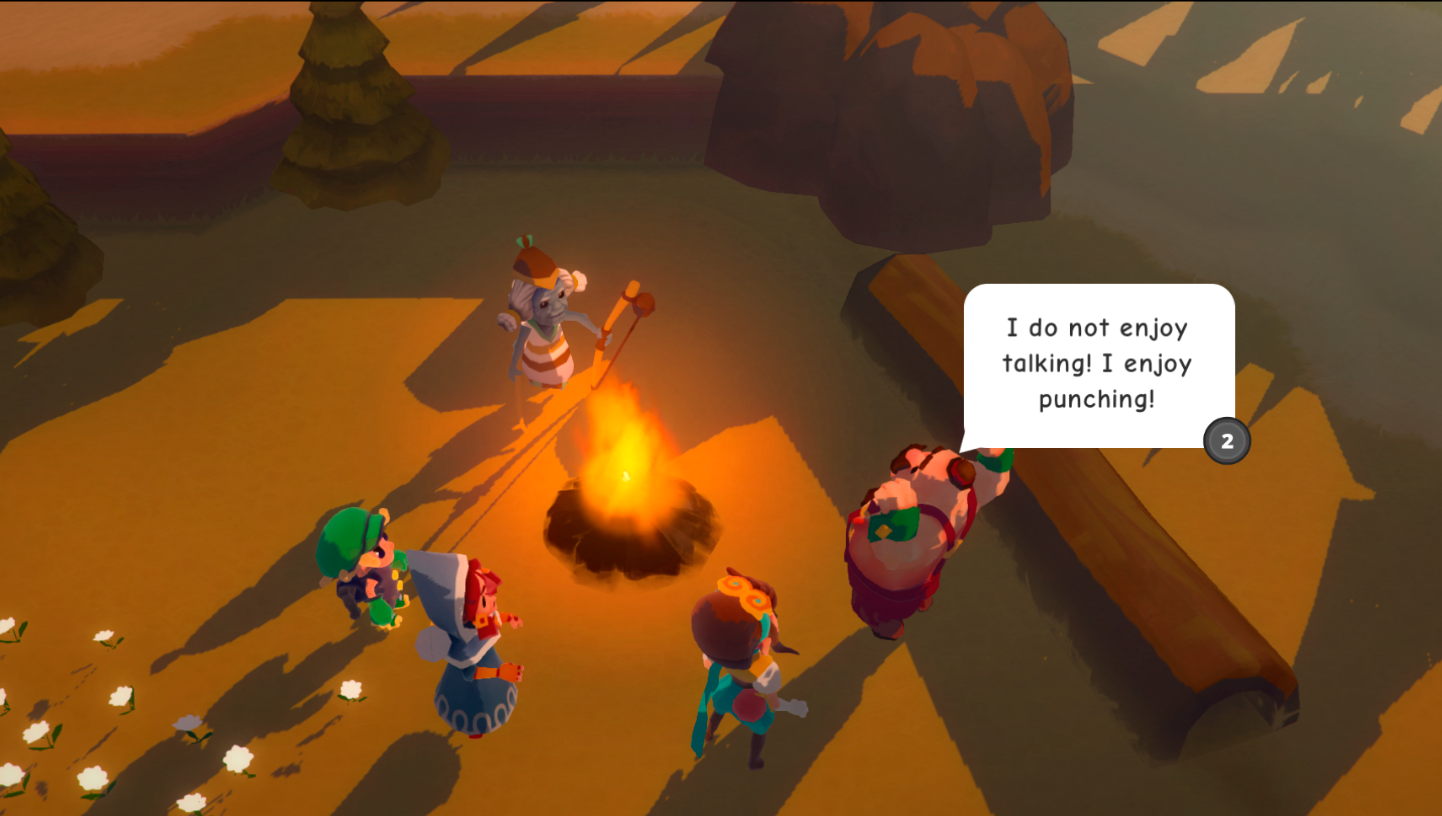
Playing as Lumina, Knaus, Miss Teri, and Lord Clonington, these are characters with unique personalities, unique abilities, coming from different parts of the world. They come together in lovely harmony. The game is split into chapters, where each of them represents a new part of a character’s story. After playing some levels to get to know the characters and their abilities, they are eventually put together as a powerful team and are set to go out on more adventures.
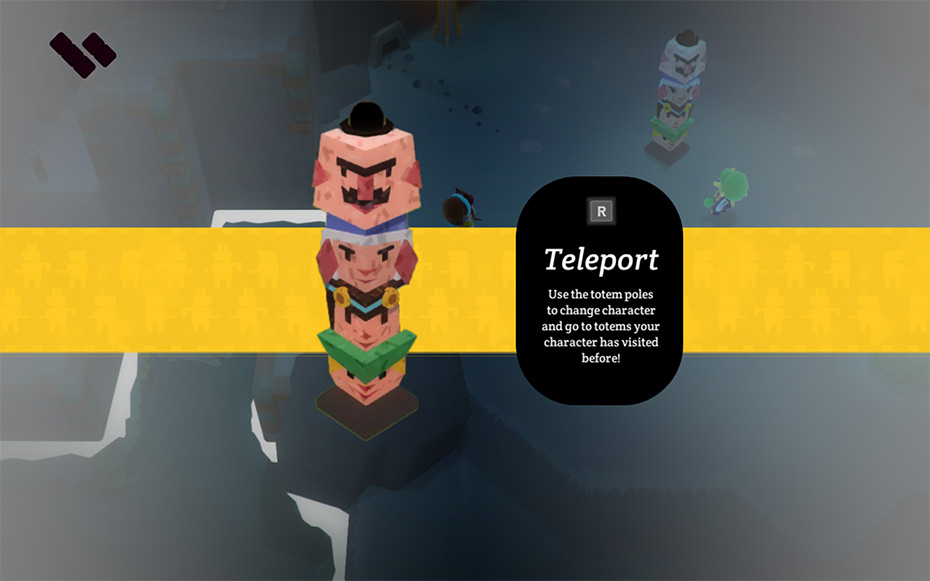
So, we learn that they are a part of a mysterious quest, they are even pictured together on a totem pole, which functions as a checkpoint as well as a teleporting system. With this, you have the ability to teleport from totem to totem, for more convenient fast-travel around the map.
“I am the totem pole, and I will be your checkpoint this evening!”
As the different levels usually require using several characters, they are not always as immediately available as I would like. When you teleport one character to a totem pole, the rest of the gang doesn’t automatically follow; and you don’t have the choice to select one or several characters to teleport either – so you have to teleport each character separately. Sadly, this mechanic gets a little bit tedious after a while, and the switching system might be the game’s largest flaw.
Seeing past that, World to the West is a visually charming and beautiful game. The scenery is vivid and alive with colors, and the details are simplistic, yet pretty. The levels underground were a bit challenging because of the lack of lights, and they got a tad too dark at times – I had some troubles seeing where I was going. But all my troubles were gone once I got back on the surface!
Onward to new adventures, my good fellows!
The story is well-written, and the characters’ commentaries are cute and funny – there’s an emphasis on the personality of each character. In addition to having their own unique skill set, they are fit to embark on adventures, fighting creatures and solving puzzles. It’s not as responsive as I would have wished, however – for example, when I played as Lumina, her dash was often slightly delayed, which meant that solving puzzles became very difficult.
The world is fairly big, so there are plenty of adventures to explore within the game. The cutscenes also grab the opportunity to show the beauty of the world in the game. The scenery is beautiful, and I love the art style. With that said, Rain Games definitely knows how to make a proper gaming title, albeit with a few flaws.
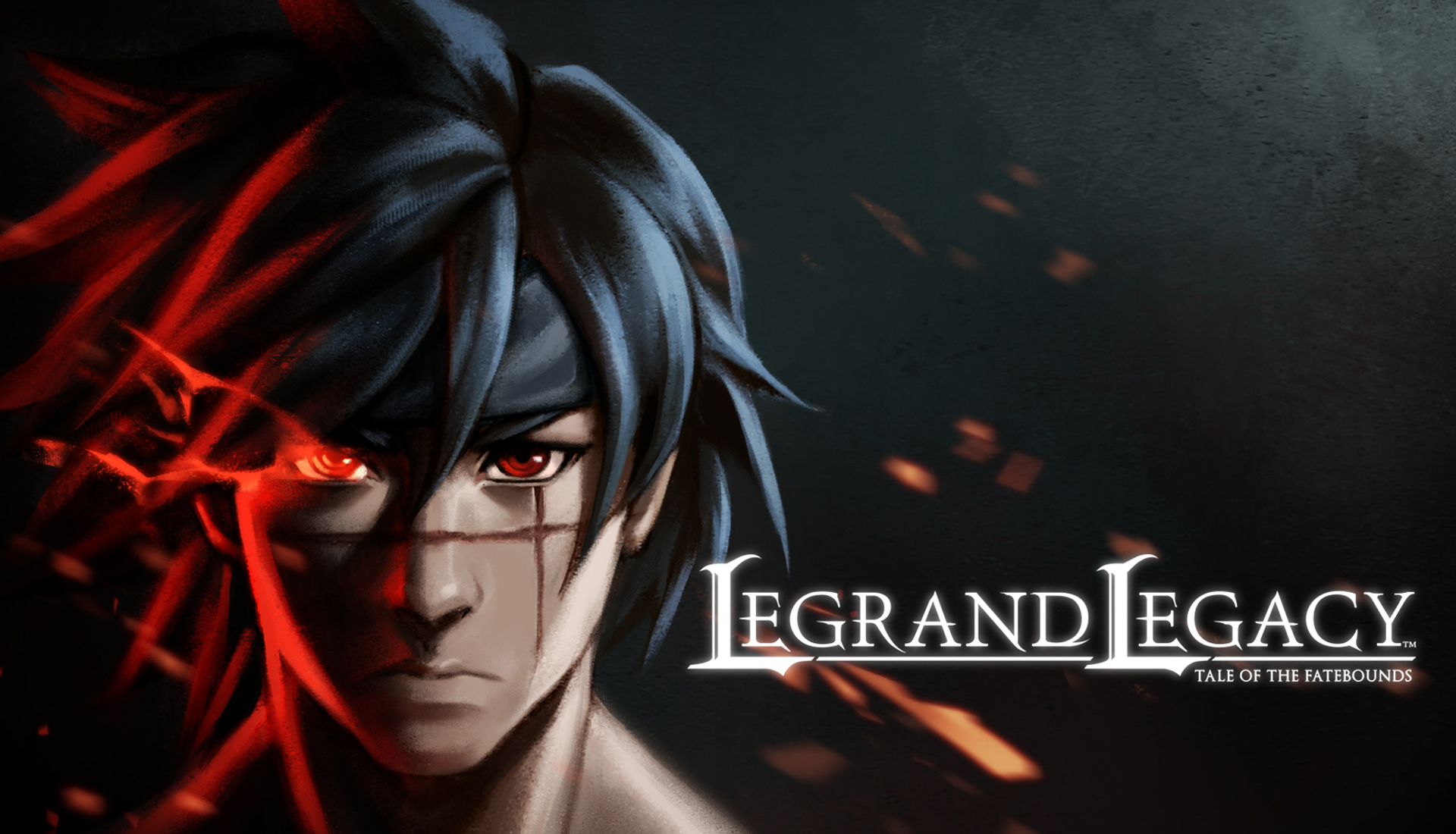
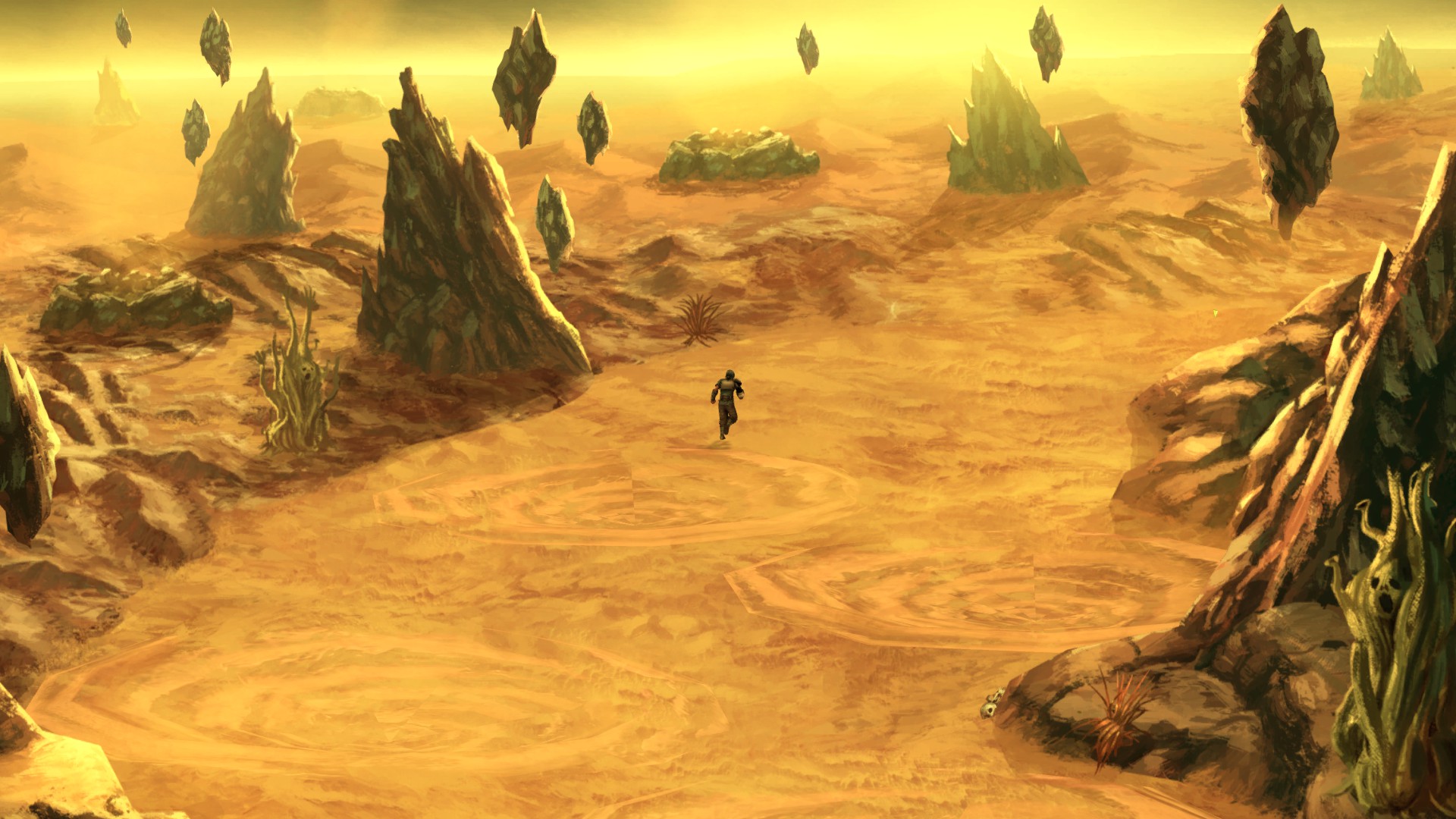
The story of Legrand Legacy: Tale of the Fatebounds is brimming with all of the beloved aesthetics from the fantasy RPG genre, taking players on a journey throughout the war-raged lands. Working your way from a meagre and worthless slave up to a worthy warrior, the enthralling package that Semisoft presents in their recently released RPG is an exciting experience with all of the makings of a surprise sleeper hit.
Taking on the role of the lowly slave – Finn – your journey throughout Legrand takes place after a devastating bout with a gruesome warrior, as a form of spectating entertainment. In a town that takes complete advantage of slaves, you are forgotten as a living being and thrown into the ring to meet your fate. Following an impressive show of power, you are purchased from a mysterious elder man known as a Norn – a race equipped with the ability to communicate telepathically.
Legrand Legacy takes players along an adventure through the fantasy lands of the warring Legrand. As players journey through the many diverse settings of Legrand, unique monsters, characters and combat tactics present themselves, offering the compelling feeling that comes attached to some of the most memorable RPG titles around today. Legrand Legacy is filled with informative lore and dialogue, most of which helps describe the somewhat confusing narrative that follows the surreal world.
As you cross the world of Legrand, aside from encountering the many enemies, Finn will also need to keep an eye out for environmental traps.
Legrand Legacy: An Intuitive Combat System
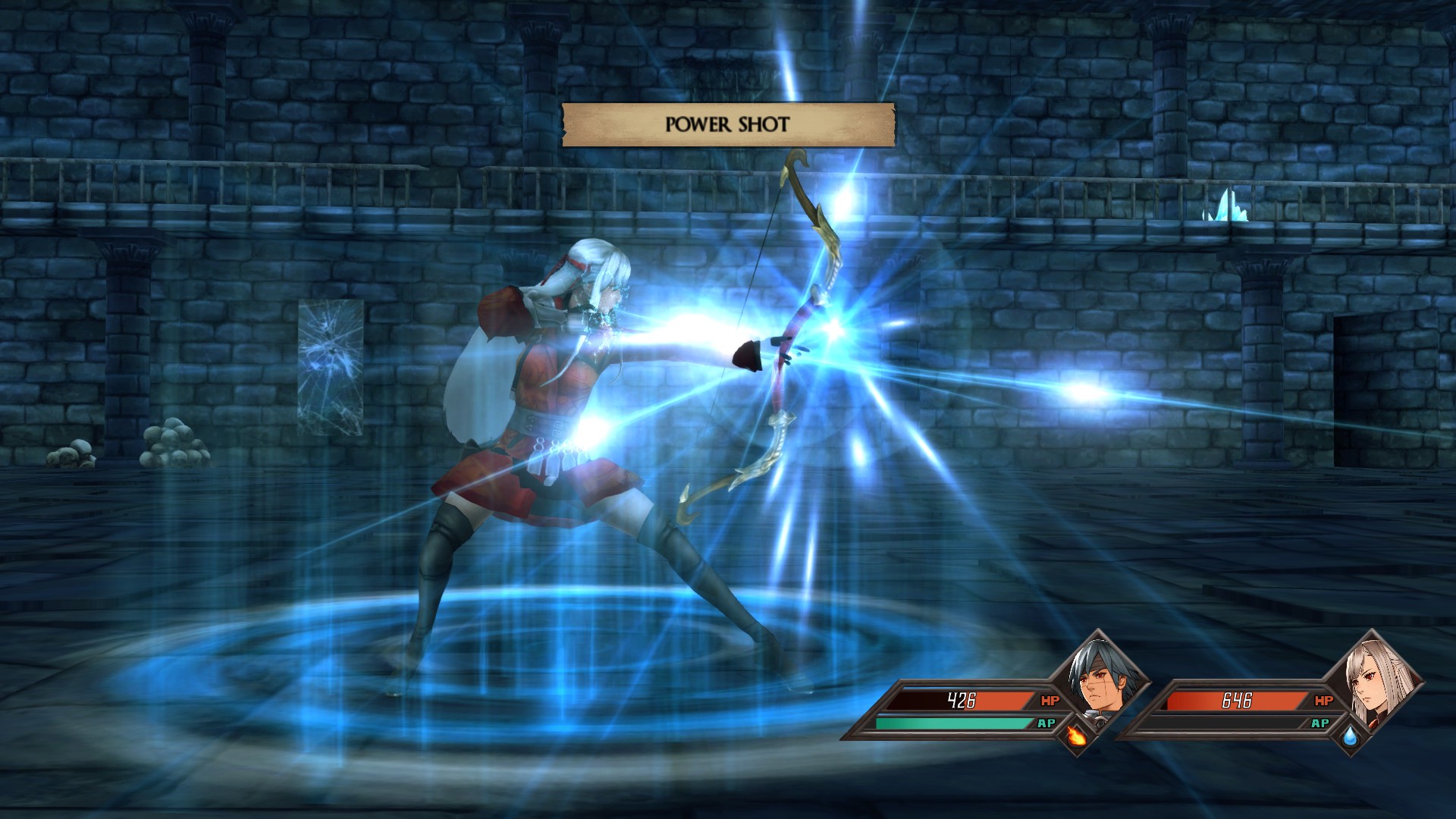
As players begin their journey, the combat system makes itself present in the form of helpful tutorials. Immediately taking a familiar plunge into the traditional turn-based strategy of similar RPG titles, Legrand Legacy does offer a few different aspects to the battle sequences. No time constraints or MP gauges to worry about within the battle, players are free to choose either offensive or defensive abilities with each turn. Unlike other popular turn-based titles where characters perform their attacks in a set order, Legacy has players performing their attacks throughout one turn, followed abruptly by their enemies. This gives a unique twist on battles, forcing players to think ahead about the consequences of each of the party members actions.
Performing physical melee attacks is the go-to method of dealing a great deal of damage, but this only strikes enemies in the front row of the battle layout. The second, or back row may only be struck with range weapons, but they offer considerably less damage. Once all characters or enemies have been eliminated in the front, the monsters in the back row move forward, allowing a more versatile attack range. Upon selecting your desired attacks with all party members, a series of rather simple QTEs – or quick time events – is thrown at the player in rapid succession. Landing these quick face button combos determines the overall power and accuracy of the ability, providing a bit more than the luck found in other turn-based RPGs.
Arcana is the powerful ability used only when players fill up their AP meters in the midst of battle.
Grow And Utilize The Strength Of Arcana
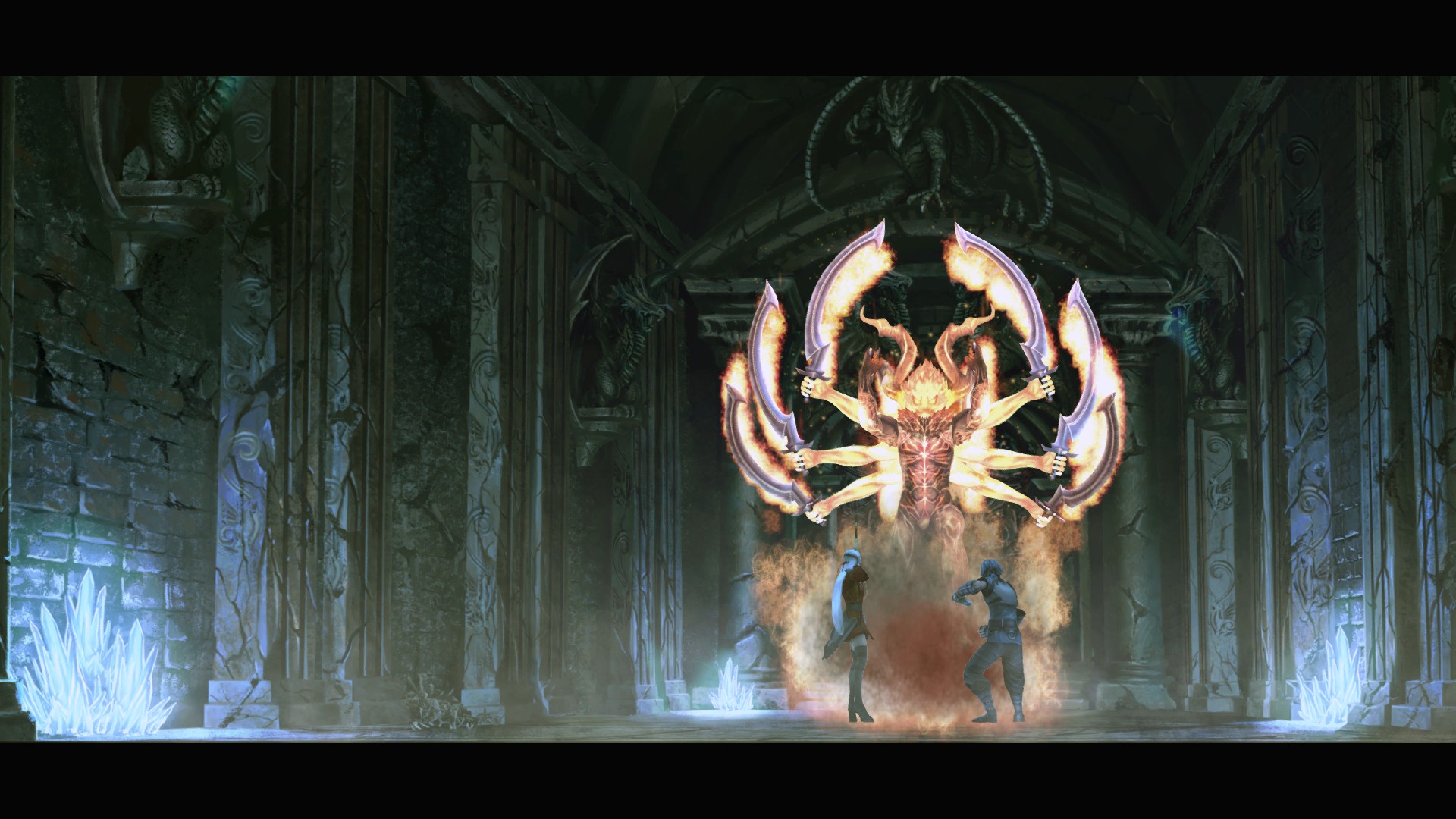
While in combat, players will begin to fill up their AP meter. Once full, the AP meter is capable of dealing a massive amount of damage to all foes on the battleground known as Arcana, which acts as an excellent tactic to easily turn the tables in battle. Along with the unique AP abilities, other skills become available with every character throughout Finn’s journey. As the story deepens with shifting plotlines pointing towards the inevitable destruction of the world, the power within Finn, and his companions, grows with every level gained through experience points.
Increasing your stats aids you in battle the further you dive into Legrand and becomes the bridge between survival and death across your journey. While new abilities become available the stronger specific stats become, sharpening your party’s overall vitality, strength, or even luck attributes are as prominent as ever. Taking on the tougher enemies found later in the game prove to be worthwhile contenders, putting everything you’ve learned about the unique combat system into play.
From small, weaker foes to massive monsters with devastating attacks, everything awaits within the world of Legrand.
Purely Riveting
Throughout the promising story that oozes with memorable fantasy settings, tons of gripping character dialogue, engaging and fulfilling battles with the freedom to strengthen your party at will, all tied together in a tightly-wound RPG package, Legrand Legacy is an impeccable way to ring in a new year of indie titles. Though never really pushing any boundaries within the realm of RPG titles, Legrand Legacy is an excellent representation of how simple RPG mechanics can still provide a deep and riveting experience.
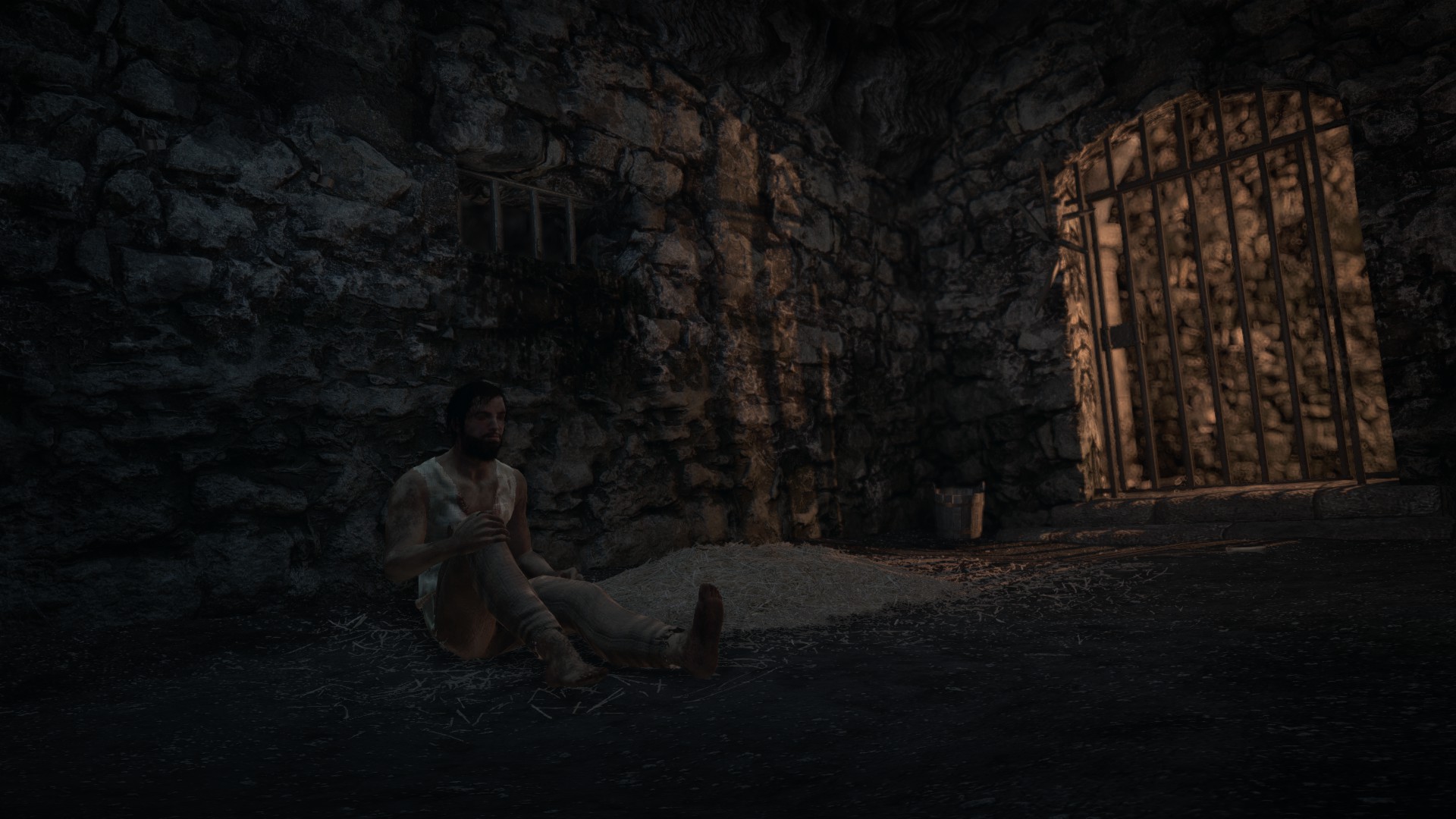
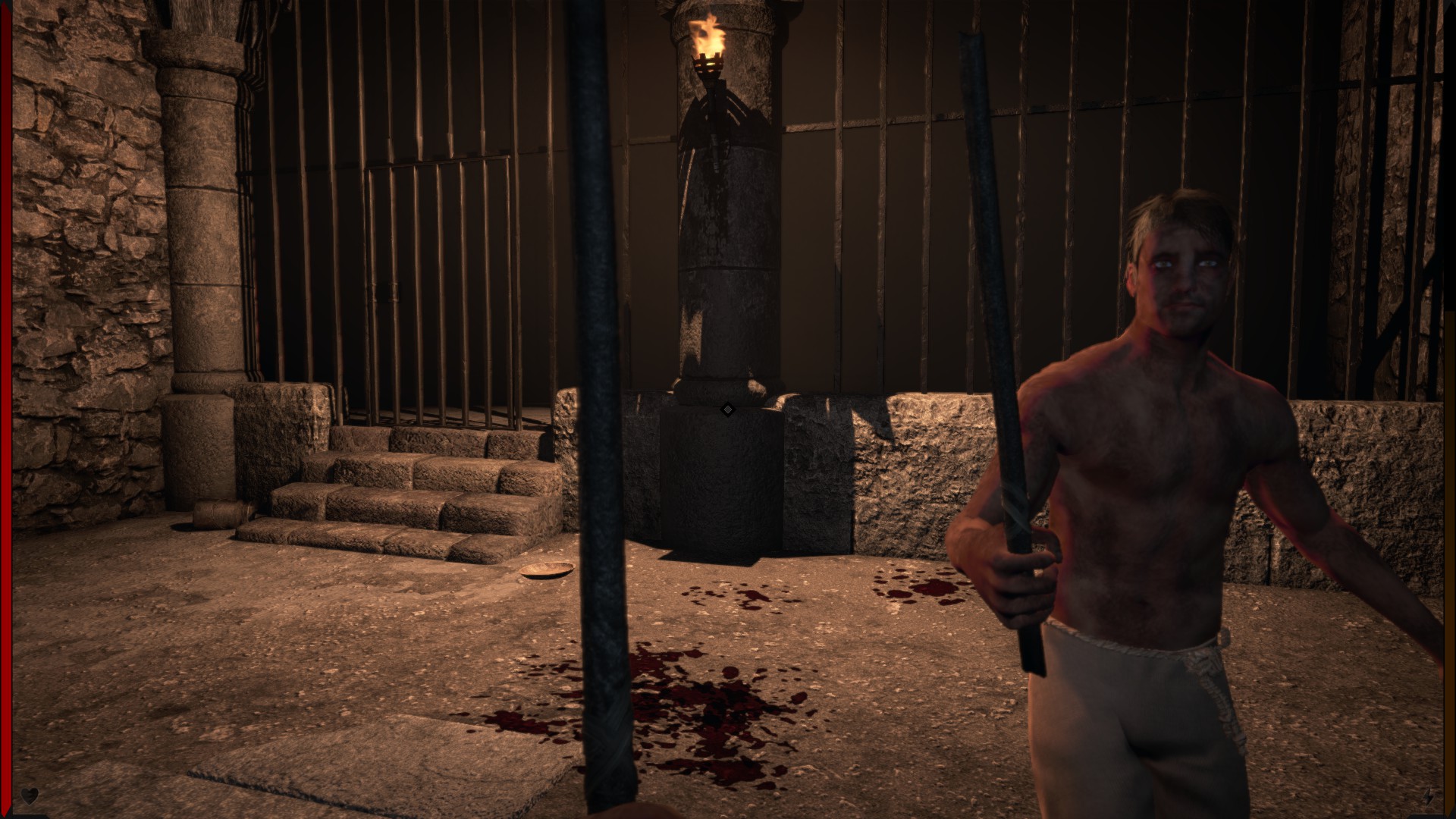
Time and time again I slayed and filleted the unknowing guards as I attempted to escape from my dirty confines in Elium: Prison Escape. The small one man indie developer – Lone Artisan Games – has put together an extremely strategic stealth combat experience. While considerably unpolished in many aspects of the game, once you battle your way through the initial trials of adapting to the control scheme, making your way through the procedural prison dungeon becomes a touch more thrilling.
After the simple and rather short tutorial which takes you through the basic movements and attacks, players may begin to embark their escape out of the medieval prison. With a four-direction attack range using a variety of different melee weapons – mostly swords and axes – players may also equip shields in their other hands. While the standard weapons are the most efficient methods of disposing enemy guards, it’s how players use the other aspects of the game to escape that’s important.
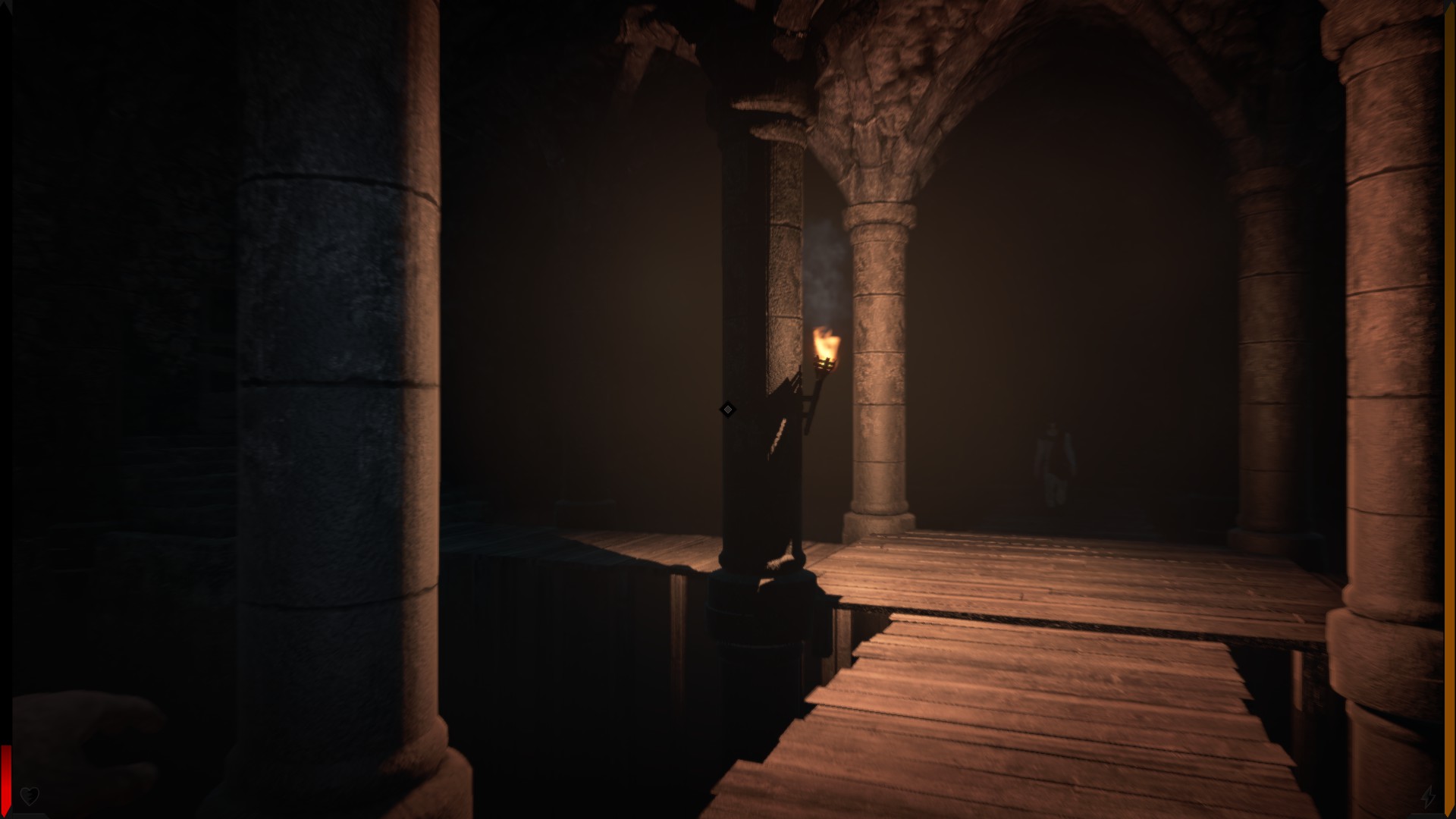
The tutorial shows players the gist of how the mechanics work in Elium. Interacting with items and doors, singing your fists or weapon, picking up objects and throwing them, or utilizing the stealth aspect are all viable techniques for safely finding a way out of the grim dungeon. Shadows are ever-so important in staying out of sight, so the brightly lit rooms that you’ll frequently pass will need to be dealt with in a shrouded manner. One easy method is finding a bag of ash to dispense on the lights, further covering the area in darkness for safe passage.
In Training Mode players will be able to hone their combat skills utilizing the strategic melee mechanics.
Elium: Prison Escape – Stick To The Shadows
Through the many shadows lurks patrolling guards ready to stick you the moment you’re discovered. Though busted out of prison by an unknown prisoner, you’re quickly abandoned and left alone to fend for yourself. However, as you make your escape through the procedurally generated dungeon, fellow prisoners may be found along the way and are able to help you in battle. These companions are helpful as the combat can be rather difficult, but not in terms of their AI skill sets, which are rather clunky and unresponsive. Setup as a mouse and keyboard only combat title, players not up to par with traditional PC gaming controls might want to hone their skills first.
The randomizing rooms concept is an excellent way to get to the point of what seems like an endless journey to escape prison. Upon death, players must start whichever level they died on from the beginning. The procedural process makes starting over much less painless, as players avoid trying the same path and discovering the same secrets in a repetitive pattern. While this particular form of gameplay offers better depth than most survival combat titles, there’s not much else to Elium.
Elium provides a unique randomized experience with procedurally generated levels upon every restart.
Players are also able to dabble a bit in changing their equipment and other item inventory options. Though, my time with Elium revealed problems with the inventory system – more than anything else in the game. Searching through chests and downed guards provides similar inventory swapping from beloved RPG titles, *but too often did guard armor, boots or belts turn directly into a prisoner shirt, netting me around half a dozen useless shirts after only a couple of kills. While weapons and other items typically didn’t fall under this error, the cost of negating protective equipment makes staying alive more difficult; but only if you’re looking to mercilessly slash your way through the campaign.
*Edit: This bug has since been patched by the developer.
Escaping The Bugs
Elium: Prison Escape is a straightforward combat experience with a big helping of stealth. With almost no story, the first person dungeon crawler is purely for those looking to engage themselves in a tactical sword fighting title as they lurk through the shadows. Each level is filled with more procedurally generated rooms throwing constant surprises for the first few hours of gameplay, but soon after it begins to feel a bit stale and is often frustrating. Glitches will also appear and frequently cause players to start the level over in hopes of negating the problematic errors.
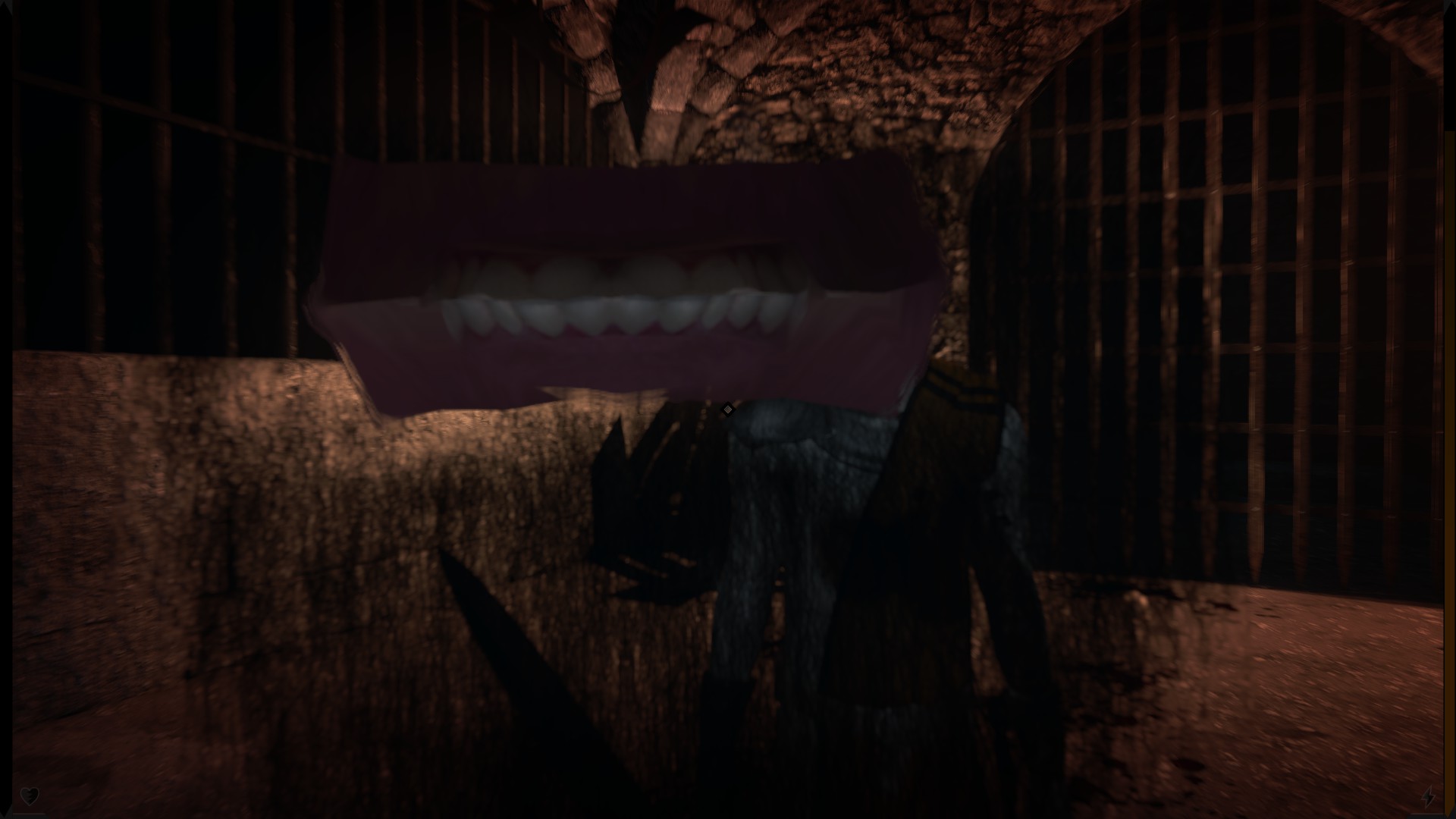
Though the gameplay can be challenging in a good way, some bugs will have players’ eyes appearing behind their teeth.
While the thrill of finding your escape route provides an initial exciting experience set in a gloomy medieval dungeon, Elium falls short as nothing more than a set of linear challenges. Though the randomizing levels add a certain sense of depth to the game and the combat can be a joy for tactical sword-swinging players, there’s still a fair share of bugs and tedious gameplay to work around.
Elium: Prison Escape isn’t a game-changer for the stealth action genre then, but it still manages to capture a dark and challenging experience that’s capable of entertaining at a mostly satisfying level.
Ladies and gentlemen, here we are. Each ending requires collecting the loose threads.
We have experienced the quandaries of teenage life with Chloe and Rachel, and now the time has come to end an amazing journey. Before you continue reading, I should mention that this review probably contains some spoilers, because I feel it would be difficult to express my opinions to the fullest without mentioning some important factors in the game. However, I will try and keep the spoilers to a minimum. Also, this will be a longer review, as I will comment on the final episode, as well as the entire season as a whole. Are you ready?
Life Is Strange: Before The Storm Review
The third and final episode, titled “Hell is Empty,” picks right up where it left off in the previous episode “Brave New World”, where we learn that the wife of Rachel’s father is not, in fact, her real mother. As my jaw dropped, the episode ended, so I was more than eager to continue on the final episode. The story of Rachel’s mother is long, dark, and sad – but in short, she got involved with drugs, and continually making bad decisions in life evidently leads to her losing custody over Rachel. Bad parenting is a reoccurring factor in the Life Is Strange-series, and their choices as parents clearly reflect the choices of the teenagers. Chloe and Rachel’s parents have made some bad choices in life, and making amends might be harder than one might think. We get to see several sides of the story as we learn about Rachel’s rough past.
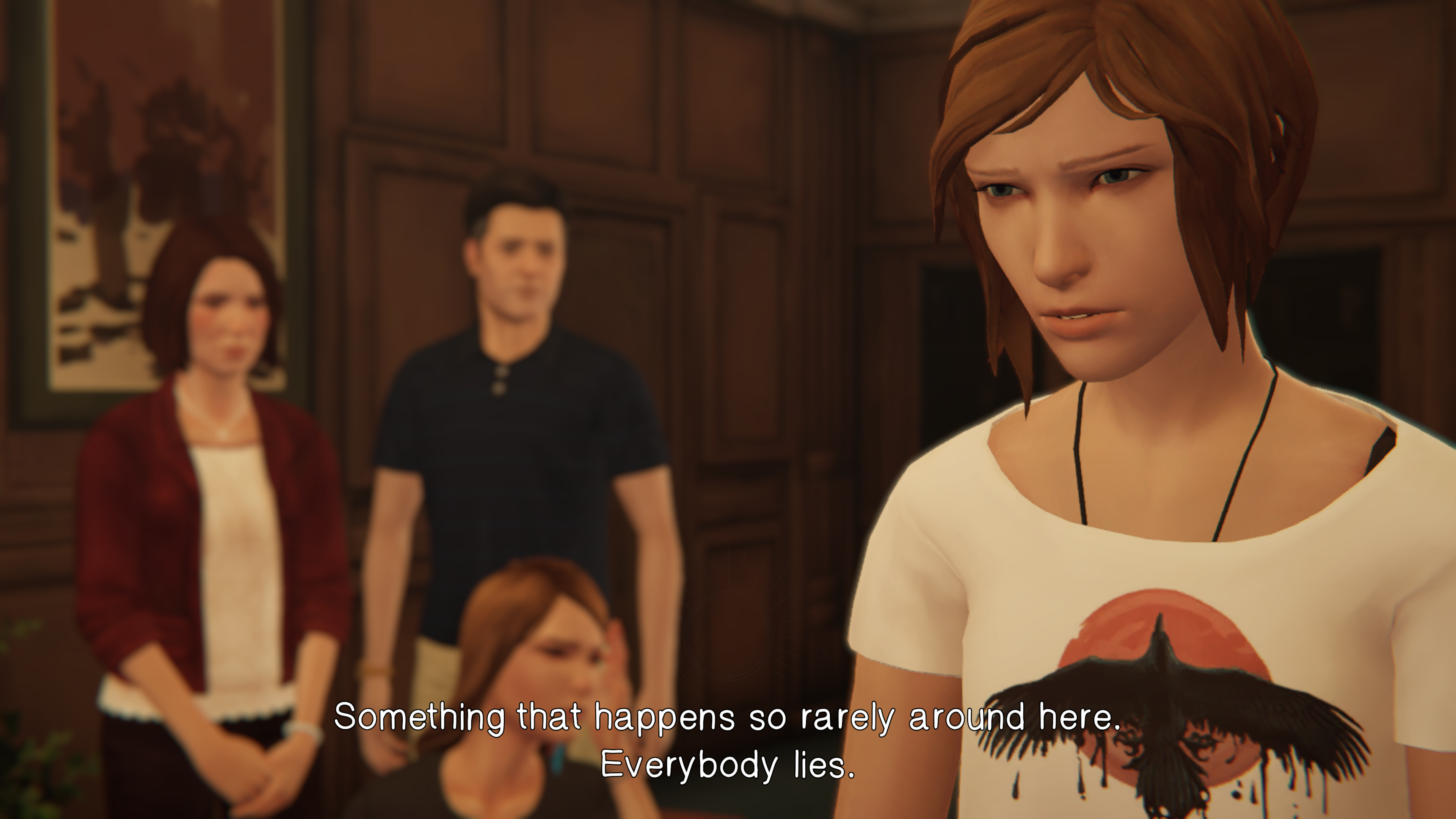
Sometimes you have to lie in order to protect someone you love.
The episode starts out in confusion, sadness and anger. As a consequence of the reveal of her biological mother, Rachel becomes obsessed with the idea of meeting her. After playing detective, Chloe finds out that this is not necessarily a good idea… But because she is a good (girl)friend, she wants to support Rachel in her decisions; whether they are good or bad. At the end of the road, you are faced with a solid dilemma, where you have to decide what is best for Rachel, and how you can do your best to protect her. The “power” that Chloe has – using words to persuade others in her favor – becomes even more important in this episode, as the outcome of these “verbal battles” decide whether we have to take the easy or the hard way to achieve what we want. Talking about things that one might go great lengths to avoid, is also an important aspect of this universe. Perhaps we might learn a thing or two from Chloe?
I’ve come to learn that when life gets hard for other people, you can count on Chloe to be there for you. Chloe is many things, but she is a damn good friend. Yet sometimes, a good friend can be taken advantage of. Slowly but surely, the player is made aware of all the things Chloe keeps doing for Rachel, without receiving anything in return. As such, the relationship between Chloe and Rachel is, in my opinion, highly romanticized. It doesn’t feel 100% believable, but it is nevertheless a beautiful and strong relationship that I guess everyone would aspire to have. The worst part of it is that it breaks my heart to see them now because I know how the relationship – unwillingly – comes to an end. The beauty of friendship and love seeps through the cracks of the dull and dismal surface, making the hard stuff a little easier to deal with, which I can appreciate. It doesn’t make the issues too heavy, just heavy enough to make the right amount of impact on the player.
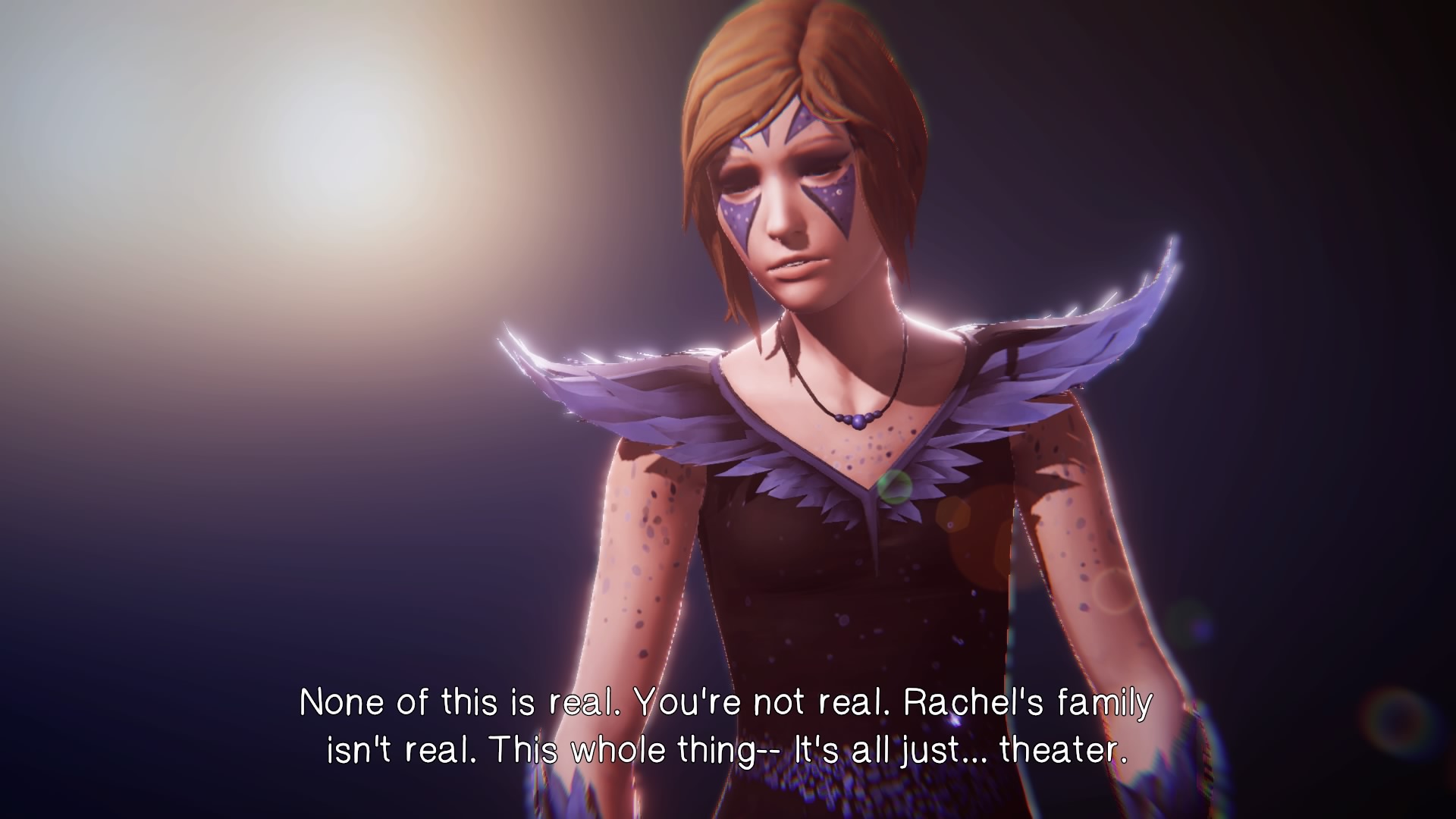
“Is this the real life? Is this just fantasy? Caught in a landslide, no escape from reality…”
Doing and dealing drugs are some of the issues that our teenagers encounter – which often include violence, and this time around is unfortunately no exception. However, as the drama escalates quickly in this episode, we can always rely on a whole new round of Dungeons & Dragons as a nice change of pace. This sequence is even longer now than it was in the first episode, but you’re not going to see me complain about it. This scene made Chloe forget all the grief, despair, and anger that she was going through, if only just for a few moments. And realizing that she had more friends than she thought might have given her the shove she needed.
And one simply cannot make A Life Is Strange review without commenting on the soundtrack. For this season, the developers chose to cooperate with the London trio neo-folk band Daughter to compose the music for this season. They even released an individual album with the songs on their Spotify. The sound of the music has a lot of character that blends beautifully in with the theme of the game, and I have found myself coming back to it repeatedly – the band truly did a great job with the soundtrack, so kudos to them. And if you have only played the first season of Life Is Strange, and you, for some reason, find yourself reading this review, I can promise you that the music aspect of the game will not disappoint you.
Even though this journey is a fulfilling one, I cannot help but feel a little disappointed. The game decided to give me a happy-ever-after ending, which I feel was unsatisfactory. Rachel’s fate is far from happy, and I think that the ending of this episode should have reflected that more than it did. I do sometimes enjoy when games give us the opportunity to create theories about what happens, but “Hell Is Empty” rather gave us too much to be interpreted.
The game left a gap storywise between the end of season 2 and season 1, whereas I hoped that the gap would be much smaller. When does Rachel meet the teacher that will inevitably murder her? What happens between Chloe and Rachel in between these events? All we know is what we learn from the first game, which is just bits and pieces told from a broken Chloe. Even though if you wait until after the credits have rolled, you do get to see a disturbing nod towards Rachel’s terrible fate. I just think it wasn’t enough. The second episode was by far the best one, because it had a fantastic build-up, with an amazing plot twist at the end. This was a fairly short episode of approximately 2-3 hours, whereas the previous episode was about 4 hours long.
I also found it interesting that the first half of the series is more about Chloe, but then the spotlight shifts to Rachel. All in all, I love this series, and if you are a fan of narrative-heavy games, I will highly recommend that you play this game. Just remember to play the other one, too.
When reading about indie games it used to be that the bar was set a little bit lower for the small teams that made them. We used to be more forgiving if a title didn’t have quite the sheen that you’d see out of an ‘AAA’ studio. I mean, what do you expect when you’ve only got a team of 5 people working on a game?
Iconoclasts Review
This isn’t the case anymore. Nowadays smaller teams are measured on the same scale as anyone else. Still, it’s hard not to be impressed by Iconoclasts’ development story. This is because Iconoclasts is a smart, challenging and gorgeous ‘puzzle-action platformer’ that was made by one person. The music, the programming, the writing and the visuals – everything.
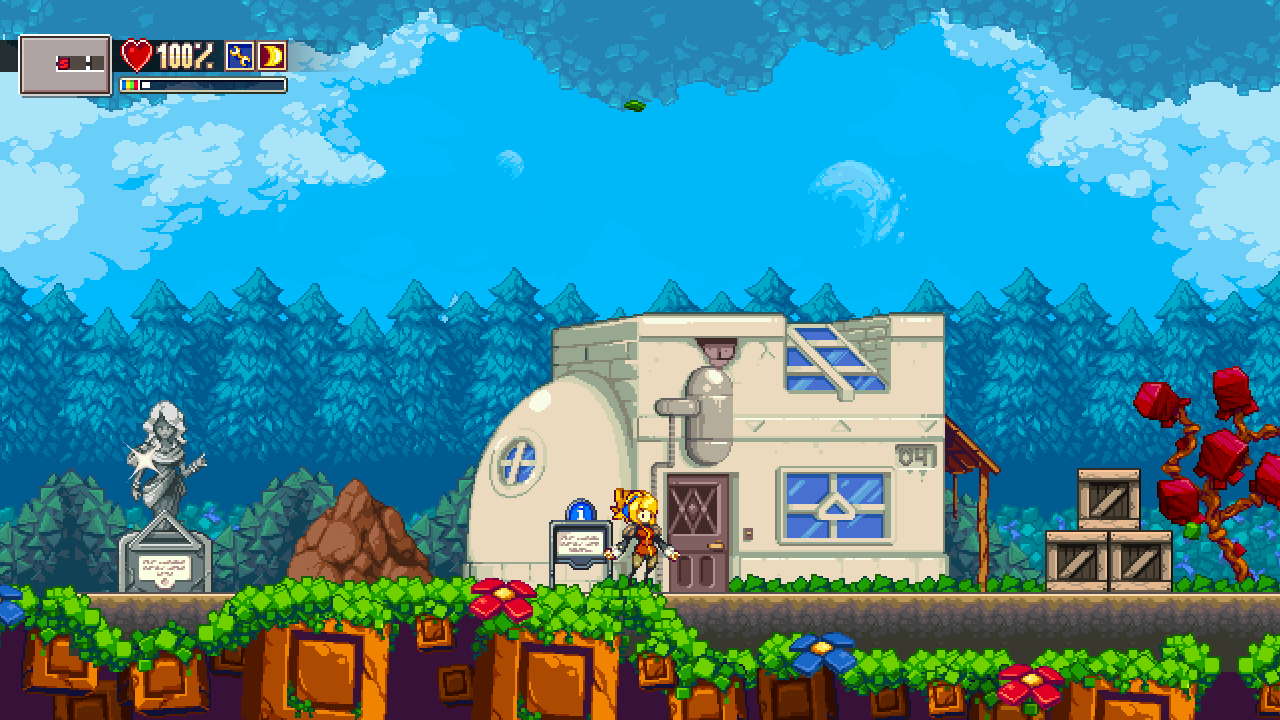
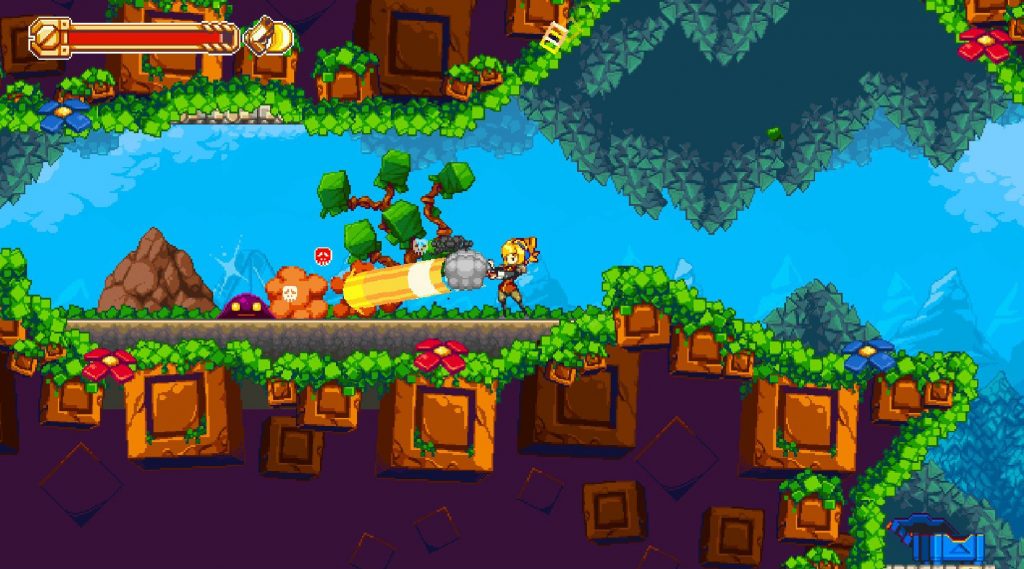
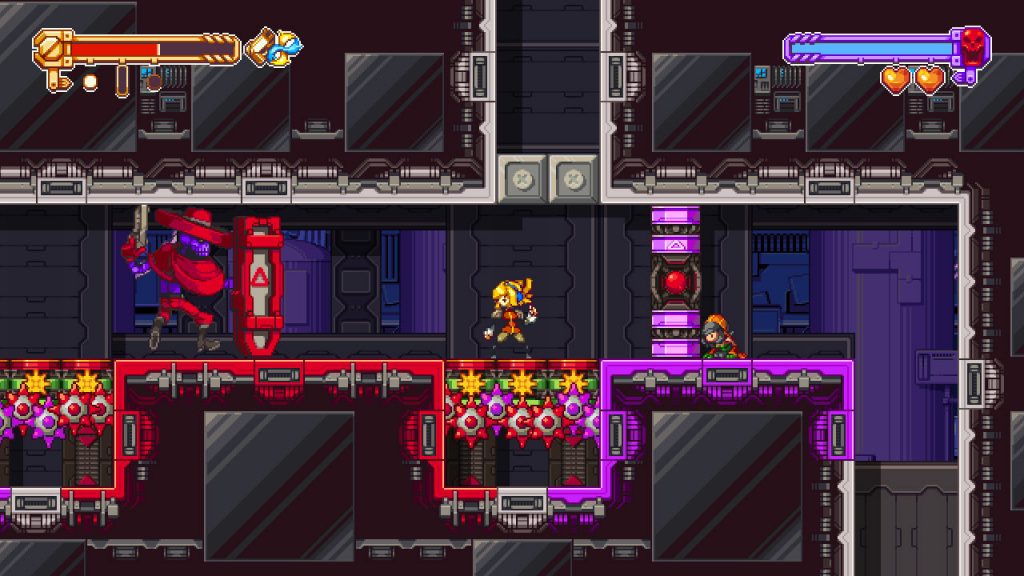
So maybe you’ve read the term ‘action-puzzle platformer’ before or maybe it’s a new term I’ve just made up. Who’s to say? In simple terms, Iconoclasts has you playing as Robin, who’s a mechanic with a spanner and a stun gun. This means you jump from platform to platform, using your wrench to fix things, move platforms around and solve puzzles. You’ll also use your stun gun to shoot at the numerous nasties that litter the levels too.
Yes, I could have said ‘this is a game similar to Metroid’ but that would be lazy of me, wouldn’t it? Also, whilst there is some backtracking to do, as you upgrade your moves, your wrench and your gun, there’s not as much as you’d find in a Metroid game.
The puzzles and platforming challenges are well-designed and leave you feeling clever rather than frustrated. The puzzle elements are smartly paced and placed. You’ll rarely encounter something that you ‘need to come back to’ and it’s often fairly clear what you need to do, with the challenge coming from figuring out how to do it. Some of the puzzles require a little too much controller dexterity, as you’ll need to be fairly quick on your feet to do what needs to be done.
What will also require some dexterous button pressing is the fighting and, particularly, the boss battles. Much like the puzzles, most of these are great and ask you to put into practice the skills that you’ve already honed throughout the last area you’ve just spent time in. Sadly, two or three aren’t that fun and introduce unique gameplay elements that don’t appear anywhere else in the game. One boss has you switching characters, which would be fun if you knew how the character controlled. Sadly, the first time you play as this new character and get to try out her entirely bespoke control scheme is during the middle of a hectic boss fight.
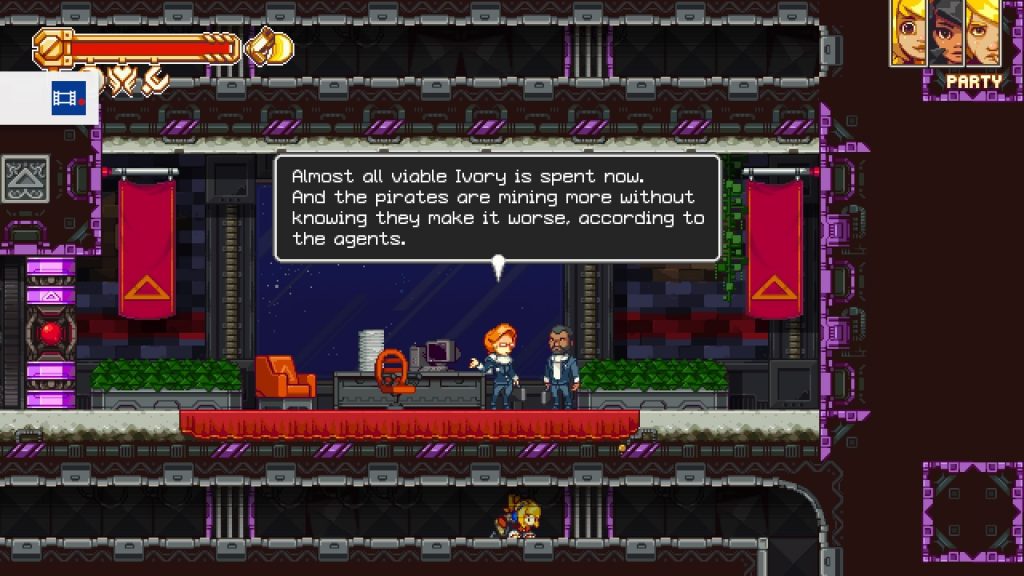
Another element that doesn’t always work is the story. I think the fact that I’m even going to talk about the story in a game of this type is pretty astounding, but Iconoclasts has a story that is worth talking about, is better developed than most ‘narrative-driven’ games and will engage mostly everyone.
I don’t want to give away any spoilers but it’s safe to say that Iconoclasts has a story that is full of character and covers some heavy topics. It’s a story about religion, challenging authority of any type and it wants you to question the things you’ve been told by your teachers, preachers and parents. It has a heavily atheist tone, which people that have strong religious beliefs may find off-putting, but it’s brave to see what looks like a simple platformer contain such a fleshed out story, setting and cast.
It’s not perfect though. Some of the dialogue goes into ‘anime’ territory for me. There are some overbearing monologues delivered throughout the game and there is a new vocabulary to learn along the way. You’ll have to pay attention and piece together just what the game is talking about when it drops in some of its unique jargon. Personally, I found it worth the effort as Iconoclasts delivered a tale that was much more dramatic and darker than its bright and breezy visuals would suggest.
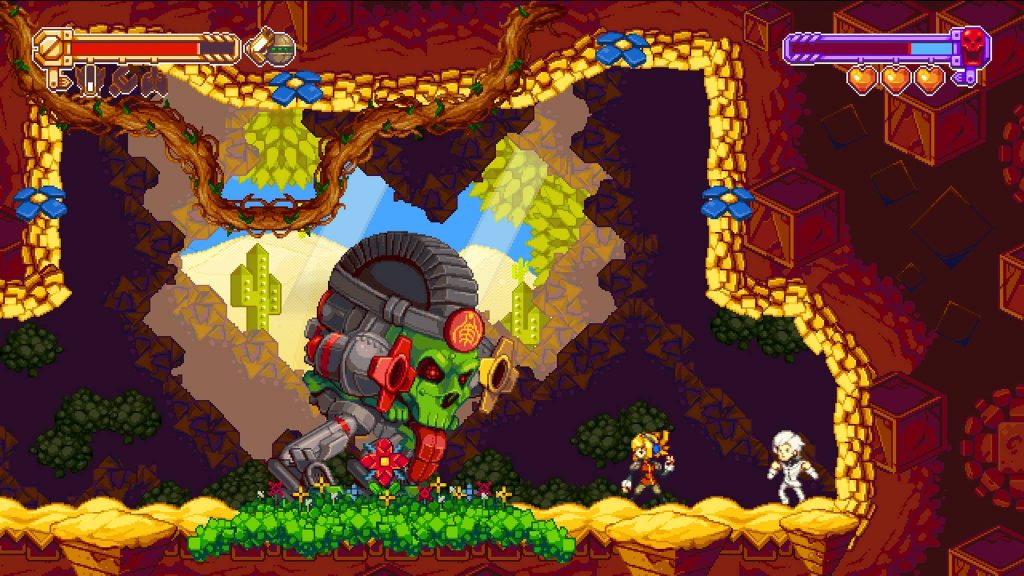
Speaking of which, it’s time I address the well-drawn elephant in the room. Yes – Iconoclasts has some beautiful pixel art.
Everything you get to see throughout the game is brilliantly animated and I can think of no higher praise than to say that quality of the art reminds me of Metal Slug. Enemies bounce, sway and have a real kinetic energy to them that means you can’t keep your eyes off the screen. I may have mentioned how the varied locations are great because they’re well-designed areas to puzzle and platform through, but they’re also really nice to look at and visually varied.
What’s also incredibly wide-ranging is the music. From cheery upbeat numbers to dourer ambient pieces, it’s really impressive to think this was done by one person. Sure, it took this one person 8 years, but you can see where the time has gone and that none of it was wasted!
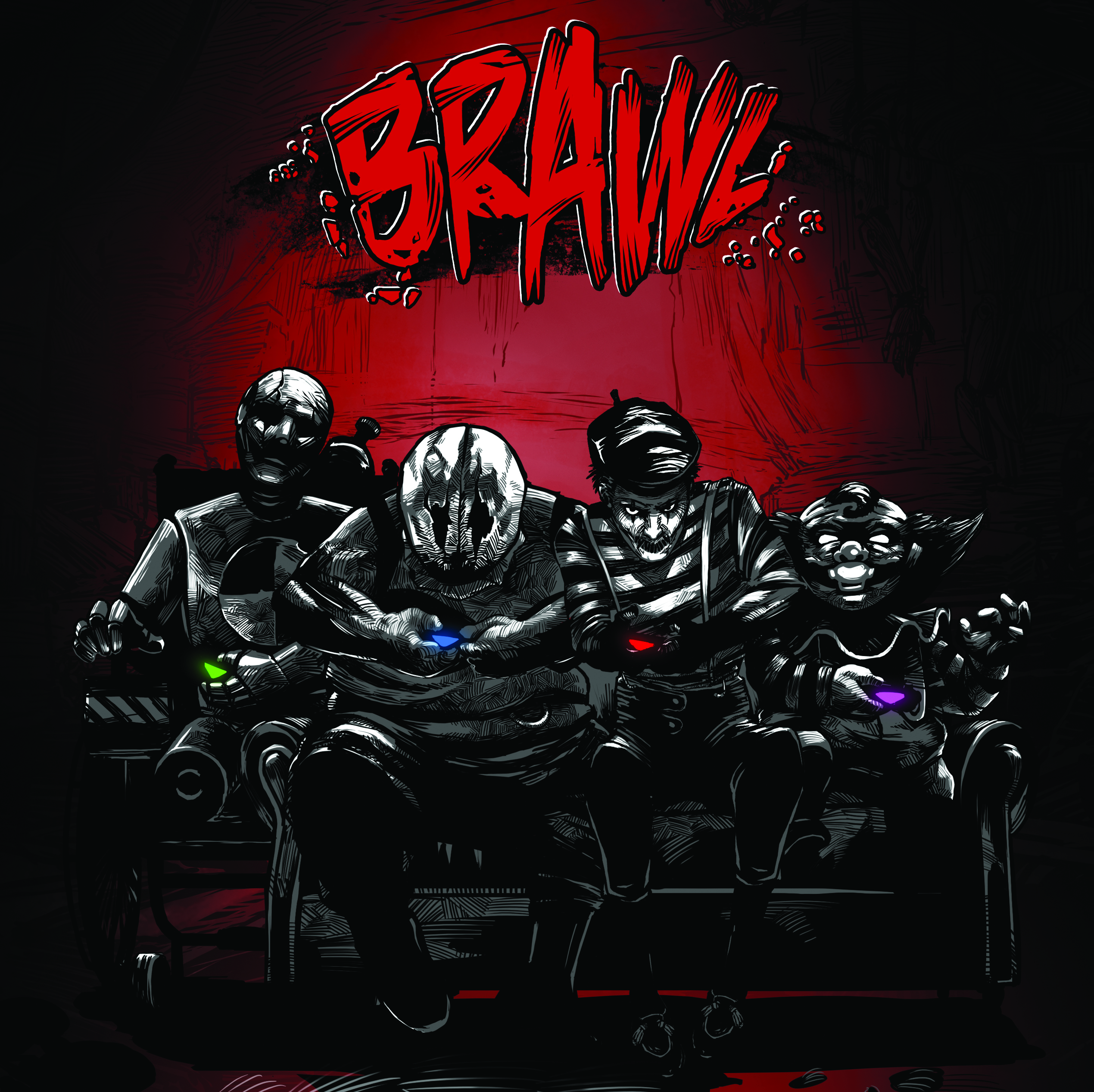
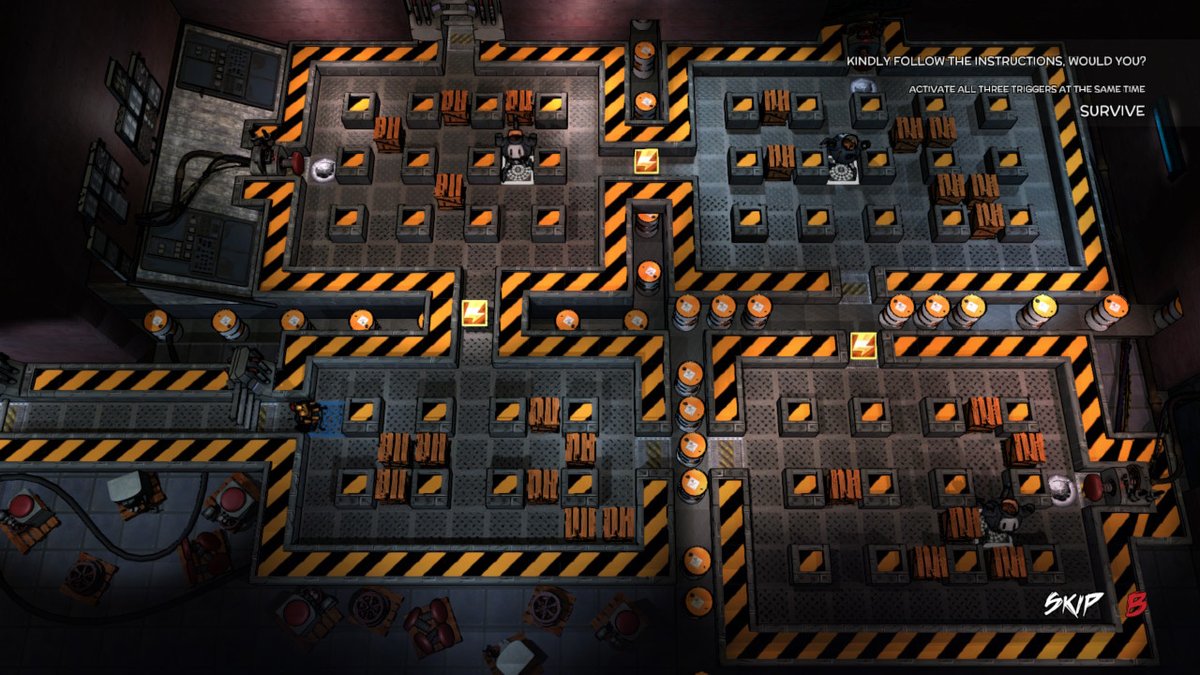
The bomb-planting, puzzle-solving action vaguely reminiscent of the iconic Bomberman series has found a new home in a dark and disturbing setting that surrounds the new Switch port – Brawl. Taking on the role of one of the gritty “heroes” like the dismembered test dummy or sad psycho clown, players find themselves amidst a deadly Emporium booby-trapped by the eerie narrator slowly guiding players to their doom. That’s, of course, only if they don’t manage to escape the grim deathtrap first.
By choosing one of the eight playable characters, players may then embark on the game’s main story campaign, which acts as the single-player portion of the game. Each level throws a handful of arenas at the character, each tossing in more obstacles and enemies to add to the difficulty. To nullify and/or defeat these enemies lies in your ability to plant bombs, as well as perform other useful special skills and abilities which are unique to each character.
The arenas act like big mazes filled with both breakable objects like boxes, and immovable walls. All of the characters have the ability to place bombs to break through boxes and defeat enemies, but it’s what they can do with these bombs that makes them unique. Freezing them in place to stop their detonation timer, or sneezing a bomb clear across the area are a few examples of the special abilities held by each character. These special skills are limited in use unlike planting bombs, so players must use caution when relying on them. Along with the bomb countdown timer, players may also detonate bombs manually for more trivial challenges later in the game.
A Precise Bombing Affair
As you make your way through the levels, more and more enemies begin to appear, making the timing and precision increasingly important. To help with the difficulty curve, upgrades also appear when busting up the right boxes, or triggering the correct switches. Various upgrades include increasing your blast radius, adding more health or upping the amount of special ability uses you have. Finding the bomb power-ups gives you the ability to plant bombs, but the more you find and add to your inventory, the more you can place down at one time. Bombs come in unlimited quantities once you’ve picked up a bomb icon, but until power-ups are found only one can be placed at a time.
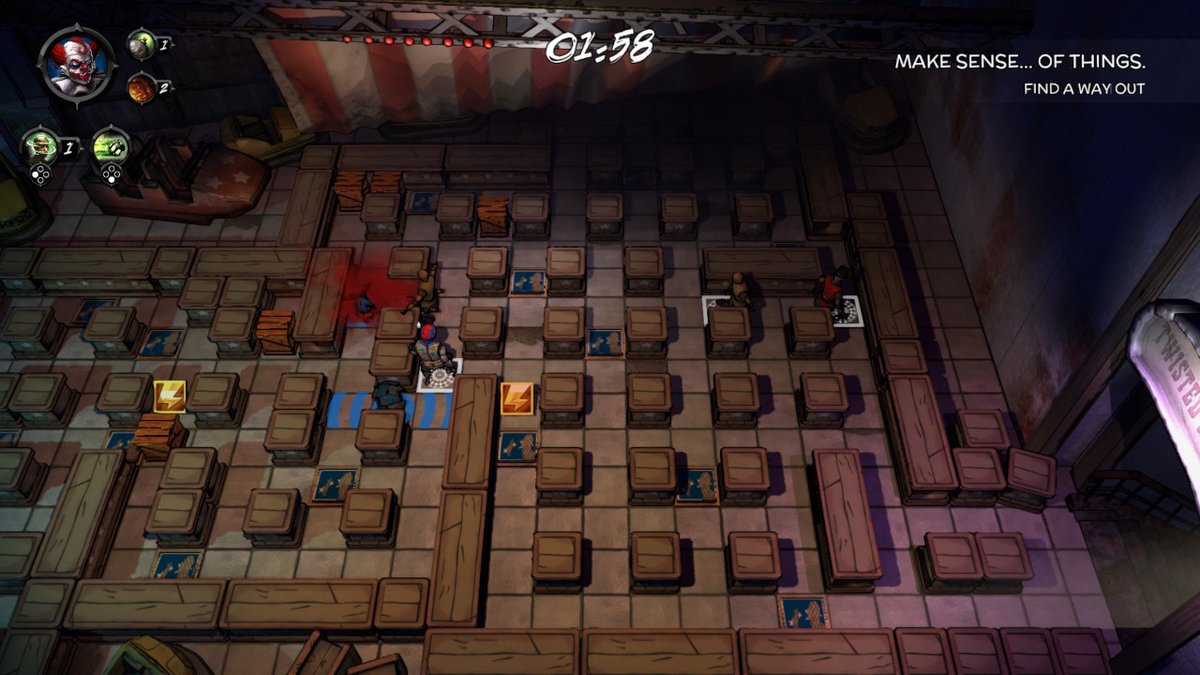
Maps are filled with plenty of deathtraps, barriers and most importantly, power-ups and abilities.
When finding health packs wyour health is already full, players may also add up to two more extra lives, and the use of a powerful ability, like causing a massive explosion surrounding a large area around your character. These are primarily useful when engaging in arenas with tricky enemy movements and plenty of breakable boxes stand in your way. Trying to use the standard bomb attack to wipe out enemy forces can become quite tricky in the later levels, which is exactly where the various power-ups and abilities come into play perfectly.
Taking players through the story mode shows off the dark and eerie visuals presented in Brawl. Like a combination of Saw and Bomberman, players will be taunted by the narrator in Brawl, leading them ever-further into the maniacal maze of deathtraps and hordes of enemies. The sinister stills that act as cutscenes in between levels show more of the character’s distraught backstory as they venture closer to freedom outside of the gruesomely haunting Emporium.
Each set of levels are different and are based on the 8 playable characters in Brawl’s story mode.
Bomb-arded With Competitive Modes
The play style of Brawl is unique when compared to the sparse ‘bomber’ style puzzle genre. Each of the eight characters not only has their own special skill and ability but a different set of levels for each as well. The story mode alone is packed with content, dozens of levels across all eight unlockable characters. On top of the main campaign is the co-op, competitive and practice modes.
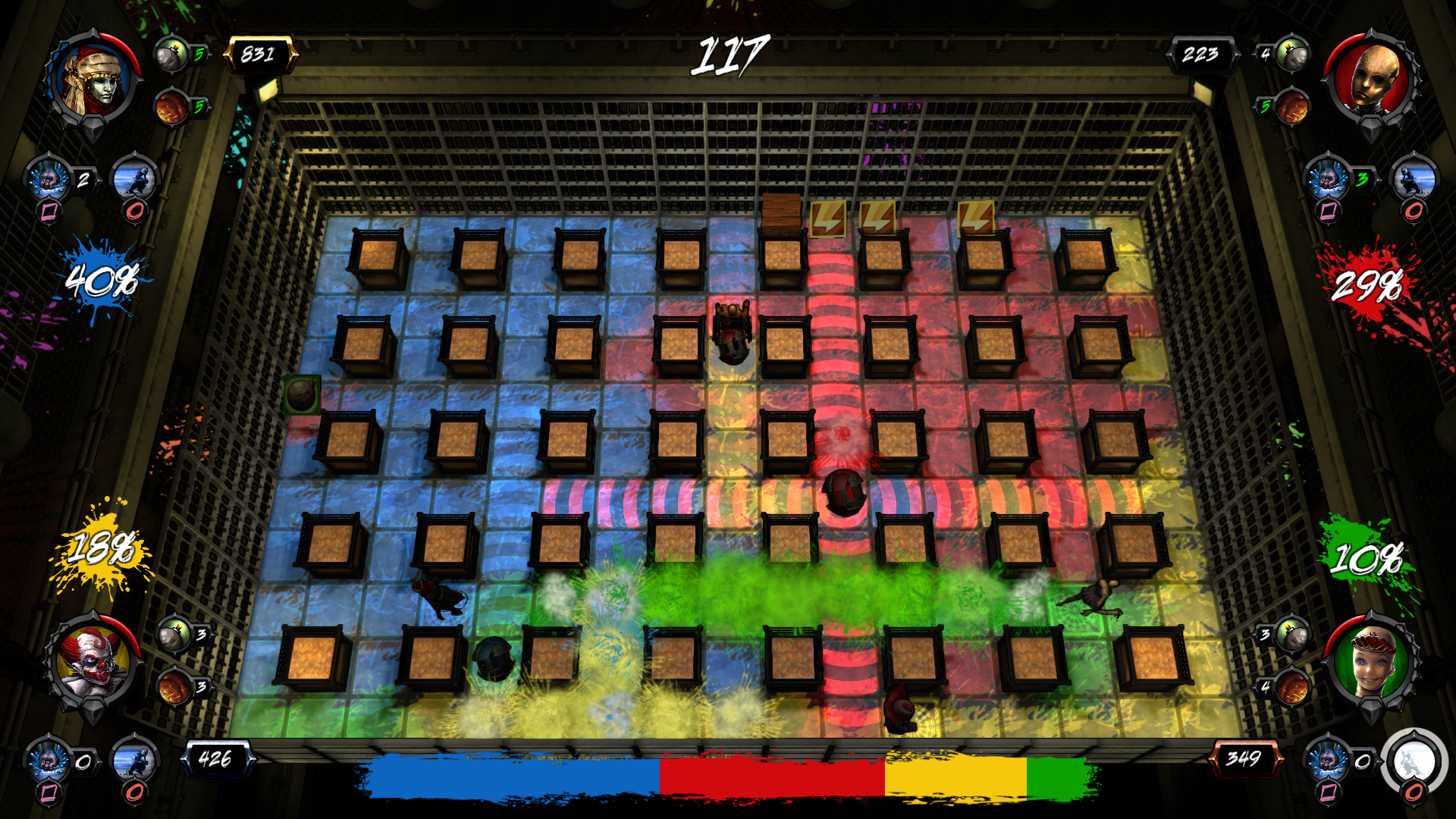
Multiplayer is filled with even more bomb planting challenges, including 4-player deathmatches, survival mode which pits players against non-stop waves of enemies, two-player duels, Sumo which has players attempting to knock one-another out of each arena, and the unique Color Domination, which involves splashing colored paint across the board against up to three other players. While the single-player content is crammed with inventive level designs and power-ups, these multiplayer modes really create a party style atmosphere in Brawl, something that moulds perfectly with the Switch console.
Color Domination has players facing off against one another attempting to blast the most paint color across the arena.
Though Bloober Team‘s Brawl brings a familiar style of puzzling challenges to the table, there’s plenty of unique assets that separate it from the rest. While newcomers to the genre may find themselves trapped and killing themselves more than they’d care for, the ability to adapt and conform to the game’s complex and strategic approach to bomb-planting, puzzle-solving carnage comes naturally through the game’s in-game progression across the story. An excellent pick up for all those co-op party doers, this doom and gloom bomber is a simple, yet tactful addition to the Switch’s indie game library.
When you think about sequels you almost expect things to get better. You think things will be bigger, better or more refined over the last outing to keep things a little fresh to maintain your interest. So when 10tons declared Baseball Riot as a direct successor to Tennis in the Face, you can’t help but expect things to be a little different, a betterment over the previous game. But what I think has happened here, is that 10tons have fallen foul of ‘Ubisoft Syndrome’. Baseball Riot is said to be a successor, but it’s more of the same just set in a different location. Much like the Assassin’s Creed titles used to be…
Baseball Riot Review
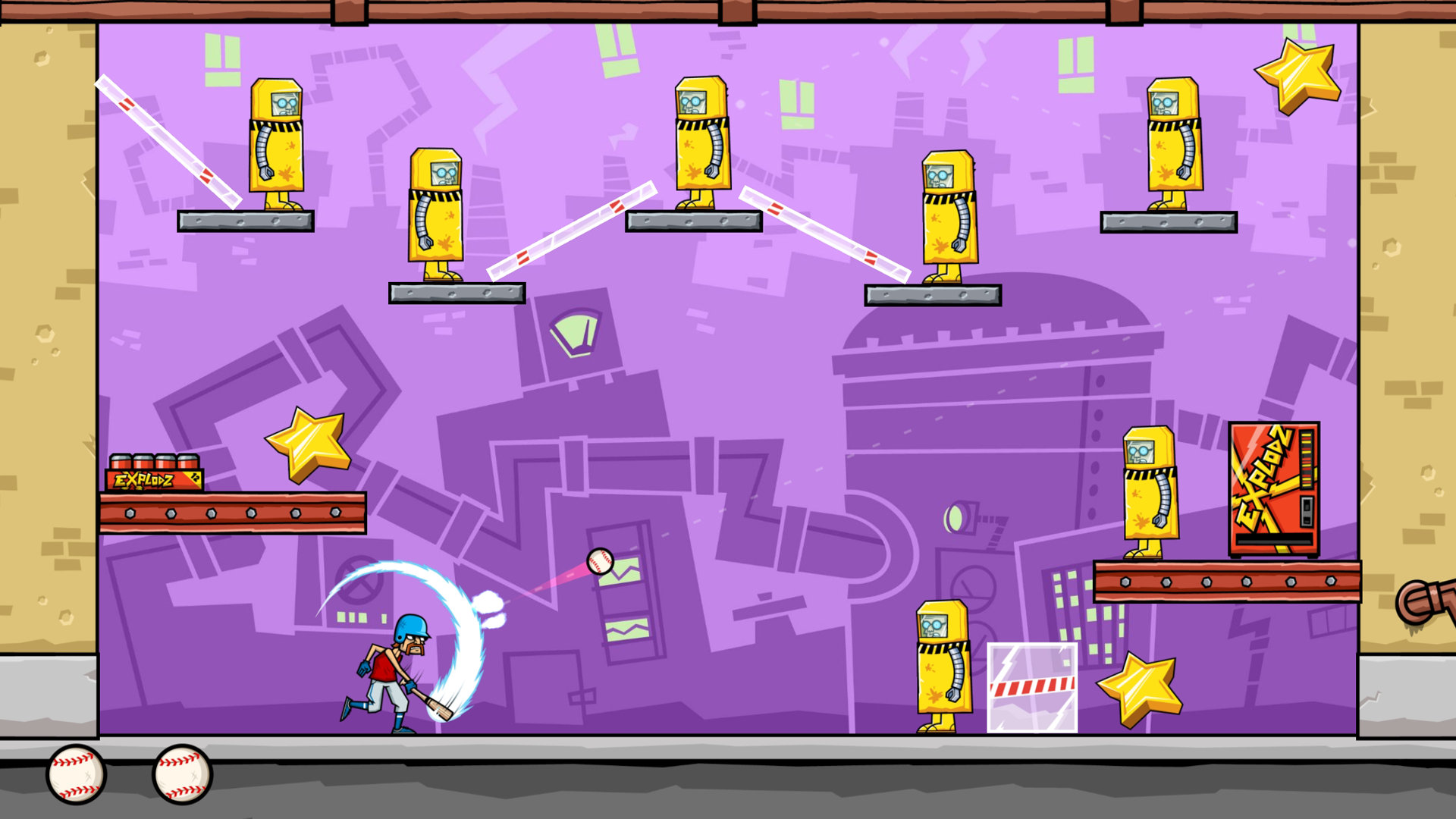
What Baseball Riot does is take a simple yet effective mechanic from Tennis in the Face, and plonk that into a different environment and change the sport ever so slightly. Whereas before you were pinging tennis balls at folk, now you’re smashing baseballs willy-nilly to continue the efforts to thwart the ‘Explodz’ drink supplier from taking over. The main man behind this most recent attempt is former baseball star Gabe Carpaccio who is trying to save his teammates after they have been brainwashed courtesy of Explodz.
Baseball Riot has a sense of wit and humour about it, much like Tennis in the Face, with all your adversaries having unique methods of trying to stop you in your tracks. They’ll block your balls with shield, use catching mitts to stop them and wear protective suits as well. You’ll need some patience and persistence to see some of the levels off, especially when a misplaced baseball can be the difference between success and failure.
There are 100 levels to smash through, each having a three-star earning potential. Collecting stars is the key to progression and you won’t get to the next area without them. I found that you’ll lose your patience with one level or another, put the game down in frustration, only to find a simple solution on your next attempt.
The presentation of Baseball Riot is very nice and has a charming feel to it, with the ragdoll physics of your enemies making some satisfying takedowns later on. You’ll be able to use the environment to your advantage hitting explosive crates, tubes that fire extra balls and let loose conveniently placed junk piles on a ledge.
But is this any different from Tennis in the Face? In all honesty, no it isn’t. The only thing that has changed is the sport you play and the protagonist. Your enemies are the same, the objectives are the same and even the main map is identical to the last. These would probably have been better as extra maps for Tennis in the Face, keeping its original identity, and progressing the story onwards slightly – in some way. Albeit a lower purchase price than other games on Switch, there’s no real reason to play Baseball Riot if you played Tennis in the Face. The only thing that will probably help you make your mind up is if one of these sports is your thing and, if not, then flip a coin to decide which one to play.
This isn’t a criticism of the game at all because it is a fun game to play and it keeps the Switch loaded with pick-up-and-play titles which suit it perfectly. It would have been nice if 10tons could have tweaked the formula ever so slightly though, bringing something new to the table, rather than just a rinse and repeat of the previous game. They have recently said, however, that their entire catalogue is now on the Switch, meaning they may now be working on new games for the future. I welcome this and hope that their next title is a culmination of their recent efforts and ‘hits’ the target.
I always like to stay positive when it comes to reviews. This is because making a game is so very, very difficult (trust me, I know!) that I feel like a bit of an unappreciative grump when all I do is moan about said game I just got to play for free.
With this in mind, let me say that I Fell From Grace, from developer Deep Taiga, is unique. It’s brave in its decision to try something different with its writing style, has some very moody visuals and music that help the game have an overall oppressive and somewhat uneasy tone.
With the intro done, let me put my critical hat on. I Fell From Grace is really not much fun to play, has a writing style that is tiring to read and ineffective at producing an emotion other than frustration, and the game has a story that thinks it’s got a lot to say but ultimately fails to say much of anything at all.
At its most basic level, I Fell From Grace is an adventure game where you walk from left to right, from screen to screen, solving puzzles. It’s listed as a ‘point and click’ adventure, but the controls are more direct, as you control the main character (Henry). There’s not much to comment on when it comes to gameplay as all you do is move left and right, occasionally you’ll have to use an item from your inventory, make a dialogue choice and the rest of the time you’ll be pressing the ‘E’ button a whole lot to interact with everyone and everything.
I Fell From Grace Review – Falling At The First Hurdle
This wouldn’t be too bad if the game had interesting puzzles like you get in classic point and click adventures, but it doesn’t. All of the roadblocks are incredibly simplistic and unsatisfying to overcome. Something you need is stuck in a tree? Find a ladder and use the ladder. Need to see what’s happening on the other side of a vent? Find the camera and use the camera. There are no ‘Aha’ moments here so the ‘game’ itself is really not much fun to play.
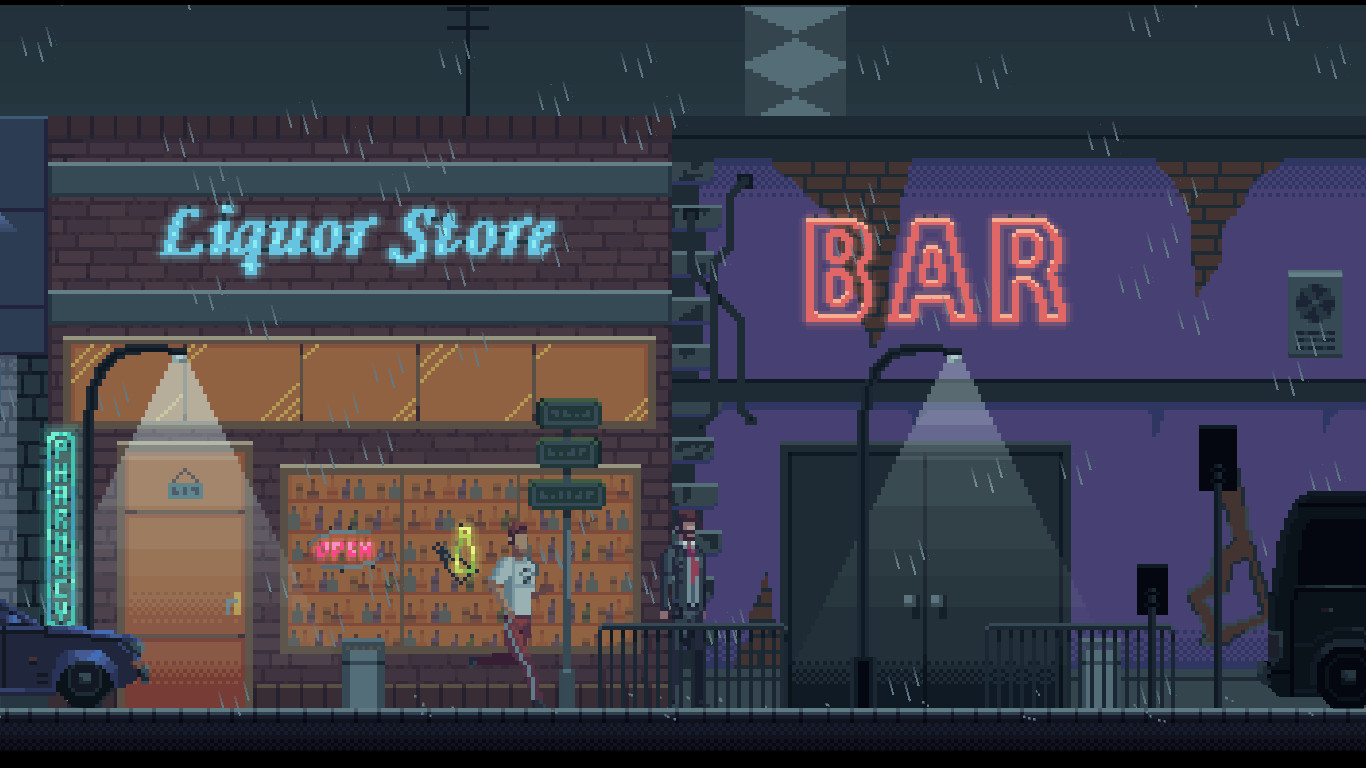
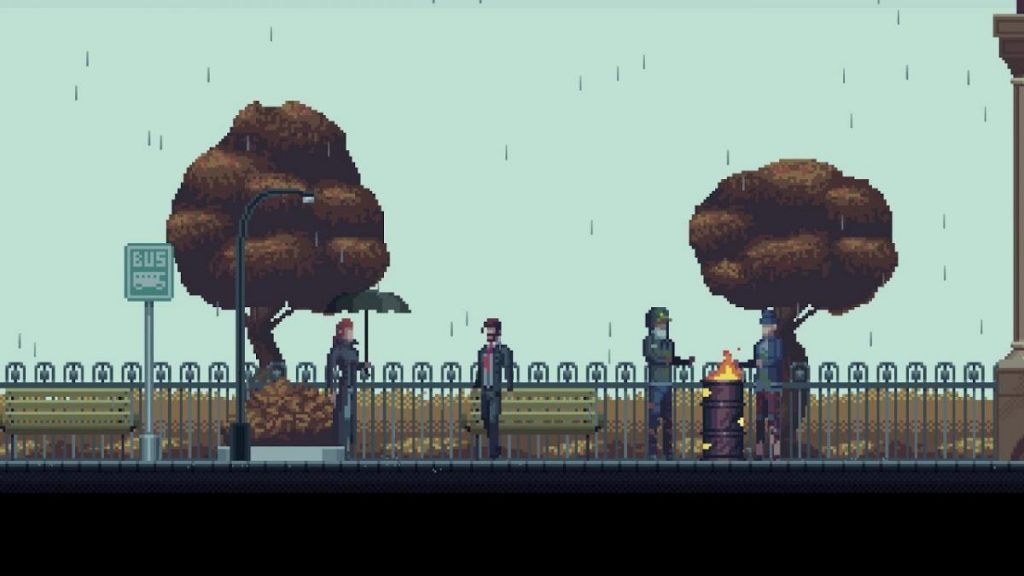
The atmosphere is pretty great though. It’s always raining, everyone’s miserable, your boss is mean and heading into town means you’re greeted by homeless drug addicts huddled around flaming barrels outside failing businesses. This won’t be a setting that’s for everyone but for those of us that really appreciate a really downbeat vibe, I Fell From Grace has sorrow in spades.
The story itself appears as if it should be interesting enough and has a strong enough premise. Henry, who you play as works for some big pharmaceutical company and has a wife that is very ill. As with every character in the game, Henry and his wife are having some tough times and have dealt with some catastrophic moments in their past. I don’t want to spoil anything but let’s say that Henry and his wife suffer a tragic loss.
Henry has now become a workaholic and is determined to cure his wife, even to the detriment of actually, you know, being there for her and looking after her. It’s clear that he’s become obsessed and in his pursuit of ‘doing what’s right’ he might make some poor decisions and… fall from grace. *puts on shades*
Not Fooling Me
So what I’m saying is that this is a narrative driven game and instead of worrying about engaging puzzles, the developers have decided to focus all of their attention on telling a compelling narrative, right? Sadly, no. This is another area that I Fell From Grace fails in because the fact is that the story soon descends into meaninglessness.
What starts as a fairly engaging journey into one man’s descent into obsession is soon littered with pointless segues into events that have no bearing on the story or some which simply don’t resolve. It may be the case that playing the game over and over again could help you tie up some of these loose ends, but I’m not convinced this is the case having finished it twice. When a plot involves nightmarish warnings about ‘black spots on the ceiling’ only for you to have the credits roll without a single encounter with a ceiling-based black blotch, you have to wonder if there is any meaning behind the game’s words or actions. It all seems to think that it’s smarter than it actually is.
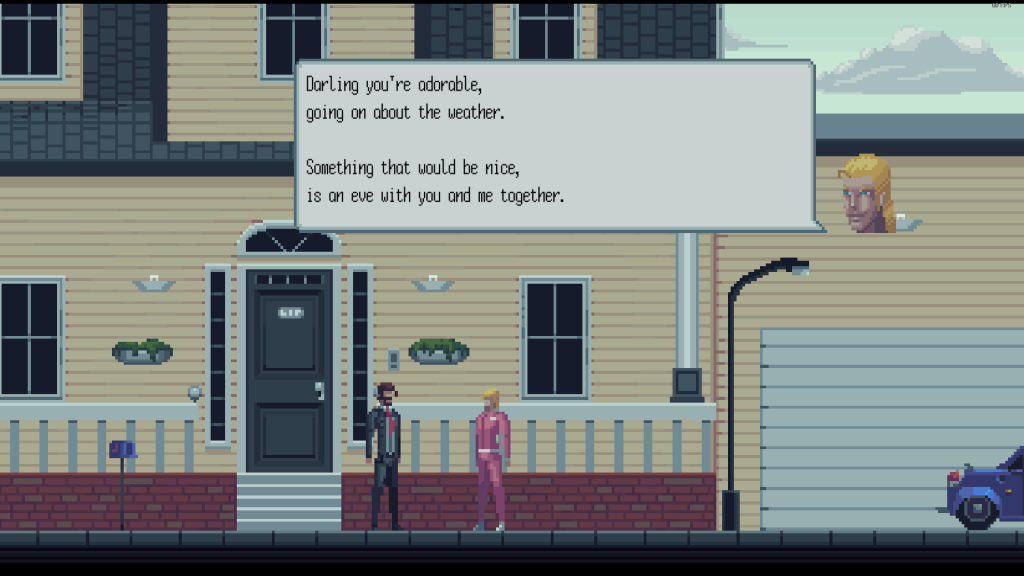
This is no more apparent than in the decision to make every. Single. Line. Of. Dialogue. Rhyme.
Every.
It’s hard to say why this was decided, what exactly this writing style was meant to evoke but all I can say is I grew tired of it within five minutes.
No Time To Rhyme
So I’m sorry to be such a downer on this game. As I said at the start, I really do want to enjoy the time I spend playing games and I do want to encourage developers to try new things and ultimately create great pieces of work that push the boundaries of what we think games are and can be. Sadly, I also have a duty to the game players who need to know that this is simply a failed attempt at something unique.
To surmise:
When reading the dialogue becomes such a chore,
it’s hard not to grow tired and start to snore.
The puzzles aren’t fun and they’re not very clever,
the same goes for the story as it’s not much better.
The graphics are nice and they help set the mood,
it’s a shame everything else just comes off as crude.
I commend you for trying something new, I Fall From Grace,
Space sims come and go but have never really opened players up to the extreme amount of vastness and endless amount of stars that dot our galaxy. Formerly known as Paragon, Jumpdrive offers the chance to set out into the great unknown and make discoveries at your own pace. Unfortunately for players short on time due to their busy schedules of adult life, school and work, Jumpdrive offers little to no shortcuts when traversing through the stars in this gutsy space exploration title. After all, the universe is infinite.
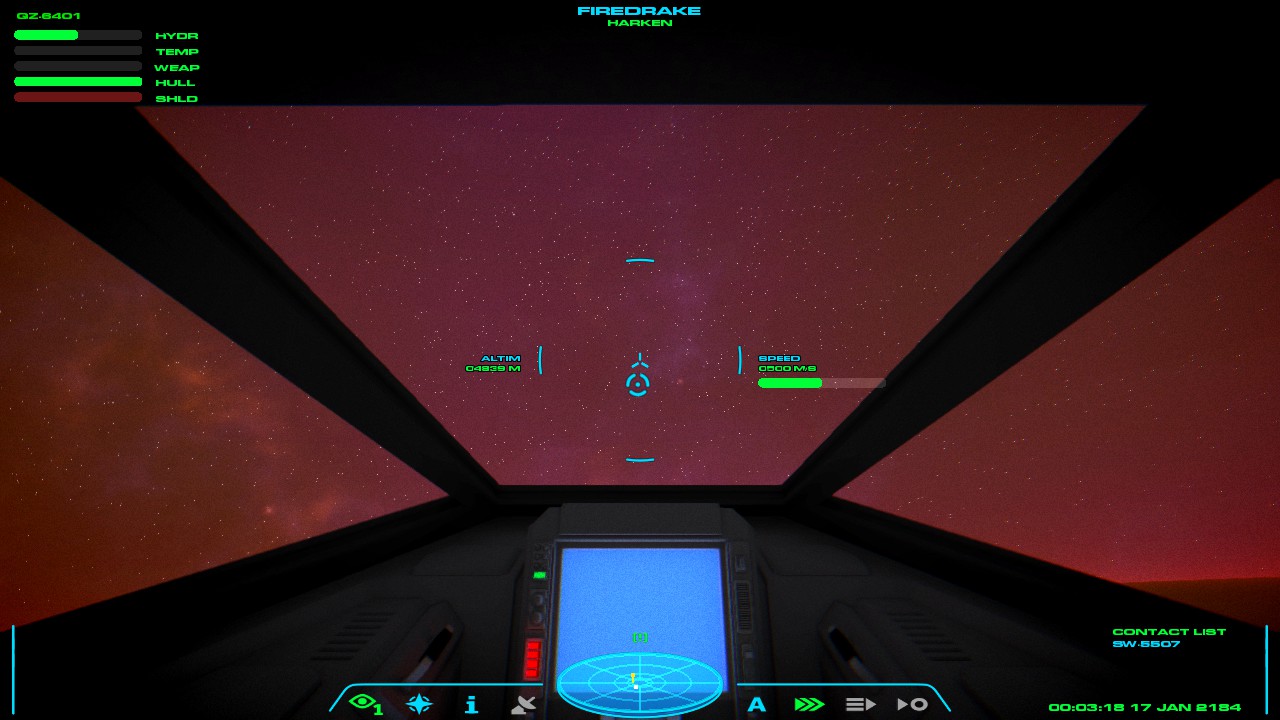
Sitting in the cockpit of your space shuttle, the instructions of the controls read across your screen. The basic click controls are simple enough, but then the game cuts you loose. The objective of Jumpdrive? Not sure… Explore? Sit in your speeding shuttle and wander through the stars for countless hours hoping to come across a unique discovery, or perhaps engage in an epic space battle? We can only hope so, anyway.
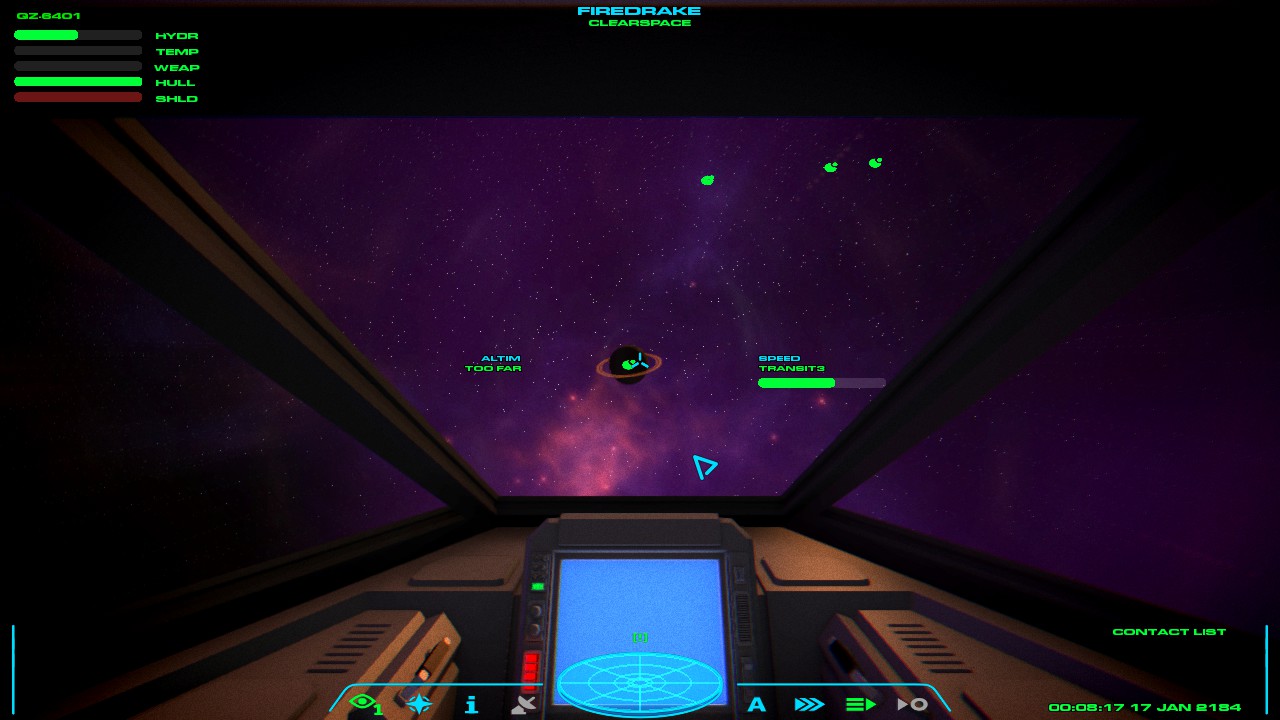
When pulling out of the gravity bubble that surrounds planets, players may then switch to an increased mode of travel, Transit Mode.
The purpose of Meteoric Games‘ Jumpdrive is to simply explore the enormous procedurally generated galaxy, picking up on anything that may cross your path. Distant missions with handsome rewards, long space expeditions to the other side of the galaxy, or fending off your shuttle from enemy ships, anything seems possible in Jumpdrive, but at what cost? The sheer amount of the universe seems endless as the developers express the ability to explore through a galaxy brimming with millions of stars and planets. Let me be perfectly clear: Jumpdrive is for the hardcore space exploring enthusiasts. Pouring in tons of hours to travel great distances, slowly immersing yourself while travelling in real-time to your next objective is an average day when living out your astronaut dreams in Jumpdrive.
Jumpdrive: How Do You Travel Through Space?
There are three basic controls when travelling from one objective to the next. When still in one planet’s gravity bubble, players may only use Maneuver Mode. This mode acts as the slowest mode of transport, used to travel around planet surfaces within the gravitational field. After exiting the planet’s atmosphere, or gravitational bubble, players may then engage in Transit Mode. Used for quicker travel between planets, Transit Mode will most likely be your main mode of travel.
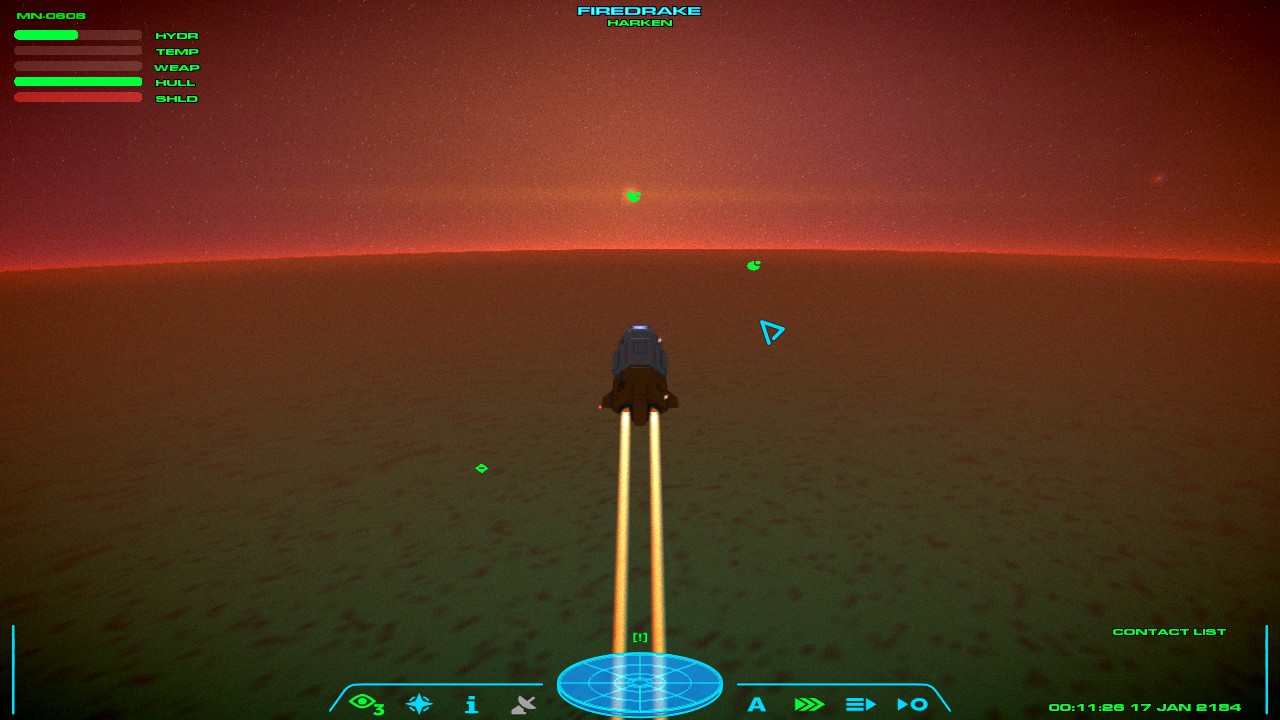
Many green blips mark your objectives and other planets/space stations throughout the systems.
Last but not least, Jump Mode is the hyper speed setting to jump between different solar systems. Though a much quicker method of travel, players will need to meet the specific item requirements, e.g. hydrogen stock, as well as a jump drive installed on their shuttle. The three modes are accessed simply by clicking on one of the icons next to your radar at the bottom of the player’s screen, offering for quick and easy switching between modes on the go.
Objectives are found when following the green blips that are scattered throughout the open universe. Either when docking on planets or space stations, completing the various missions given to you will net cash rewards, which can be used to purchase upgrades or even new ships. Though from what I experienced with my time in Jumpdrive, the missions are standard fetch and grab or destroying enemy ships, but the amount of ground (or space) to cover is remarkably vast. I can easily see one losing most of their day spent completing a handful of objectives spanning across a number of different solar systems.
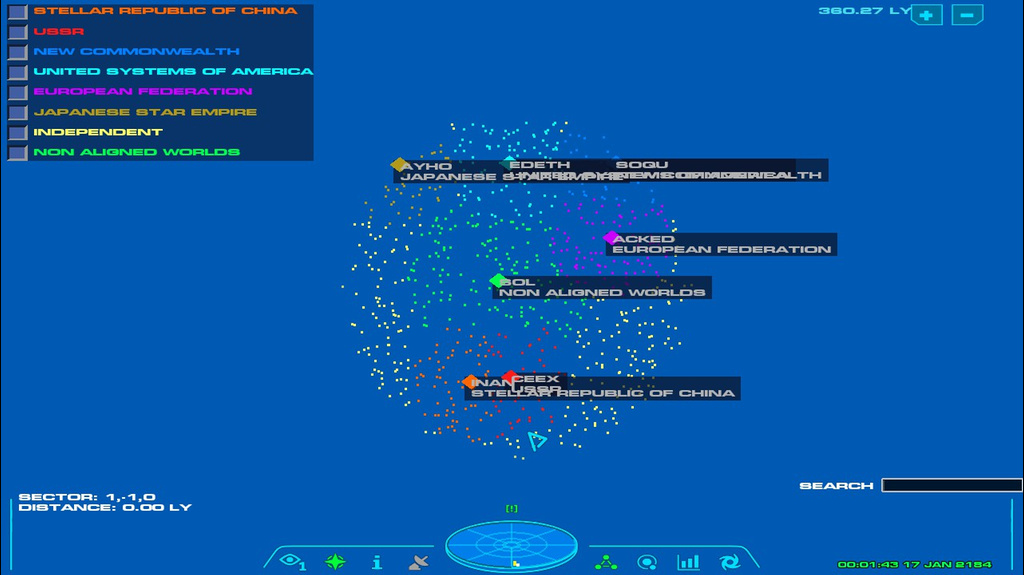
Plot your destination on the galactic map and use Jump Drive to travel between solar systems.
While Jumpdrive is astonishing in size, the visuals are no conversation starter. Though there’s not much to gaze upon when deep in the blackness of space, planet surfaces and textures when in sight are grainy, bleak and boring. I suppose that’s not exactly the point of Jumpdrive but it still manages to break some of the immersion when descending into a planet’s atmosphere. Still, the view of colors amidst the star-dotted sky is a sheer joy to stare at while endlessly drifting into the void.
So Much To Do, So Little Time
So, what is the point of Jumpdrive? Is there any storyline, plot twists or ending in sight? The answer is yes, but it all comes down to the player involved. With Jumpdrive you are offered a chance to create your very own space legacy in this massive space explorer, and take it for as long as you please. Players have a completely open experience from the start, whether they’re engaging in combat, completing various mission objectives, purchasing new ships and parts, or simply exploring the vast darkness of space.
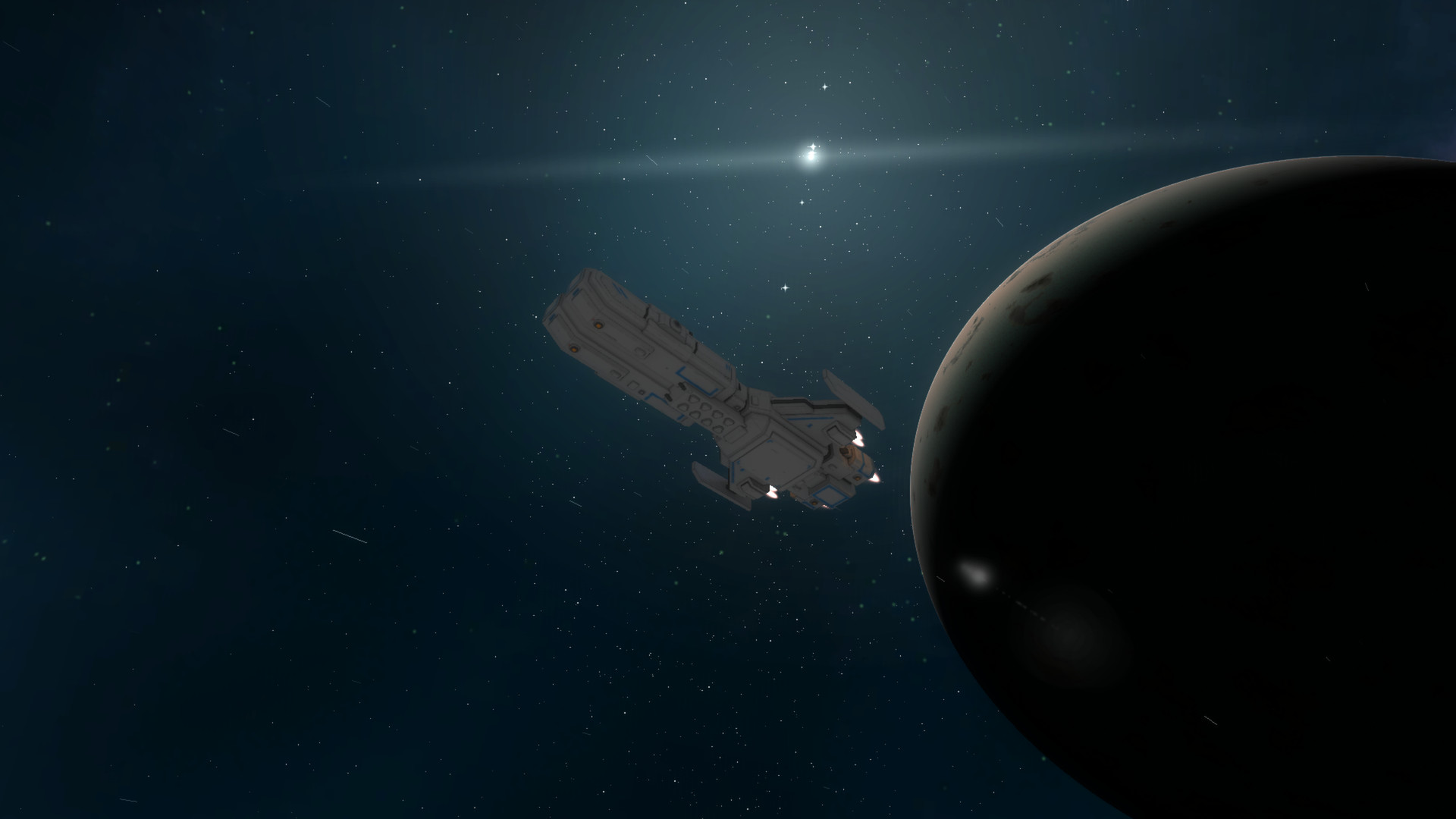
The distant visuals of space are breathtaking in Jumpdrive, adding a thrilling sense of depth to the enormous space sim.
Jumpdrive is an impressive space sim, but if one thing is certain, it only appeals to a relatively small audience. Those hindered by time and, in my case, an ever-growing backlog of other titles, simply won’t find it in their schedule to continue on this vast journey through the great unknown.
The unimaginable technological feats of Nikola Tesla combined with the sci-fi horror fiction of H.P. Lovecraft – 10tons has added yet another adrenaline-fueled twin-stick arena shooter to their already impressive library. Strap on your teleport pack and prepare to face off against Cthulhu, and its many hordes of demonic enemies in this monstrous arena shooter – Tesla vs. Lovecraft.
As you take on the role of none other than the electric-wielding genius, Nikola Tesla, the minions and fiendish creations of the coveted sci-fi writer, H.P. Lovecraft, begin to take over the world. Distraught by Tesla’s electric inventions, Lovecraft takes matters into his own hands to stop Tesla and his inventive actions. Harnessing the power of his very own creation, Cthulhu, Lovecraft unleashes waves of nightmarish monsters on our hero Nikola, but that won’t stop Tesla from fighting back.
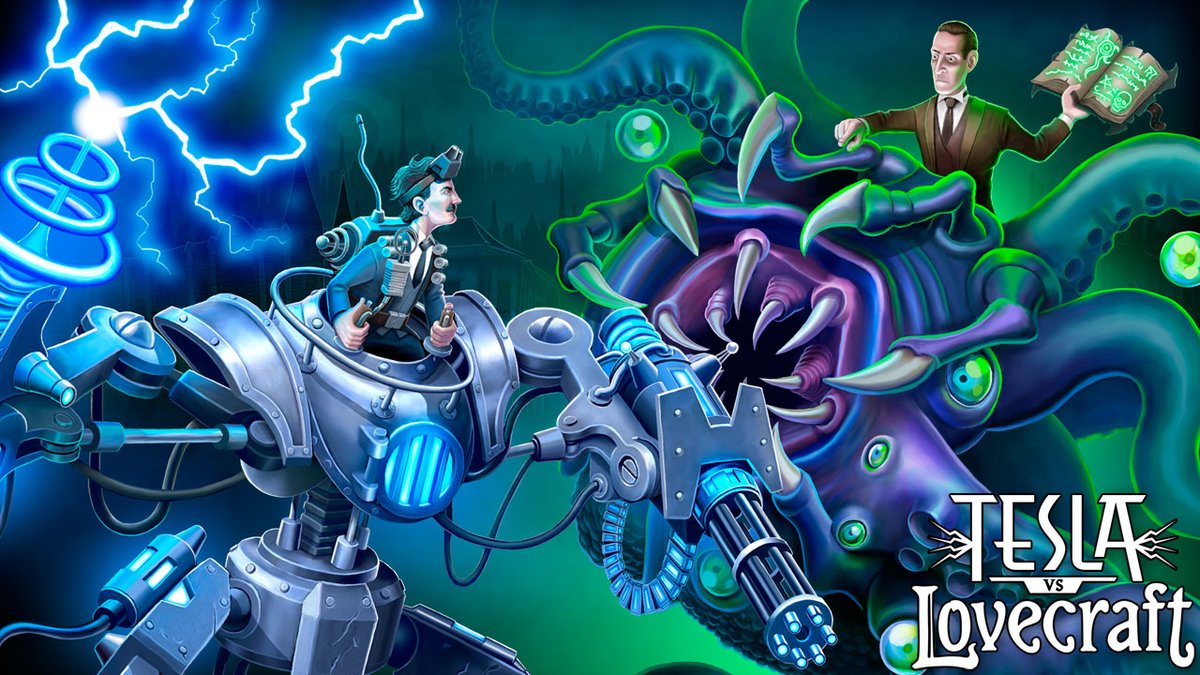
Angered by the inventive actions of Nikola Tesla, H.P. Lovecraft unleashes his army of monsters on the world.
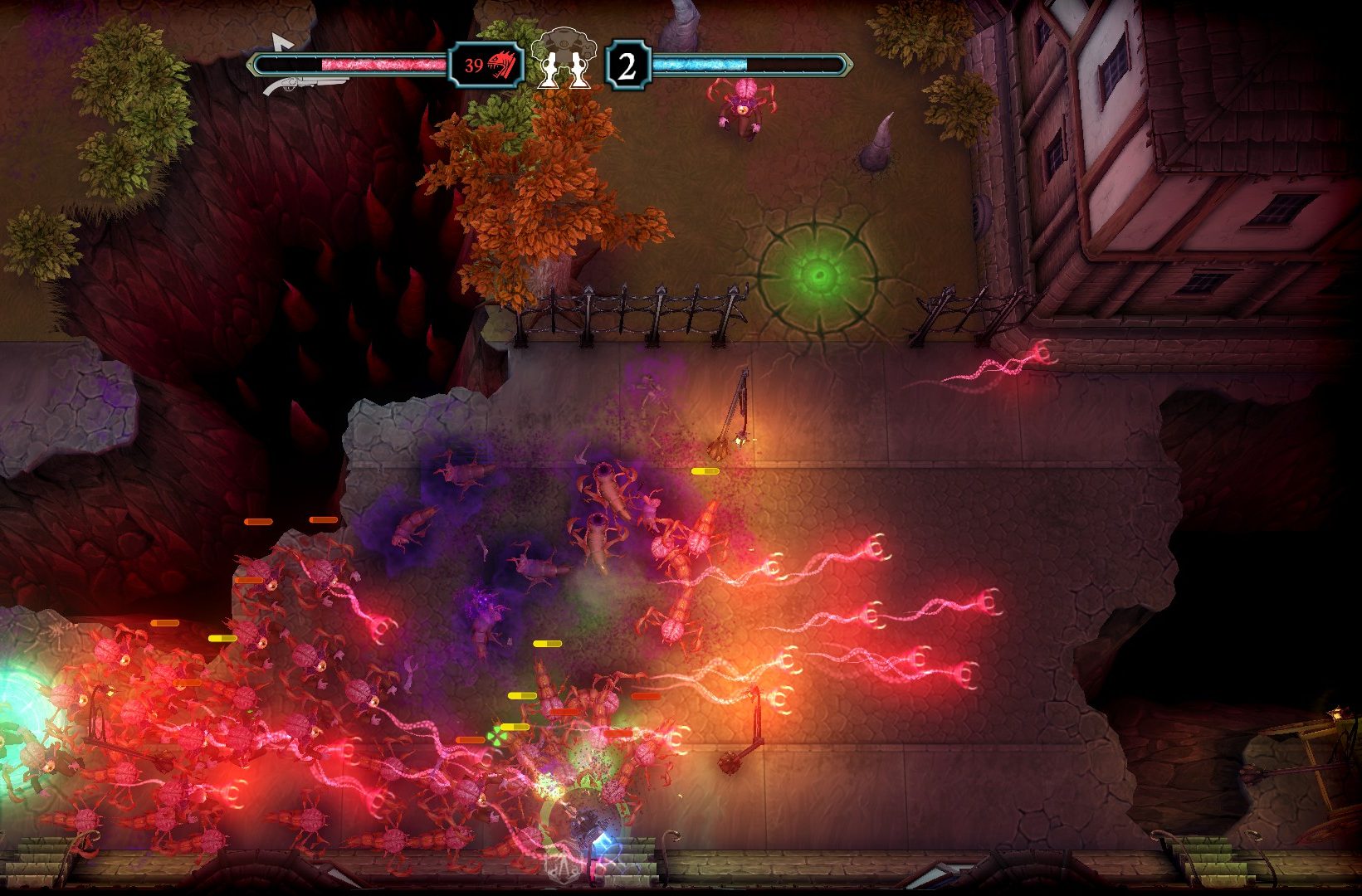
The story of Tesla vs. Lovecraft is completely out of this world, but that only strengthens the energetic gameplay that backs it all up. This top-down arena shooter is as exciting as it is weird, providing players with a wildly entertaining experience from start to finish. From blasting through walls of grotesque monsters with Tesla’s super-sleek electric weapons, to running a full assault in the powerful Mech suit, this twin-stick shooter is as intense as they come. Tesla vs. Lovecraft is smooth, addictive and keeps pushing the player forward by unlocking satisfying perks and abilities to take your reign to the highest degree.
Tesla vs. Lovecraft: Sci-Fi Shooting Mayhem
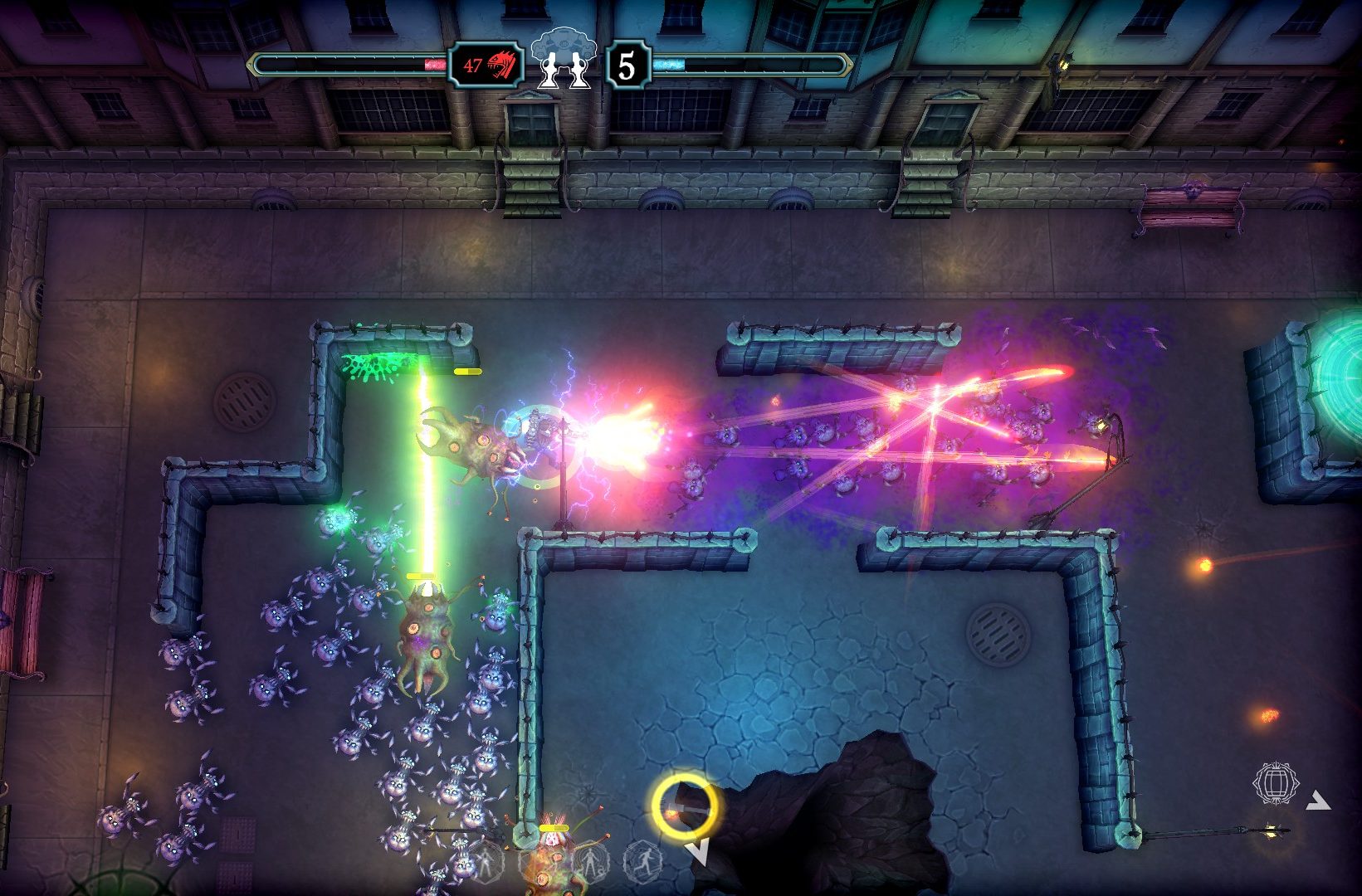
Throughout the many stages of the campaign, Tesla’s main goal is to wipe out all enemies in each level. The enemy bar at the top of the screen not only shows the player how much longer the stages are, but how many enemies are currently on the map as well. Once you hit an empty bar and zero enemies left, the stage is complete. It’s a simple concept that’s worked for decades across the popular genre, but Tesla vs. Lovecraft – like all unique indie titles – has what it takes to gracefully stand out from the crowd.
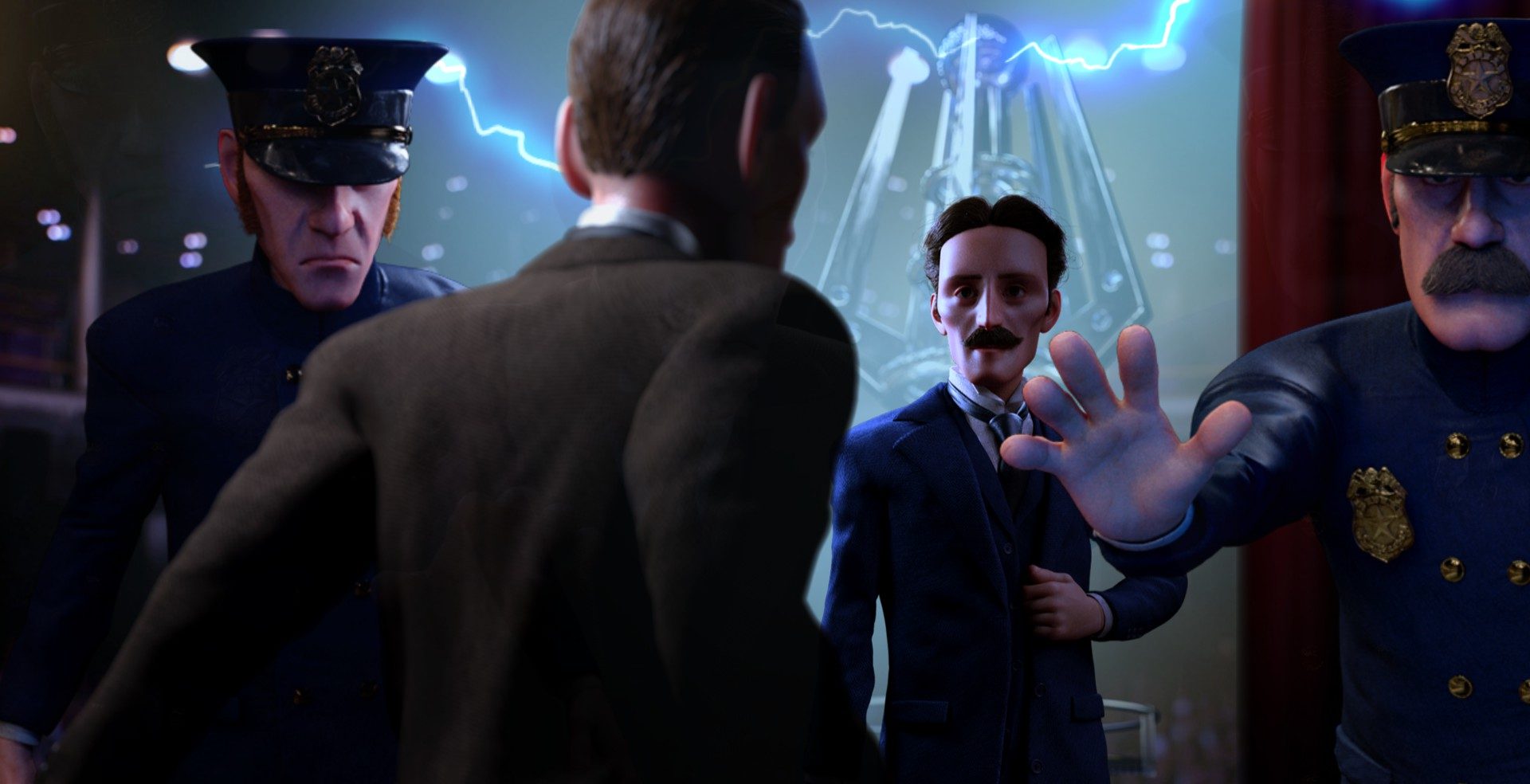
Enemies swarm in this ultimate twin-stick shooter – Tesla vs. Lovecraft.
The levels in Tesla vs. Lovecraft offer a wide arrange of size and obstacles in various settings across the campaign. Some act as small areas barely filling up more than the entire screen, while others have the players running through alleyways, courtyards and city streets, searching for the next player-boosting perk. Along with primary weapons and abilities, players will keep things interesting with other consumables like health packs, armour shields and unique enhancements like fire bullets. After a few short training levels, the player is granted the Quantum Teleport backpack which allows Tesla to teleport a short distance, as well as through most fences or other obstacles. Now all Nikola needs is some weaponry.
Tesla vs. Lovecraft creates a unique arcade feel with unlimited ammunition rounds, a vast array of awesome weapons to pick up, mighty abilities and character customizing perks. Weapons like pistols, revolvers, gauss rifles, shotguns, repeater shotguns and the beloved Tommy Gun are found throughout the levels during your campaign. Randomly spawning during each stage, players are only permitted to carrying one weapon at a time. Running over a different weapon than you have will automatically replace your current weapon, often leading to unwanted weapon switches.
With the intense action and splashing array of colours flooding the screen, it’s easy to lose sight of what’s what. The developers have done a substantial job in colour-coding items based on whether they’re weapons, power-ups or mech parts, but there may still be some visual confusion that slightly hinders the overall gameplay. Whether or not you accidentally swap a quick-firing Tesla blaster for a slow 2-shot shotgun, you still have a few options to keep the action in your favour.
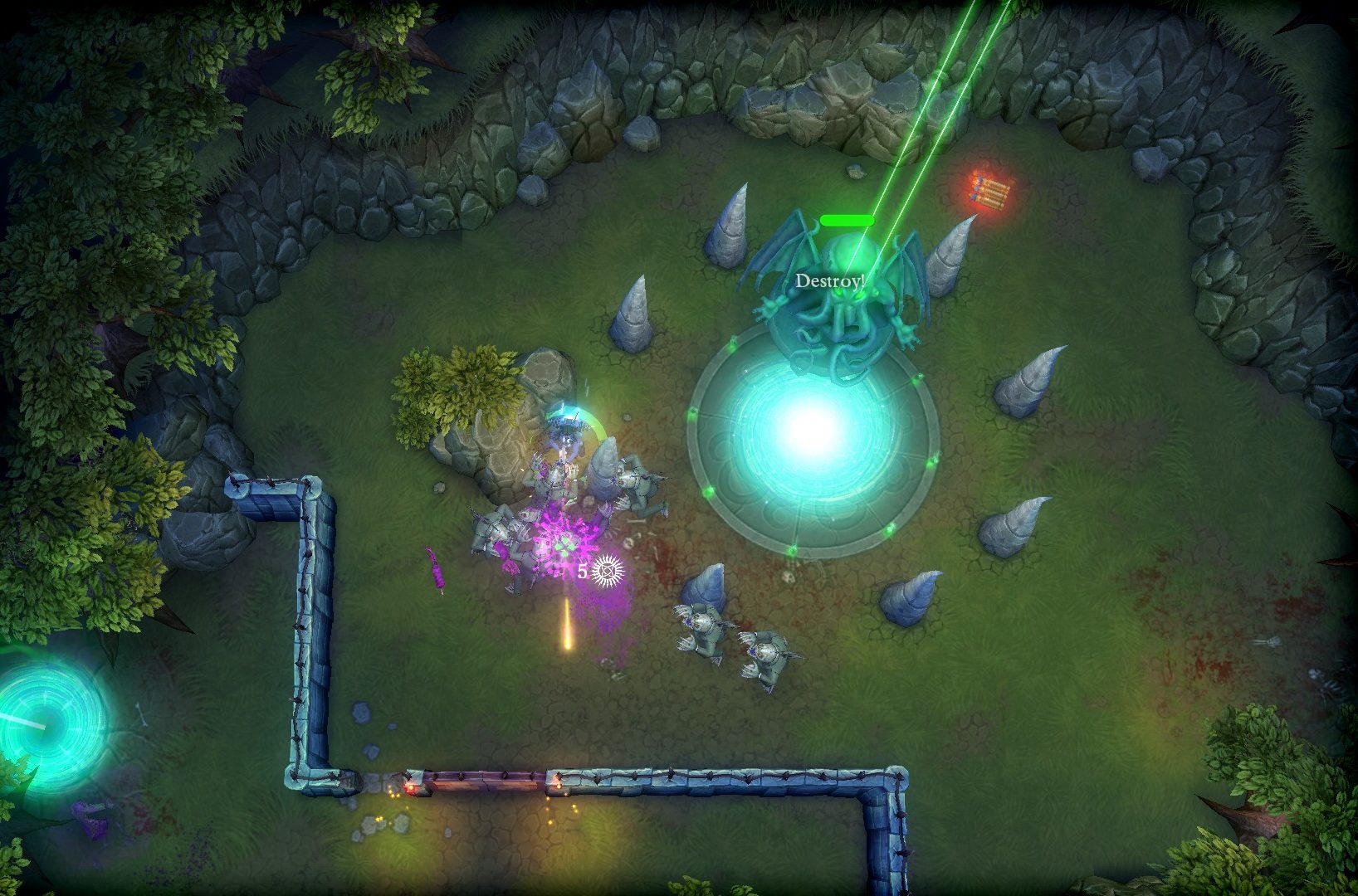
Along with the many waves of enemy monsters, Cthulhu statues will appear which endlessly spawn enemies until they are destroyed.
Strengthen Tesla’s Skills With Unique Perks and Abilities
Along with the many weapons to find and unlock throughout the game, players also have many perks and abilities to trigger. In typical arcade fashion, every stage starts Nikola Tesla off at level one, growing through the ranks as you mercilessly slaughter Lovecraft’s army. Leveling up comes quick, as stages typically last anywhere from 20 seconds to a few minutes, as players wipe out hundreds of enemies in one stage. As you gain each new level, players are awarded a perk point and may choose between two randomly selected perks.
Increasing movement speed, adding bullet penetration, a higher chance of acquiring more power-ups, or unleashing lightning strikes every few seconds are only a few of the perks available throughout the game. Starting off with a limited number of perks, more are unlocked as you progress further in the game. Gaining anywhere from 5-10 levels in one stage is an average run in Tesla vs. Lovecraft, allowing players to enhance Tesla in unique ways for every single level.
Unique perks help develop Tesla across each level, like having the ability to ricochet bullets off of walls.
On top of the useful and semi-permanent perk to choose from, powerful abilities also come into the mix when fending off the hordes of Lovecraftian nightmares. Spawning randomly in each stage, much like the standard weaponry, players may only equip one ability at a time. However, unlike standard weapons, these abilities are capable of dealing massive amounts of damage to the many waves of enemies. Using a massive sword to slash through a thick crowd of enemies, unleashing a flurry of static shock, or an AoE nova attack act as some of the unique abilities found in each level. Not similar to the unlimited ammunition found with primary weapons, abilities have a limited number of uses, making for more strategic actions.
Lay Out Some Carnage With The Mighty Mech Suit
With all of this talk about unlimited ammo, character developing perks and game-changing abilities, these are nothing when compared to the deadly and outrageously fun Mech suit. Invented by none other than Tesla himself, this Mech suit is the ultimate table turner. Once unlocked – which is relatively early in the game – players will start each round with the assaulting Mech suit intact. After about 10 seconds or so, the Mech suit explodes into six pieces, all scattered throughout the stage. Once players pick up each part, the rampage is back on for another 10-or so second run, or until the Mech takes enough damage.
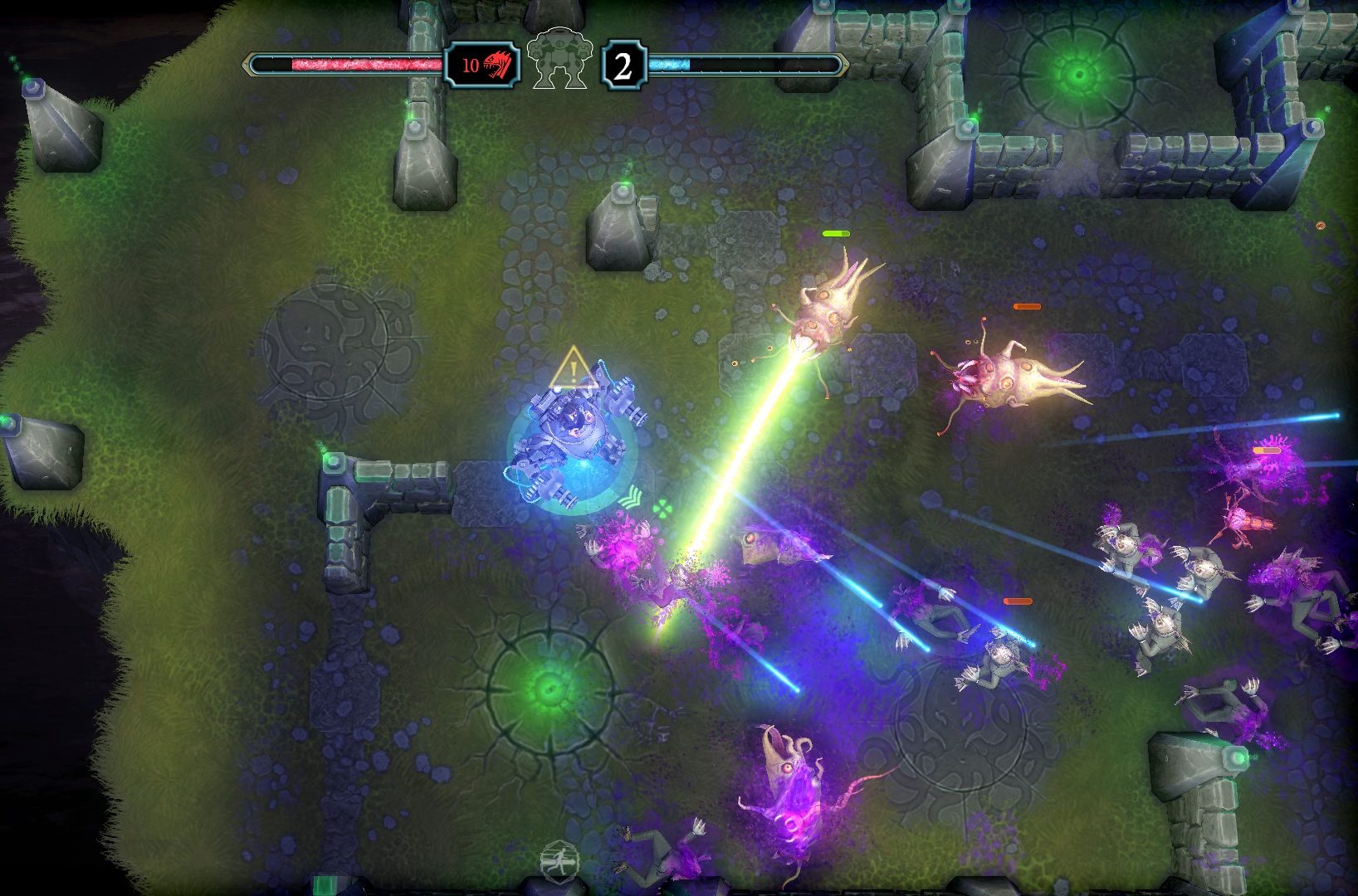
The Mech suit is not only extremely powerful but all-too satisfying as well. While firing the duel cannons works perfectly fine against the many waves of monsters, walking through them and crushing walls and barriers bring the carnage to a maximum level. It’s easy to get carried away once the Mech suit is engaged, effortlessly wiping out any helpless monster standing in your path.
The Mech suit is the ultimate weapon for slaying an enormous amount of monsters quickly.
Tesla vs. Lovecraft is a rampage inducing, action-packed sci-fi arena shooter that stands tall amongst titles of similar stylings. With the unique perk and levelling system, smooth controls, one-of-a-kind story, devastating abilities and Mech suit, 10tons graciously hands over an experience of science and horror like no other game has before. Throughout the game’s many, many levels available through three different areas, plenty of monster slaying, Mech-suit-smashing mayhem awaits at your fingertips in this latest twin-stick arena shooter.
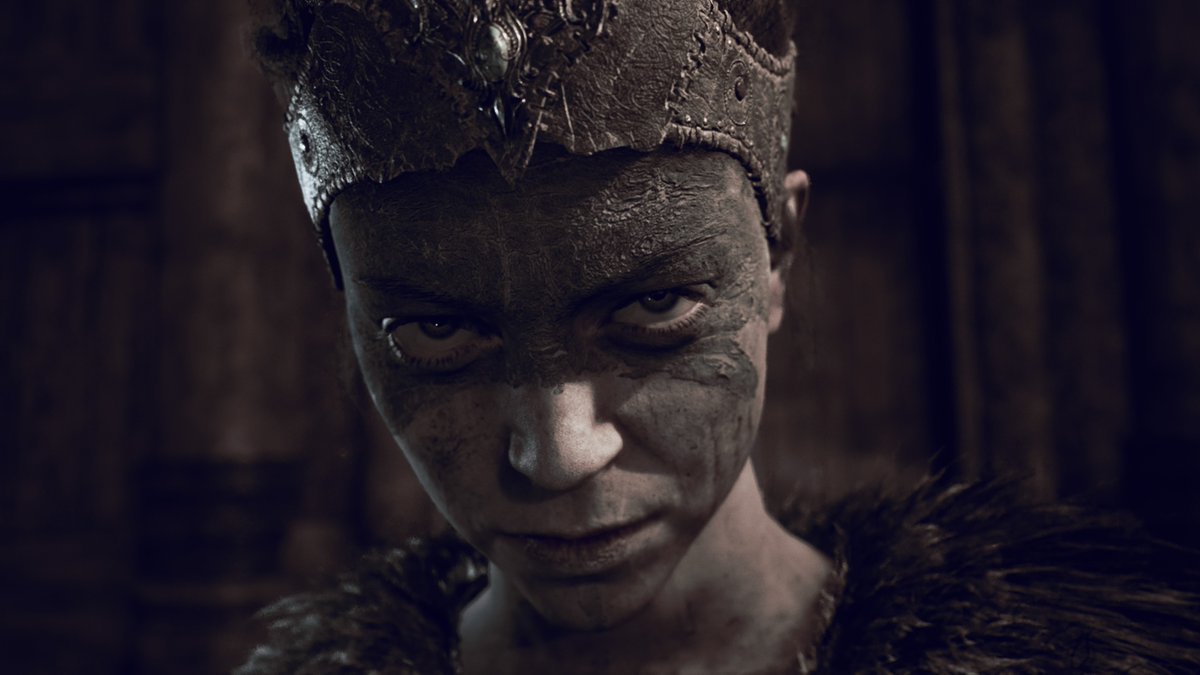
With the ever-popular action adventure category of video games becoming more and more saturated throughout the years, developing teams are finding new ways to push the envelope for the repetition-riddled genre. After making a name for themselves with titles like DmC: Devil May Cry, Enslaved: Odyssey to the West and Heavenly Sword – Ninja Theory is back with another gripping action experience; but doing so by tackling the dark and merciless journey of a Viking warrior, aided by her haunting curse of psychosis and mind-rotting visions in Hellblade: Senua’s Sacrifice.
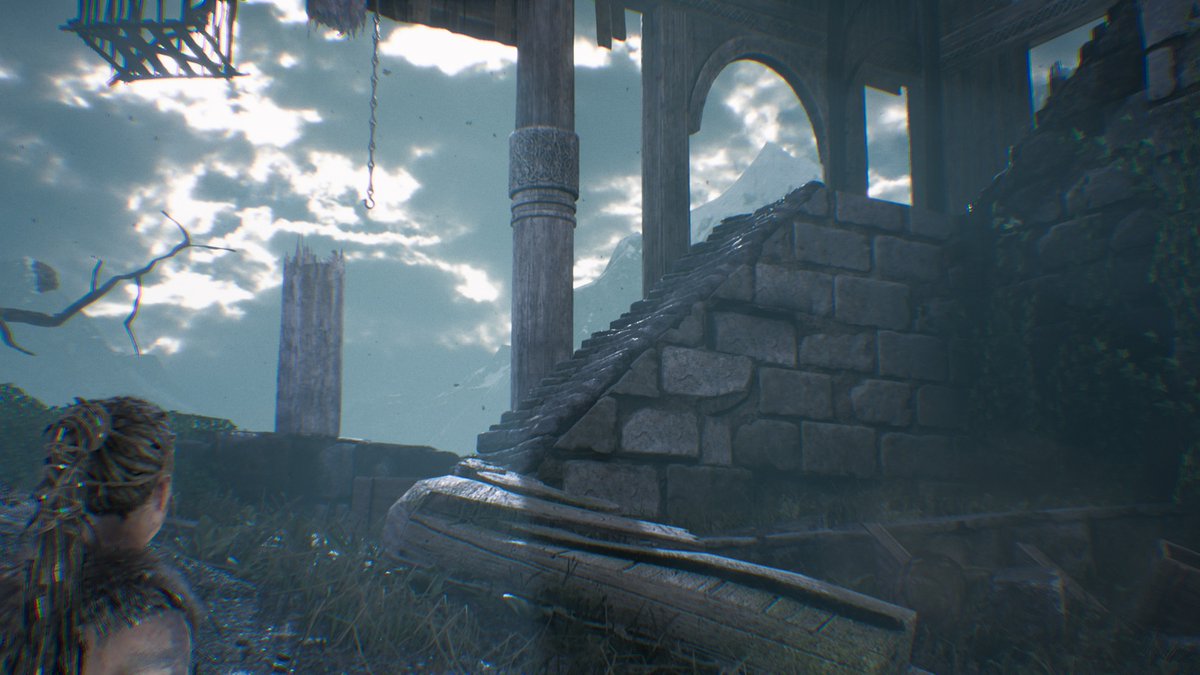
Playing as the Viking warrior – Senua – you’ll embark on a disturbing journey to the depths of Helheim.
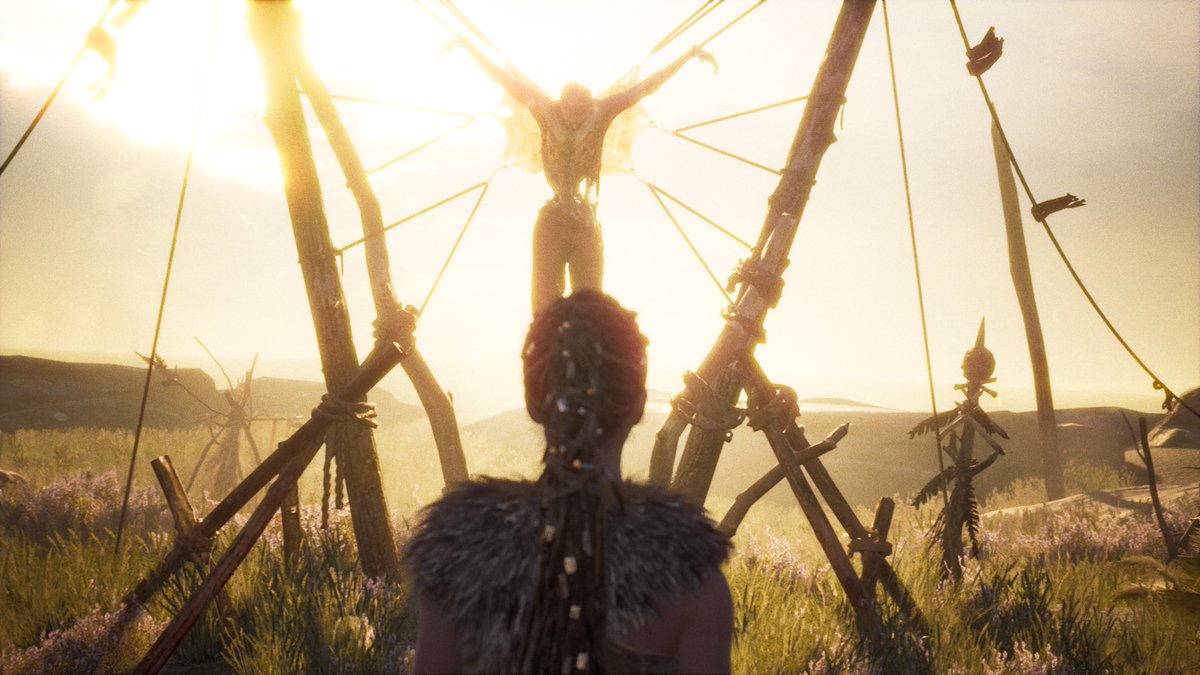
The path of Senua is a violent and disturbing one, bringing to life the realism of psychosis and interpreting what it’s like perceiving an alternate reality from what’s right in front of the player. The team at Ninja Theory did their research regarding this mental disorder, and it shows dramatically. The entire run-through of the 7 hour or so long campaign is brimming with haunting whispers, flickering lights and distant movements, ever pushing the twitching reality of Senua’s chaotic, and broken mind.
Hellblade: Senua’s Sacrifice – Fighting the Curse of Psychosis
The game is extremely linear, following a given path of intricate puzzle-solving and staged combat experiences. The dark story of the Viking warrior and her quest to Helheim to bring her loved one back to the living is as endearing as any love story, but permeates with evocative dialogue, enveloping sounds and troubling imagery. The puzzles featured are innovative and unique to the story of Hellblade, but add a much-needed sense of depth to the overall gameplay. If not for the ever-present puzzles to solve, the staged combat doesn’t quite fill Hellblade with sword swinging hack ‘n’ slash battles like other titles from the Ninja Theory catalogue.
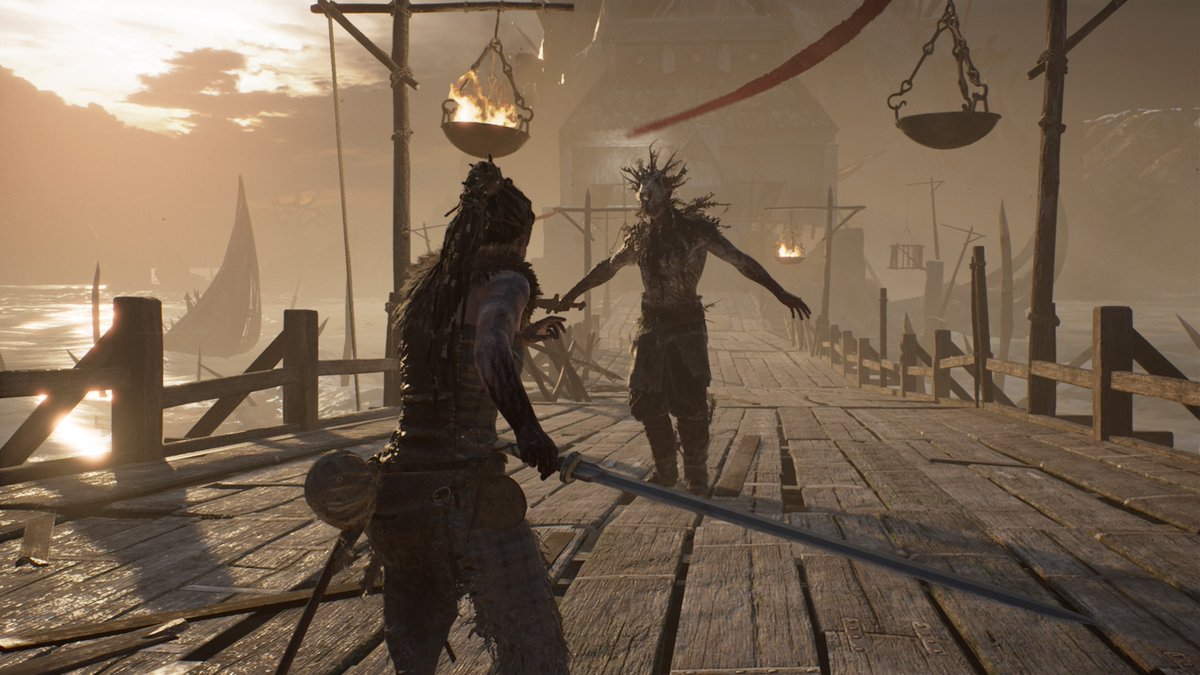
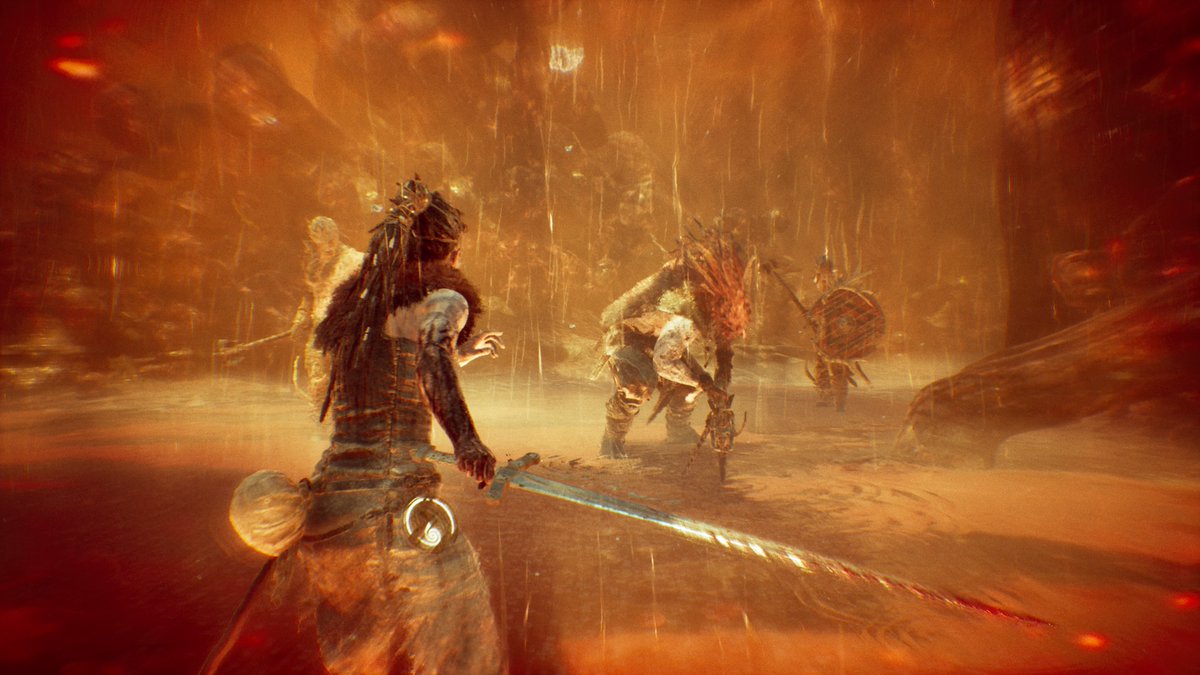
Throughout Hellblade players will be faced with brutally grotesque monsters in the staged hack and slash combat.
As you begin your journey to Helheim, the grave voice narrates over your slow trek to one new area after another. Hellblade is fueled off the drawbacks of psychosis. The constantly shifting reality of the scenery surrounding Senua is the source to figuring out the many puzzles, by either finding specific shapes scattered somewhere in the world, discovering and aligning segments of a symbol to create the full image or finding other discoveries hidden deep within the Viking world.
As you progress through, the combat in Hellblade will soon enough be introduced. Appearing in front of your from the ashes, enemies come in a handful of different forms. Quick acting sword swingers, shield-wielding brutes and giant warriors bringing down a heavy blade with extreme force are all part of the family of opponents found in Hellblade. Senua fights with a standard mode of attack, with both a light and heavy attack, a melee kick and, of course, the useful dodge technique.
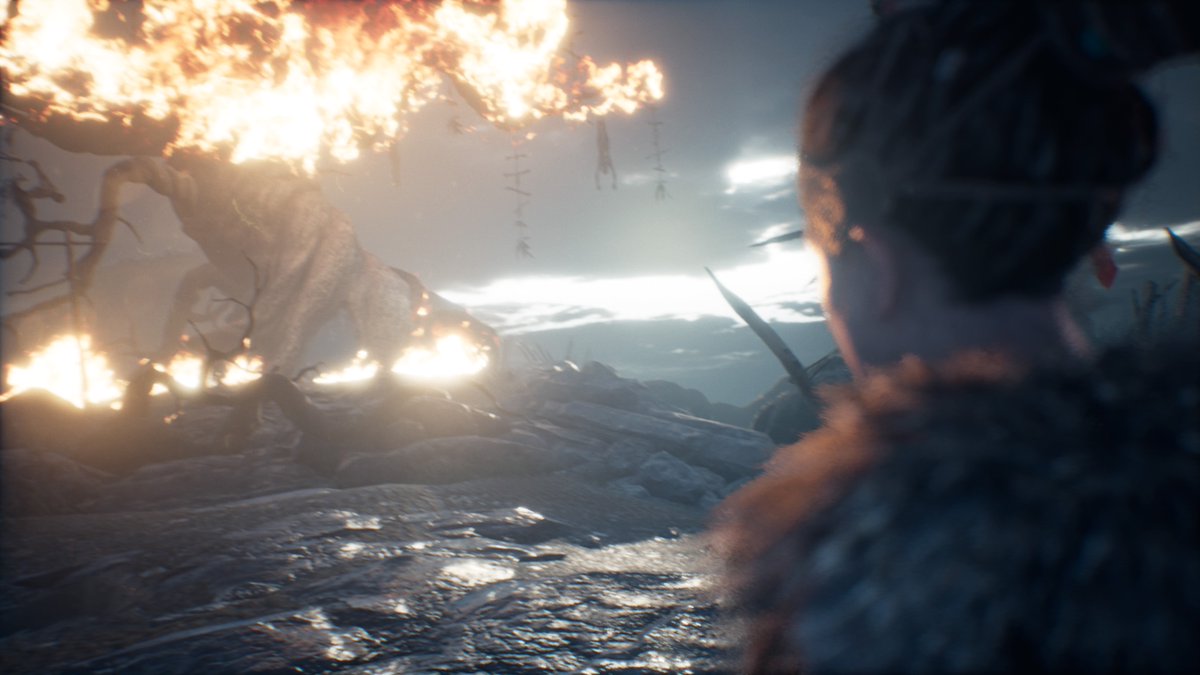
Illusions from psychosis haunt Senua throughout her deadly journey to Helheim.
Along with the defensive tactic to roll or sidestep, Senua is capable of blocking attacks with her sword, as well as performing a parry move to open up an attack window for extra damage. I mention this parry technique because the game simply fails to do so. What seems like an important combat ability, parrying is only discovered by the player when they time a perfect defence against an enemy’s attack. On top of the parry technique and other essential combat manoeuvres, Senua also has the ability to use her focus skill in combat.
Focus. Use Your Inner Eye
The focus skill while outside of combat allows Senua to “focus her inner eye” on important details and symbols throughout the journey. The focus technique is the primary ability to solving the puzzles that riddle Senua throughout her story. That being said, puzzle-solving is not the only occasion Senua will use this secret skill. During combat, using the focus skill – which is charged by connecting Senua’s attacks – will slow down time for a few moments, increasing the number of strikes Senua can land on her opponents. Though simple and unembellished, the what seems like shallow combat mechanics provide an incredibly exciting and thrilling experience when engaging in the vile monsters that come to take Senua’s life.
Using the focus mode, players will need to solve puzzles by paying close attention to details in Senua’s surroundings.
The curse that follows Senua throughout the game is both mental and physical. While the whispers and cynical chants eat away at her mental stability as she undergoes her harrowing journey, the physical torment endured from failing is just as disturbing. The lingering fear of losing your progress is a significant weight the player must carry as the black plague on Senua’s arm crawls upward with every player death. Once the webbing plague reaches Senua’s head, the game is over and the player must start from the beginning. Luckily, with a selection of combat difficulty, text-book staged combat and relatively short story length, starting over doesn’t seem as much of a chore as it sounds. Of course, there are some who claim that losing your progress never actually happens after numerous deaths, but is merely a bluff from the developers.
Senua will often find herself against multiple enemies at once, but using focus in the midst of battle will allow a brief period of slowed down enemy movements.
Impressively Evocative
The winding and distraught road of Hellblade: Senua’s Sacrifice is something so powerfully stirring that playing through the linear campaign multiple times still feels fresh and thrilling. The isolated quest to defeat the horrors of Helheim, overcome the dark curse that haunts Senua and return her loved one back to the living is as enthralling as it is disturbing. The realism and time spent on providing an accurate reflection of what it means to wield the curse that is psychosis is impressively alone, not to mention the astonishing visuals and sound effects. Ninja Theory took their time with this one, and it shows, as Hellblade: Senua’s Sacrifice is easily one of the most memorable experiences from 2017.
When it comes to games that have literal titles, Mom Hid My Game! is definitely up there with the rest of them. Much like other indie titles that have launched on the Switch such as Tennis in the Face, it seems to be the trend at the moment. But, when it comes to quantity, there certainly is no shortage of games to try via the eShop which is fantastic to see. 2018 will be huge for Nintendo and hopefully, the support for the smaller games will boost the Switch’s appeal further.
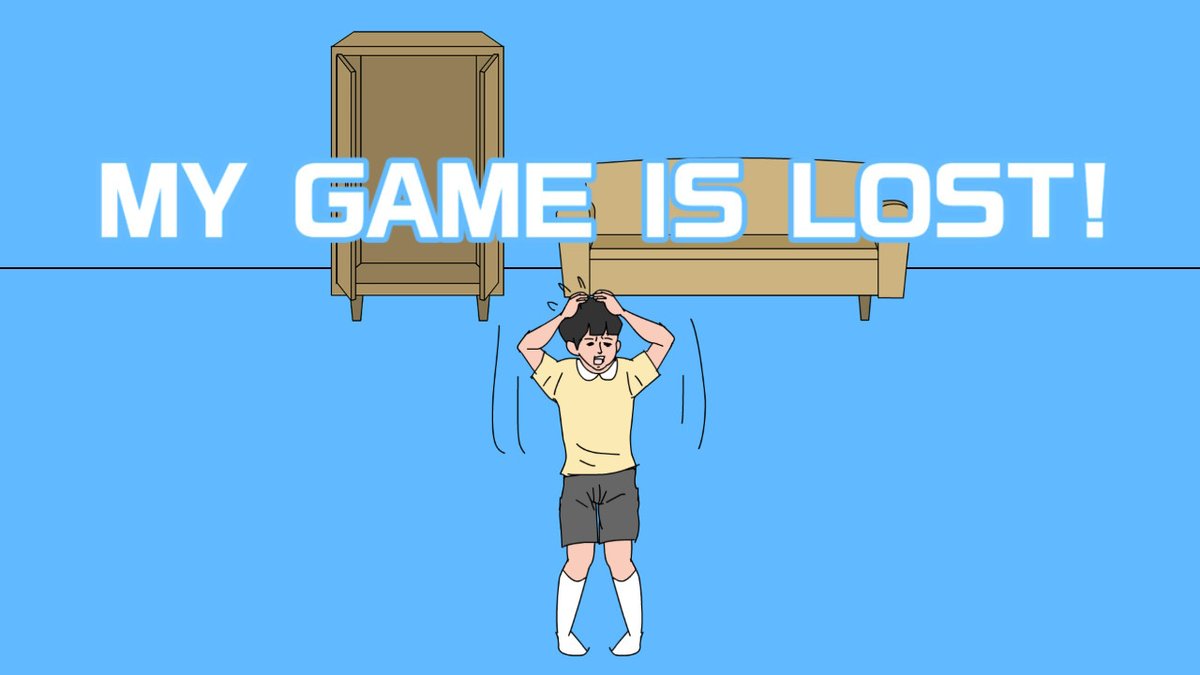
So what is Mom Hid My Game!, from developer Kemco, about? Well, as mentioned, the clue is literally in the title and your aim is to find your fake/unbranded, portable games console after your mother has decided to hide it away from you. Clearly, those psychologists were right in diagnosing gaming addiction as a mental illness as this poor chap can’t put his console down and will do anything to find it again.
Mom Hid My Game!
Although your console-finding antics take place in your bedroom, that doesn’t mean that the lengths the poor old mother goes to hide the thing are boring. Oh no, she gets quite creative when it comes to finding places to plonk the little console. Enlisting the help of animals, sports teams and the general public, she certainly knows how to make life difficult for you. Even when she’s hiding somewhere ready to spring him mid-search too, some of the scenarios and puzzles to find a way to collect the console are quite humorous if a little farfetched (poor kids bedroom doesn’t half get some thoroughfare).
Altogether there are 50 puzzles to solve that take place over concurrent days, each with their own perks and twists as described above. They’re short, sharp and don’t hang around too long making them ideal time killers when you’ve got a few moments to spare. They can put a smile on your face and cause some frustration/confusion when you fall foul to the hidden mother (hiding as a floor lamp for instance) or get knocked over by a pacey pedestrian blocking your way.
The Problem
The main downfall of the game is in its deliverance; it is a short game, so much so that it will probably be something that is easily forgotten about – lost amongst other games. It is best suited to the mobile platform and you could say that it is a bit basic for a console title, albeit a indie game. But you can’t help but feel that it has some charm to it beyond that its longevity and appeal may be limited. The animations, style and sound effects have an air of cheese to them and clearly, the game doesn’t take itself too seriously or have ideas above its stations.
So whilst it’s nice to see Mom Hid My Game on Switch, is it worth the price of £4.49? Price and value is a very subjective matter and, for me, I wouldn’t say that it would be worth paying out for.