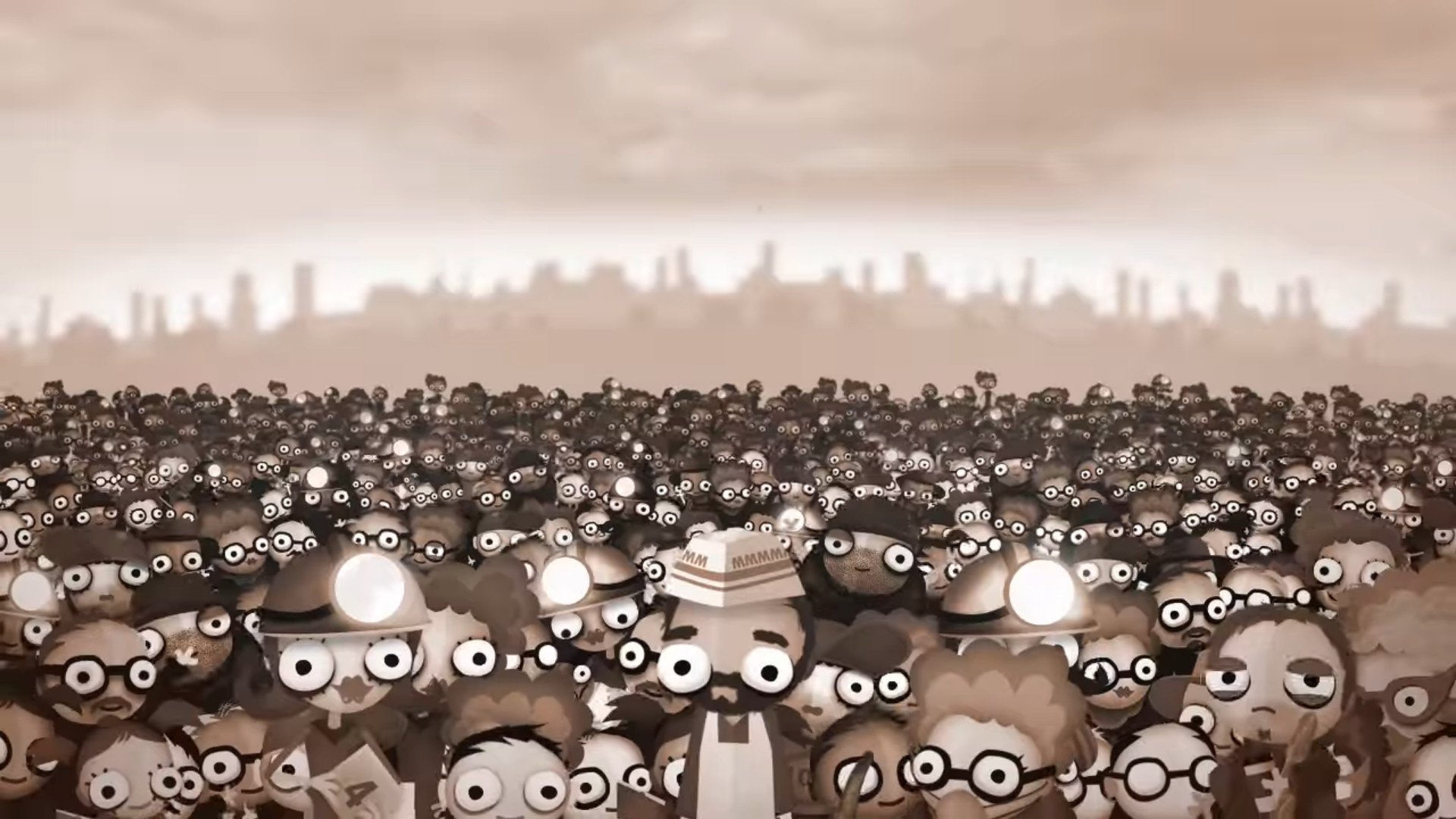
Close your eyes and think of an office environment. What do you see? Are visions of cubicle workstations, cluttered computer desks, and rubbish bins full of disposable coffee cups rushing your mind’s eye? Can you hear the click-clack of keyboards and the soft noise emitting from computer hard drives? My mind floods with the aforementioned images and sounds when I think of work offices, but maybe when you think of an office environment you think of something else. Perhaps for some reason, you envision puzzles, quirky dialogue, and big eyes?
Tomorrow Corporation’s recently announced title, 7 Billion Humans, intends to realize the puzzle, quirky dialogue, and big eye-filled office setting some of you may imagine when you hear “work office”.
7 Billion Humans: No Sweat
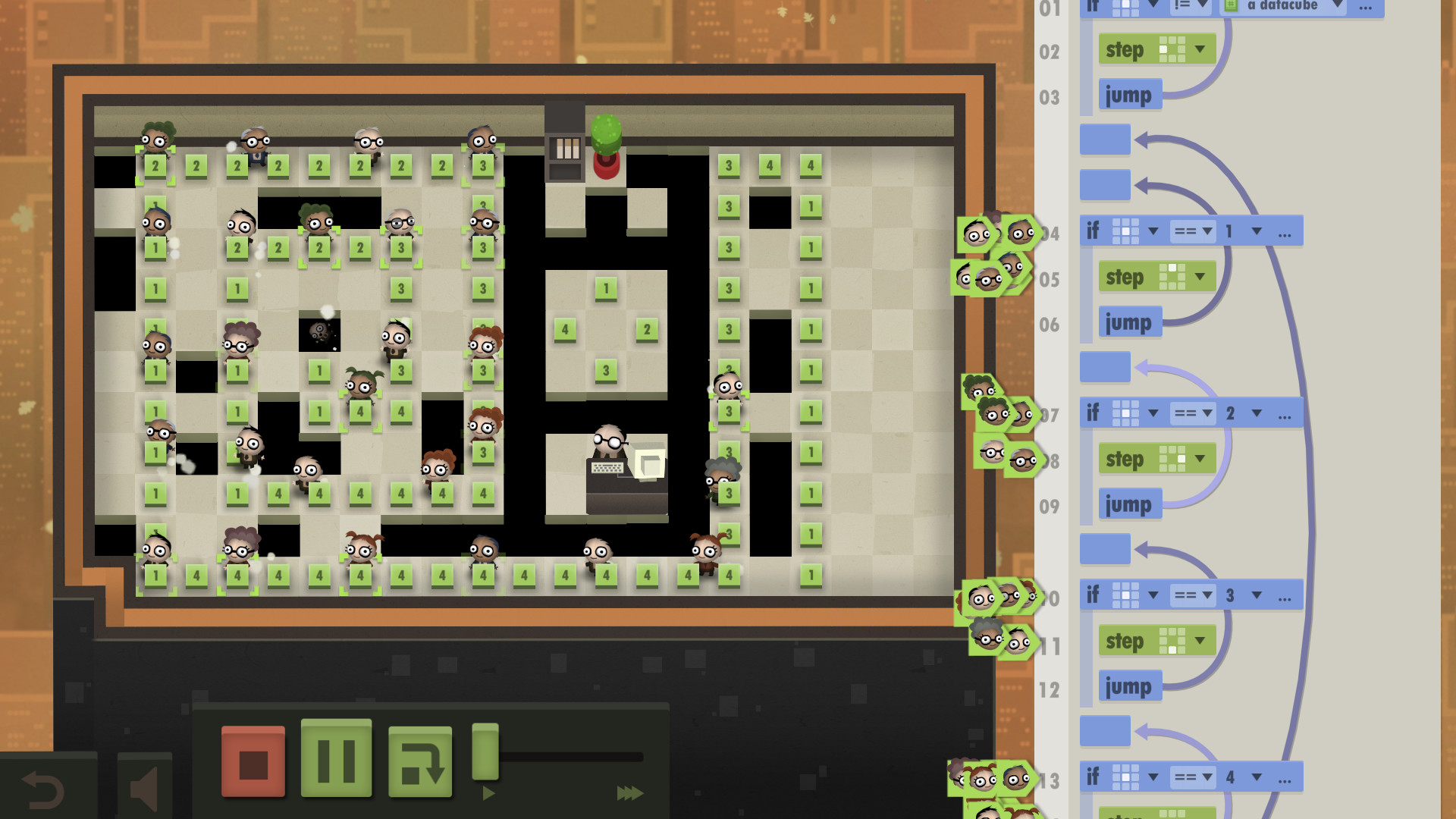
Like Tomorrow Corporation’s 2015 title, Human Resource Machine, the heart of 7 Billion Humans’ gameplay is found in its programming puzzles. Players must command a bevy of office workers using programming commands. If you don’t know how to program, no sweat! 7 Billion Humans’ programming language will be taught within the game. Screenshots are intimidatingly confusing, but instruction should make understanding the UI and programming language a breeze.
7 Billion Humans
Did I mention 7 Billion Humans’ office workers are working inside of a parallel computer? In 7 Billion Humans you are tasked with keeping a parallel computer running smoothly. As the player, you must program your office workers to solve puzzles within the computer. The puzzles, being the obstacle before you, will make your computer run poorly lest you use programming to solve them.
Of course, 7 Billion Humans is not set solely inside of a parallel computer, you’ll also be navigating your workers around a sky-scraping office building housing 7 billion human workers.
My lack of programming knowledge aside, looking at screenshots of 7 Billion Humans makes my cortisol levels jump. The art direction’s big-eyed office workers all look like they are on the edge of a breakdown, but hell, they are kind of cute. Besides a similar art direction, 7 Billion Humans will also feature the return of Human Resource Machine’s soundtrack wizard, Kyle Gabler. Gabler’s work in Human Resource Machine makes for great listening, and hopefully, his work on 7 Billion Humans will be just as great.
A release date for the game has yet to be announced. Be sure to check back here at Nitchigamer for 7 Billion Humans and its developments.
Space sims come and go but have never really opened players up to the extreme amount of vastness and endless amount of stars that dot our galaxy. Formerly known as Paragon, Jumpdrive offers the chance to set out into the great unknown and make discoveries at your own pace. Unfortunately for players short on time due to their busy schedules of adult life, school and work, Jumpdrive offers little to no shortcuts when traversing through the stars in this gutsy space exploration title. After all, the universe is infinite.
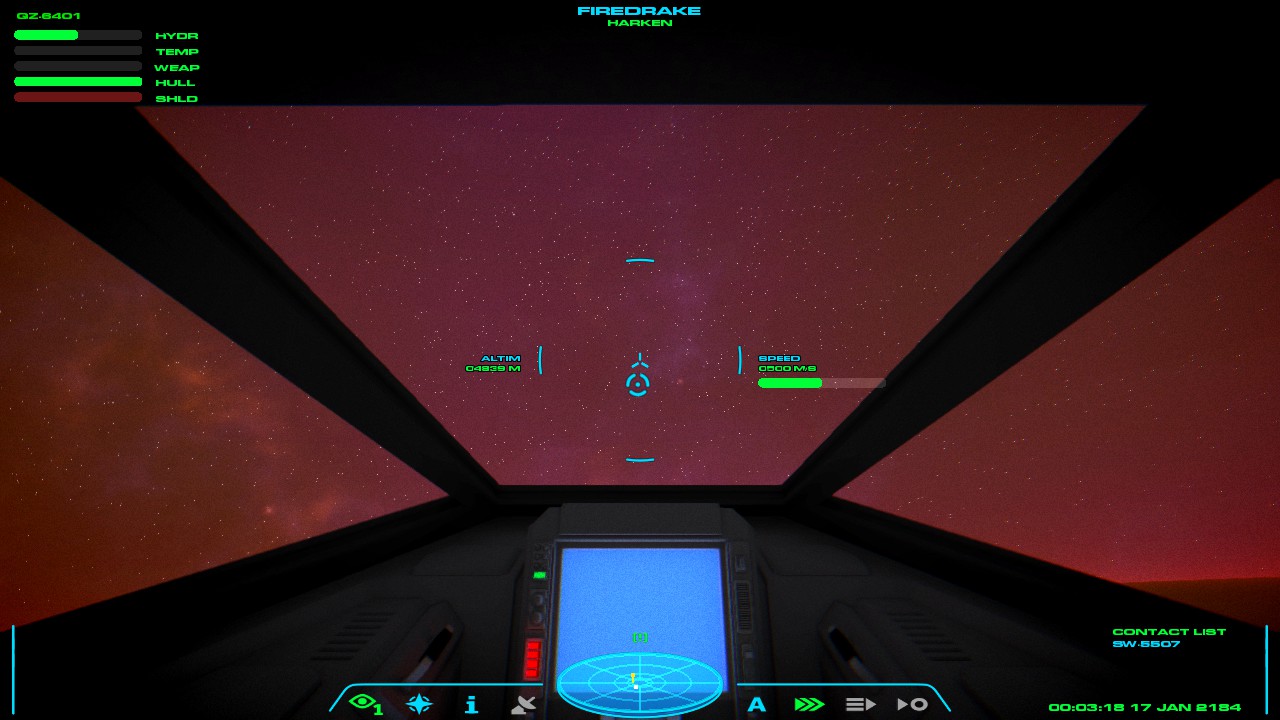
Sitting in the cockpit of your space shuttle, the instructions of the controls read across your screen. The basic click controls are simple enough, but then the game cuts you loose. The objective of Jumpdrive? Not sure… Explore? Sit in your speeding shuttle and wander through the stars for countless hours hoping to come across a unique discovery, or perhaps engage in an epic space battle? We can only hope so, anyway.
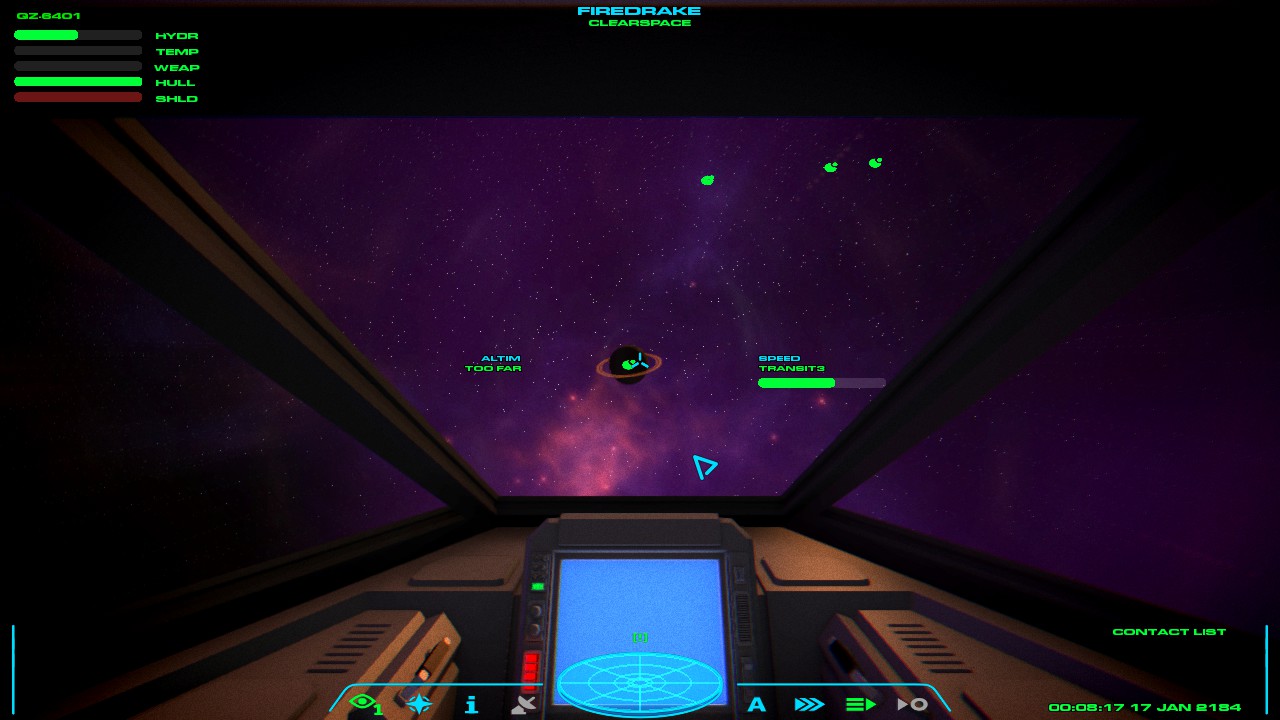
When pulling out of the gravity bubble that surrounds planets, players may then switch to an increased mode of travel, Transit Mode.
The purpose of Meteoric Games‘ Jumpdrive is to simply explore the enormous procedurally generated galaxy, picking up on anything that may cross your path. Distant missions with handsome rewards, long space expeditions to the other side of the galaxy, or fending off your shuttle from enemy ships, anything seems possible in Jumpdrive, but at what cost? The sheer amount of the universe seems endless as the developers express the ability to explore through a galaxy brimming with millions of stars and planets. Let me be perfectly clear: Jumpdrive is for the hardcore space exploring enthusiasts. Pouring in tons of hours to travel great distances, slowly immersing yourself while travelling in real-time to your next objective is an average day when living out your astronaut dreams in Jumpdrive.
Jumpdrive: How Do You Travel Through Space?
There are three basic controls when travelling from one objective to the next. When still in one planet’s gravity bubble, players may only use Maneuver Mode. This mode acts as the slowest mode of transport, used to travel around planet surfaces within the gravitational field. After exiting the planet’s atmosphere, or gravitational bubble, players may then engage in Transit Mode. Used for quicker travel between planets, Transit Mode will most likely be your main mode of travel.
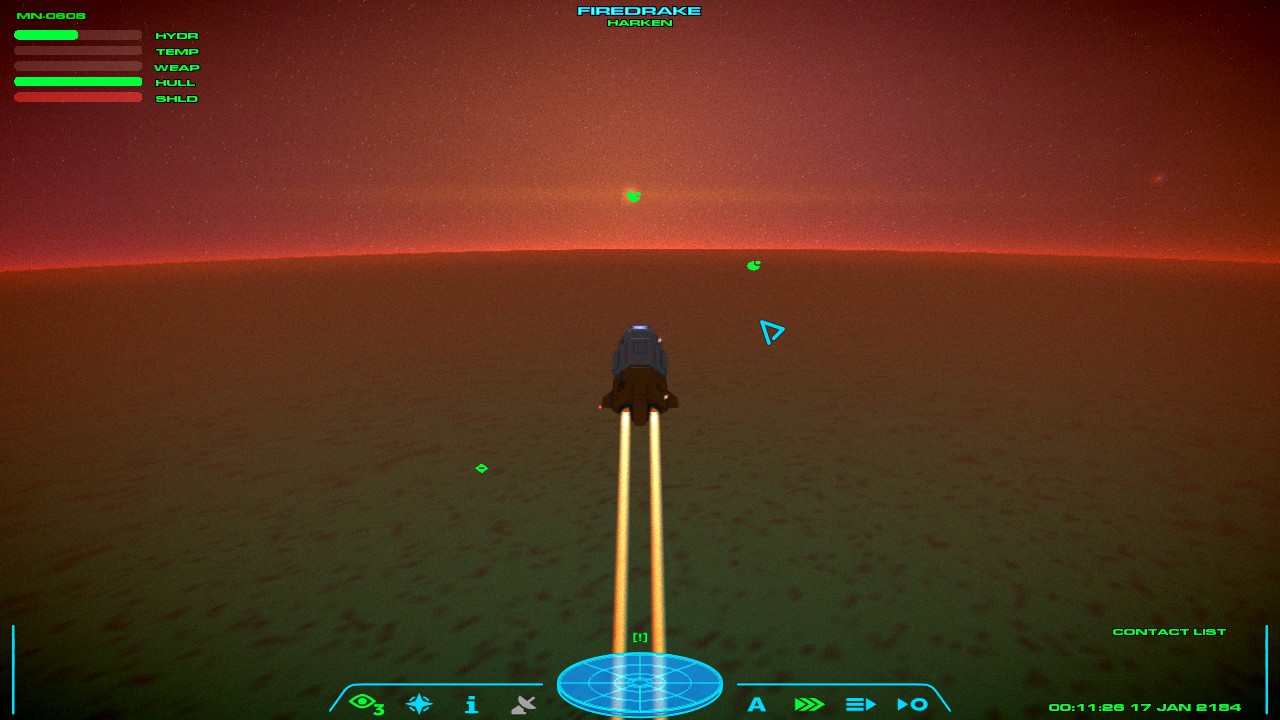
Many green blips mark your objectives and other planets/space stations throughout the systems.
Last but not least, Jump Mode is the hyper speed setting to jump between different solar systems. Though a much quicker method of travel, players will need to meet the specific item requirements, e.g. hydrogen stock, as well as a jump drive installed on their shuttle. The three modes are accessed simply by clicking on one of the icons next to your radar at the bottom of the player’s screen, offering for quick and easy switching between modes on the go.
Objectives are found when following the green blips that are scattered throughout the open universe. Either when docking on planets or space stations, completing the various missions given to you will net cash rewards, which can be used to purchase upgrades or even new ships. Though from what I experienced with my time in Jumpdrive, the missions are standard fetch and grab or destroying enemy ships, but the amount of ground (or space) to cover is remarkably vast. I can easily see one losing most of their day spent completing a handful of objectives spanning across a number of different solar systems.
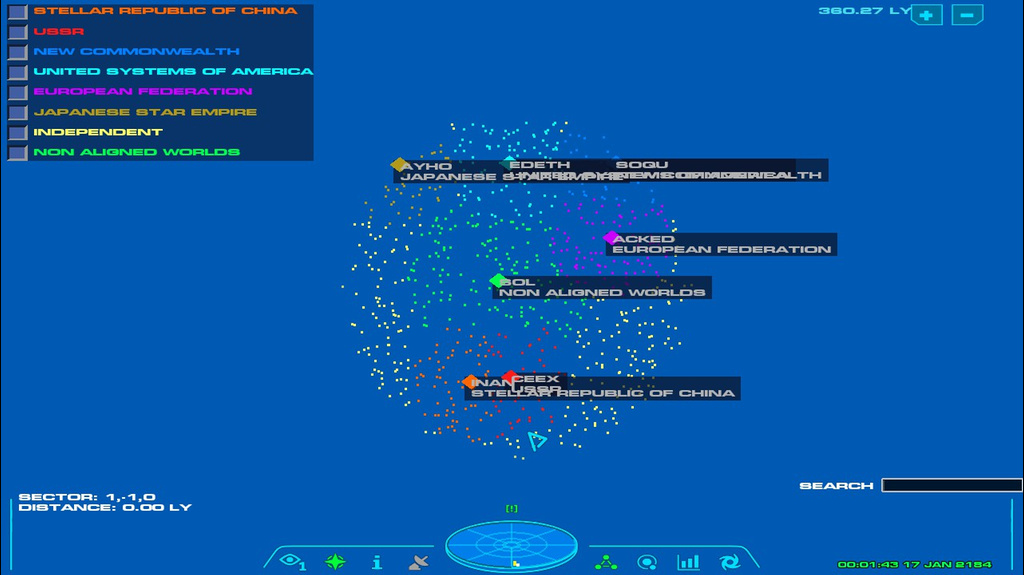
Plot your destination on the galactic map and use Jump Drive to travel between solar systems.
While Jumpdrive is astonishing in size, the visuals are no conversation starter. Though there’s not much to gaze upon when deep in the blackness of space, planet surfaces and textures when in sight are grainy, bleak and boring. I suppose that’s not exactly the point of Jumpdrive but it still manages to break some of the immersion when descending into a planet’s atmosphere. Still, the view of colors amidst the star-dotted sky is a sheer joy to stare at while endlessly drifting into the void.
So Much To Do, So Little Time
So, what is the point of Jumpdrive? Is there any storyline, plot twists or ending in sight? The answer is yes, but it all comes down to the player involved. With Jumpdrive you are offered a chance to create your very own space legacy in this massive space explorer, and take it for as long as you please. Players have a completely open experience from the start, whether they’re engaging in combat, completing various mission objectives, purchasing new ships and parts, or simply exploring the vast darkness of space.
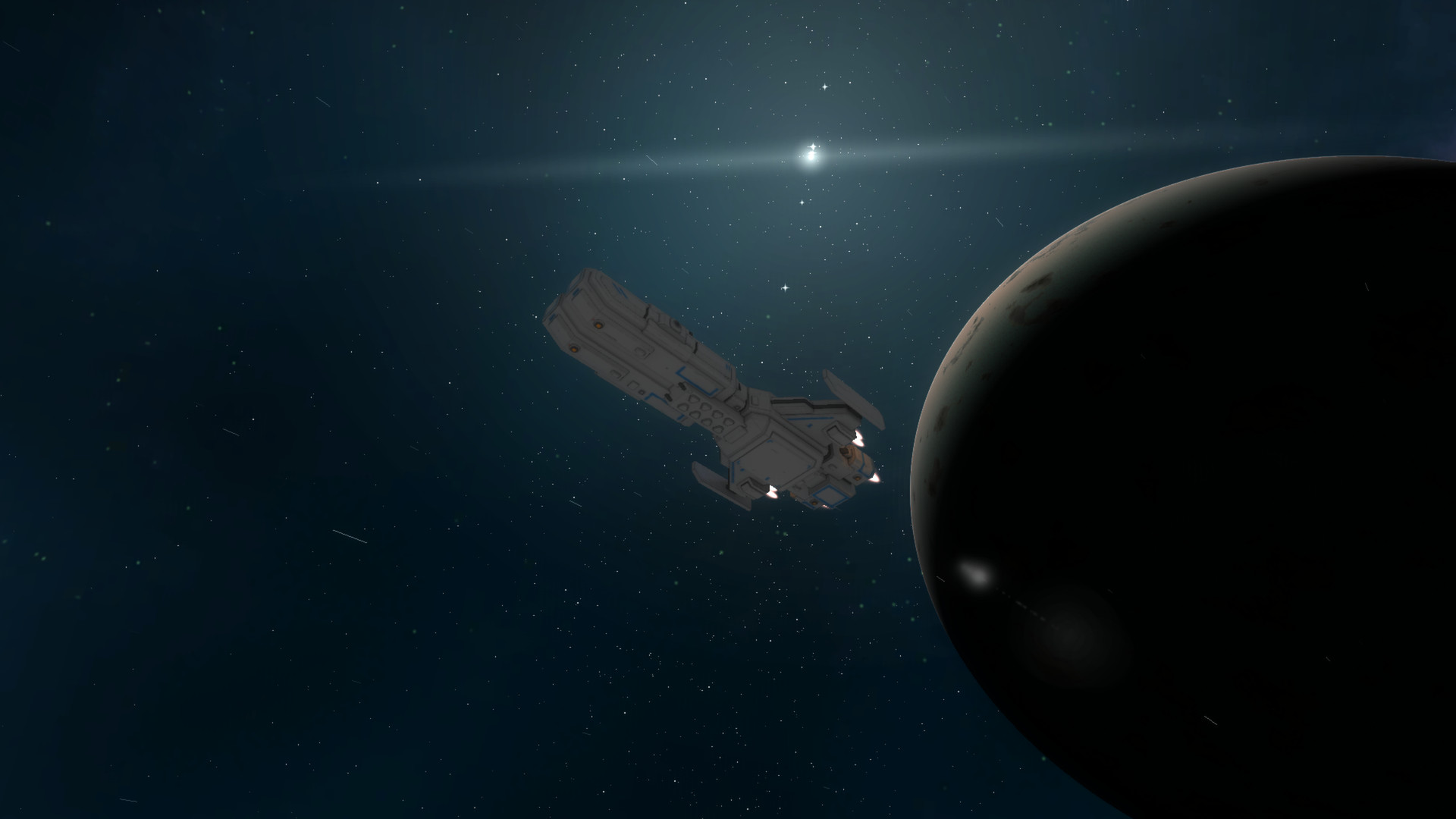
The distant visuals of space are breathtaking in Jumpdrive, adding a thrilling sense of depth to the enormous space sim.
Jumpdrive is an impressive space sim, but if one thing is certain, it only appeals to a relatively small audience. Those hindered by time and, in my case, an ever-growing backlog of other titles, simply won’t find it in their schedule to continue on this vast journey through the great unknown.
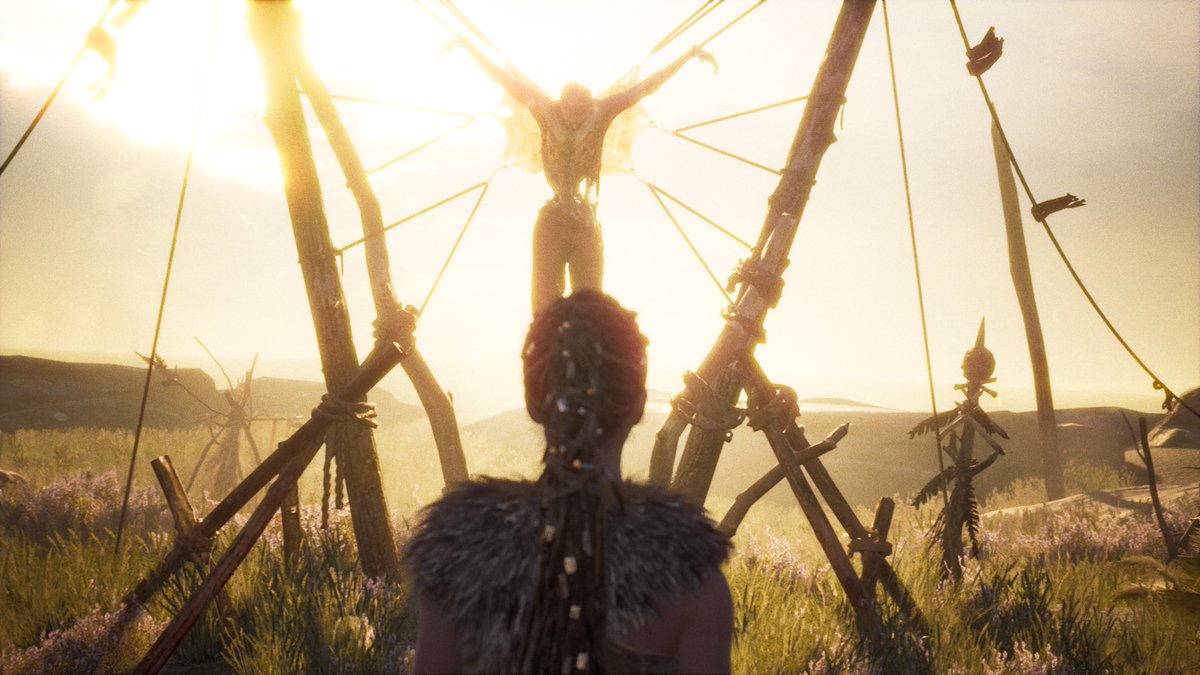
With the ever-popular action adventure category of video games becoming more and more saturated throughout the years, developing teams are finding new ways to push the envelope for the repetition-riddled genre. After making a name for themselves with titles like DmC: Devil May Cry, Enslaved: Odyssey to the West and Heavenly Sword – Ninja Theory is back with another gripping action experience; but doing so by tackling the dark and merciless journey of a Viking warrior, aided by her haunting curse of psychosis and mind-rotting visions in Hellblade: Senua’s Sacrifice.
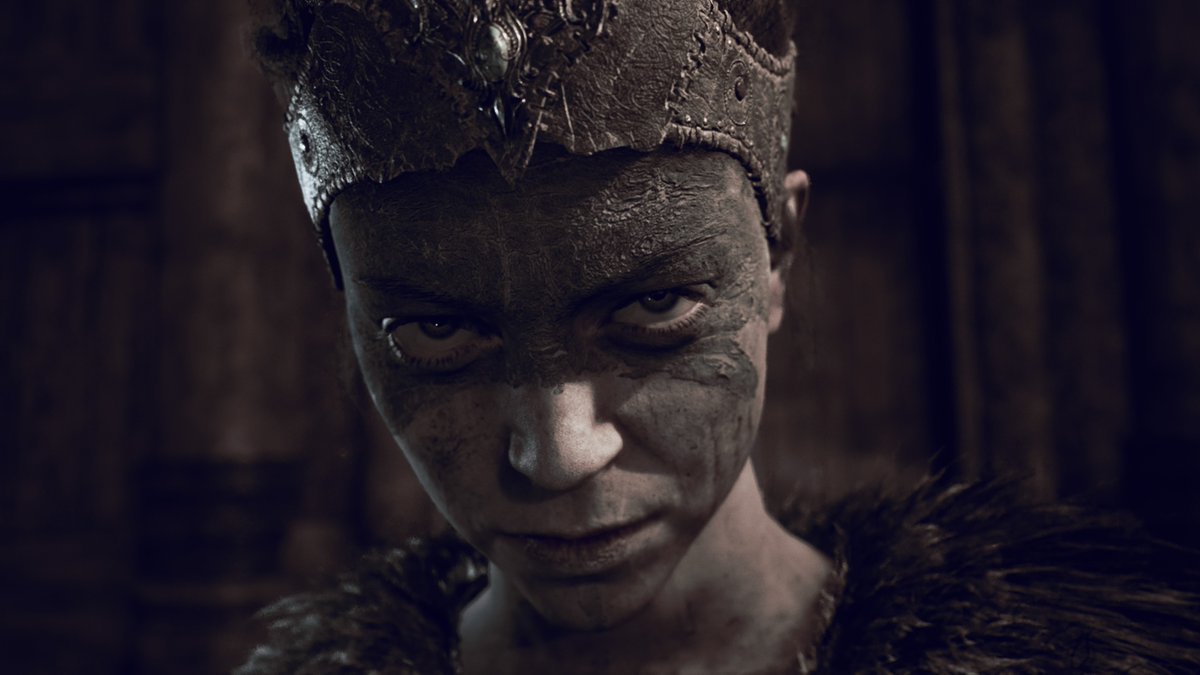
Playing as the Viking warrior – Senua – you’ll embark on a disturbing journey to the depths of Helheim.
The path of Senua is a violent and disturbing one, bringing to life the realism of psychosis and interpreting what it’s like perceiving an alternate reality from what’s right in front of the player. The team at Ninja Theory did their research regarding this mental disorder, and it shows dramatically. The entire run-through of the 7 hour or so long campaign is brimming with haunting whispers, flickering lights and distant movements, ever pushing the twitching reality of Senua’s chaotic, and broken mind.
Hellblade: Senua’s Sacrifice – Fighting the Curse of Psychosis
The game is extremely linear, following a given path of intricate puzzle-solving and staged combat experiences. The dark story of the Viking warrior and her quest to Helheim to bring her loved one back to the living is as endearing as any love story, but permeates with evocative dialogue, enveloping sounds and troubling imagery. The puzzles featured are innovative and unique to the story of Hellblade, but add a much-needed sense of depth to the overall gameplay. If not for the ever-present puzzles to solve, the staged combat doesn’t quite fill Hellblade with sword swinging hack ‘n’ slash battles like other titles from the Ninja Theory catalogue.
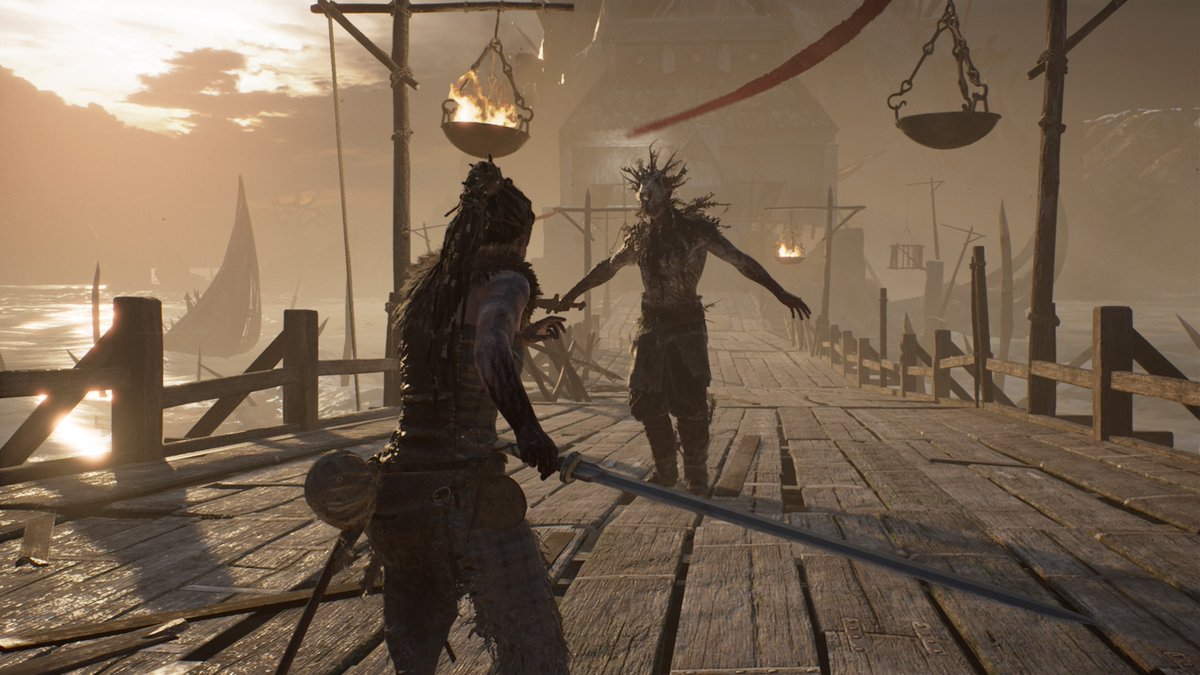
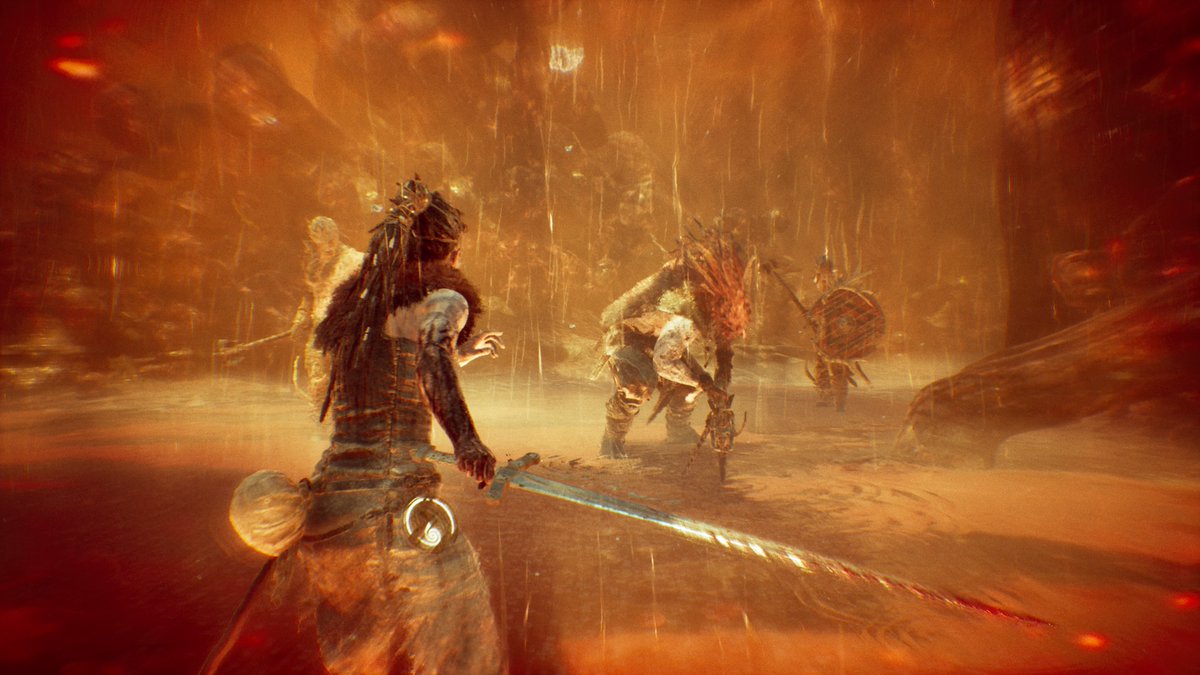
Throughout Hellblade players will be faced with brutally grotesque monsters in the staged hack and slash combat.
As you begin your journey to Helheim, the grave voice narrates over your slow trek to one new area after another. Hellblade is fueled off the drawbacks of psychosis. The constantly shifting reality of the scenery surrounding Senua is the source to figuring out the many puzzles, by either finding specific shapes scattered somewhere in the world, discovering and aligning segments of a symbol to create the full image or finding other discoveries hidden deep within the Viking world.
As you progress through, the combat in Hellblade will soon enough be introduced. Appearing in front of your from the ashes, enemies come in a handful of different forms. Quick acting sword swingers, shield-wielding brutes and giant warriors bringing down a heavy blade with extreme force are all part of the family of opponents found in Hellblade. Senua fights with a standard mode of attack, with both a light and heavy attack, a melee kick and, of course, the useful dodge technique.
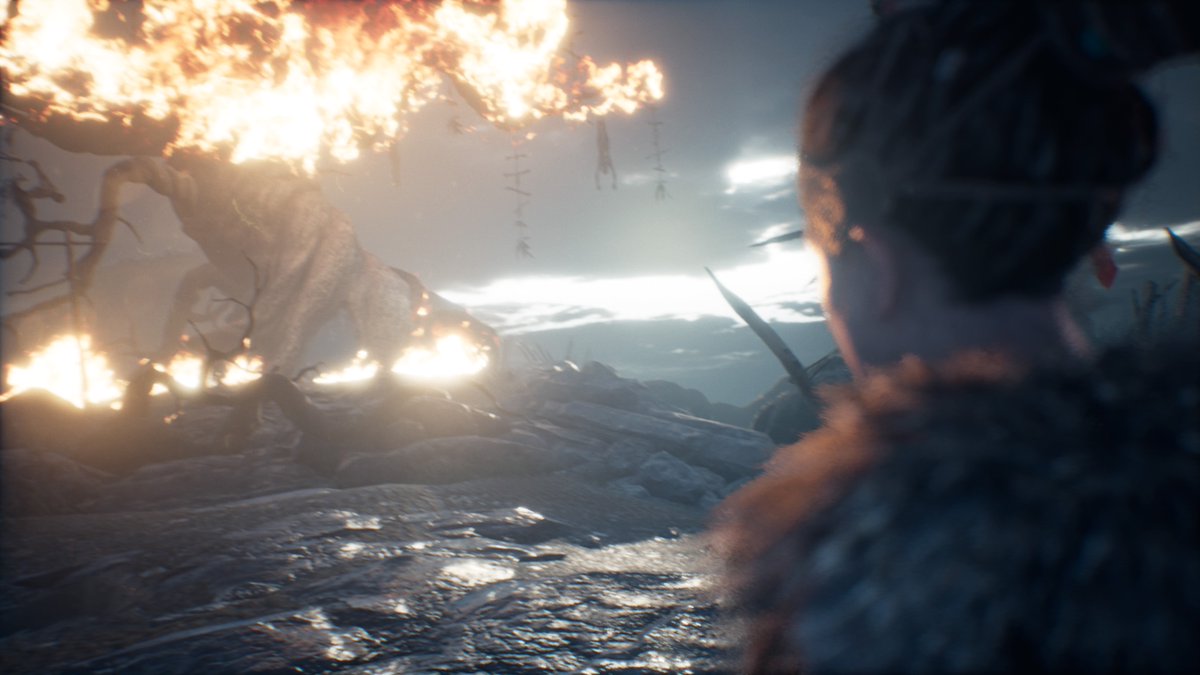
Illusions from psychosis haunt Senua throughout her deadly journey to Helheim.
Along with the defensive tactic to roll or sidestep, Senua is capable of blocking attacks with her sword, as well as performing a parry move to open up an attack window for extra damage. I mention this parry technique because the game simply fails to do so. What seems like an important combat ability, parrying is only discovered by the player when they time a perfect defence against an enemy’s attack. On top of the parry technique and other essential combat manoeuvres, Senua also has the ability to use her focus skill in combat.
Focus. Use Your Inner Eye
The focus skill while outside of combat allows Senua to “focus her inner eye” on important details and symbols throughout the journey. The focus technique is the primary ability to solving the puzzles that riddle Senua throughout her story. That being said, puzzle-solving is not the only occasion Senua will use this secret skill. During combat, using the focus skill – which is charged by connecting Senua’s attacks – will slow down time for a few moments, increasing the number of strikes Senua can land on her opponents. Though simple and unembellished, the what seems like shallow combat mechanics provide an incredibly exciting and thrilling experience when engaging in the vile monsters that come to take Senua’s life.
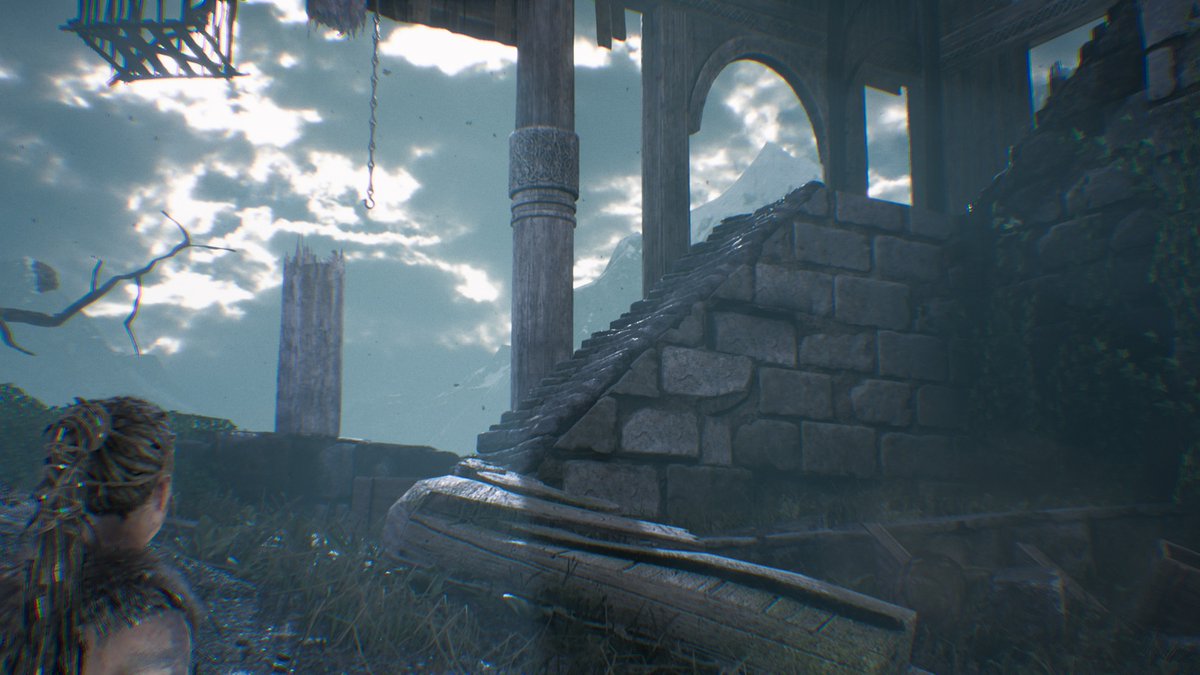
Using the focus mode, players will need to solve puzzles by paying close attention to details in Senua’s surroundings.
The curse that follows Senua throughout the game is both mental and physical. While the whispers and cynical chants eat away at her mental stability as she undergoes her harrowing journey, the physical torment endured from failing is just as disturbing. The lingering fear of losing your progress is a significant weight the player must carry as the black plague on Senua’s arm crawls upward with every player death. Once the webbing plague reaches Senua’s head, the game is over and the player must start from the beginning. Luckily, with a selection of combat difficulty, text-book staged combat and relatively short story length, starting over doesn’t seem as much of a chore as it sounds. Of course, there are some who claim that losing your progress never actually happens after numerous deaths, but is merely a bluff from the developers.
Senua will often find herself against multiple enemies at once, but using focus in the midst of battle will allow a brief period of slowed down enemy movements.
Impressively Evocative
The winding and distraught road of Hellblade: Senua’s Sacrifice is something so powerfully stirring that playing through the linear campaign multiple times still feels fresh and thrilling. The isolated quest to defeat the horrors of Helheim, overcome the dark curse that haunts Senua and return her loved one back to the living is as enthralling as it is disturbing. The realism and time spent on providing an accurate reflection of what it means to wield the curse that is psychosis is impressively alone, not to mention the astonishing visuals and sound effects. Ninja Theory took their time with this one, and it shows, as Hellblade: Senua’s Sacrifice is easily one of the most memorable experiences from 2017.
First-person shooters have developed a sort of stigma over the years of being linear, cover and shoot forms of entertainment, primarily focusing on war in realistic scenarios. Soldiers of the Universe follows this mechanic almost religiously, giving new definition to the term “linear”. Infiltrating Middle-Eastern terrorist organizations across Syria and Istanbul, independent developers, Rocwise Entertainment, bring a sobering experience to the ‘duck and cover’ genre of FPS games.
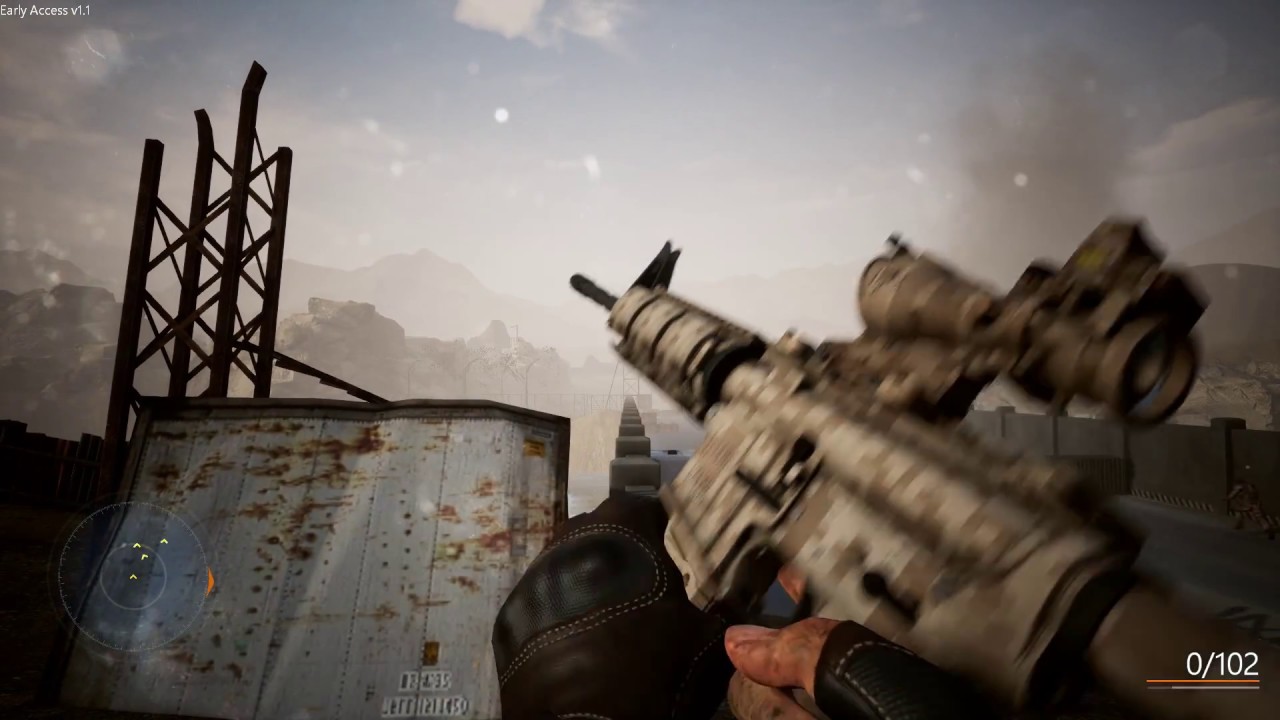
The visuals in Soldiers of the Universe take advantage of the Unreal 4 engine, but do little for content featured in the dull shooter.
Soldiers pits the player in with a colourful group of specialized comrades all with their own unique skills and dialogue. Though there’s not much dialogue throughout the course of battle, each character supposedly has their own style of play. Throughout my time with Soldiers I found myself running through the same old routine of following the completely linear path while the three members in my party blindly ran around corners into raging gunfire. Luckily for them, they’re rendered invincible, and mostly not targeted by enemy forces, thus leaving me to follow unsuspectingly into instant death encounters.
The story behind this “narrative-driven” shooter takes players through rugged and uninspired settings, holding the hands of the squad throughout the game. There are no secrets, hidden areas or objects, or any incentive to tread off of the linear questing, which is filled with un-lively, statuesque AI enemies. Gunning after the major Middle-Eastern terrorist organizations, players – and their dull squad – will fight through waves of tactless opponents throughout a dim range of maps.
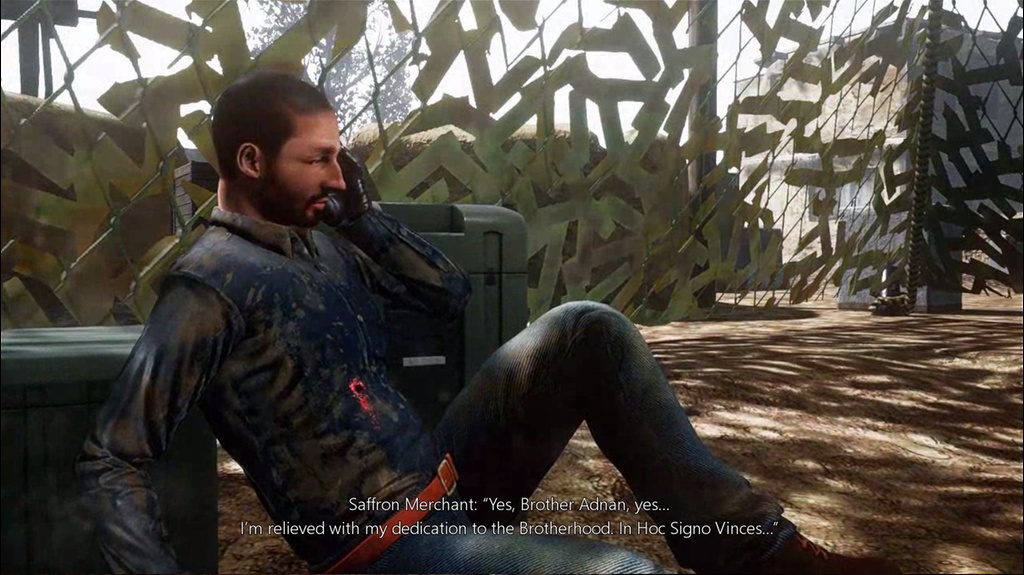
The story behind Soldiers of the Universe is dull and mostly full of un-suspenseful moments.
Straight To The Point
Traversing through the maps is a breeze, with only one objective and one route to go, proceeding forward is literally the only option. There are instances of areas, which, in other shooters would be filled with loot, secret items and intel – Soldiers brings a barren wasteland. Empty homes are completely abandoned without anything interesting to investigate. Not even pieces of broken furniture or other household items were added to the game, leaving an unfinished, and un-rewarding experience to the FPS.
The emptiness of Soldiers is only scratching the surface of the limitations found in the linear campaign. While following your squad, like clockwork, every 20 seconds or so a handful of enemies began firing down upon you. What’s different from most shooters we see nowadays, is the enemies will switch to better cover, flank, or at the very least, act as though they resembled a human being. The enemies in Soldiers are as boring as they come, standing in place firing away at our hero. Only to reload would some of the terrorists hide in front of cover, but this is the actual extent of how motionless these enemies are. Hiding behind cover to regenerate your health was easy and fluid knowing none of the enemies dare move from their position.
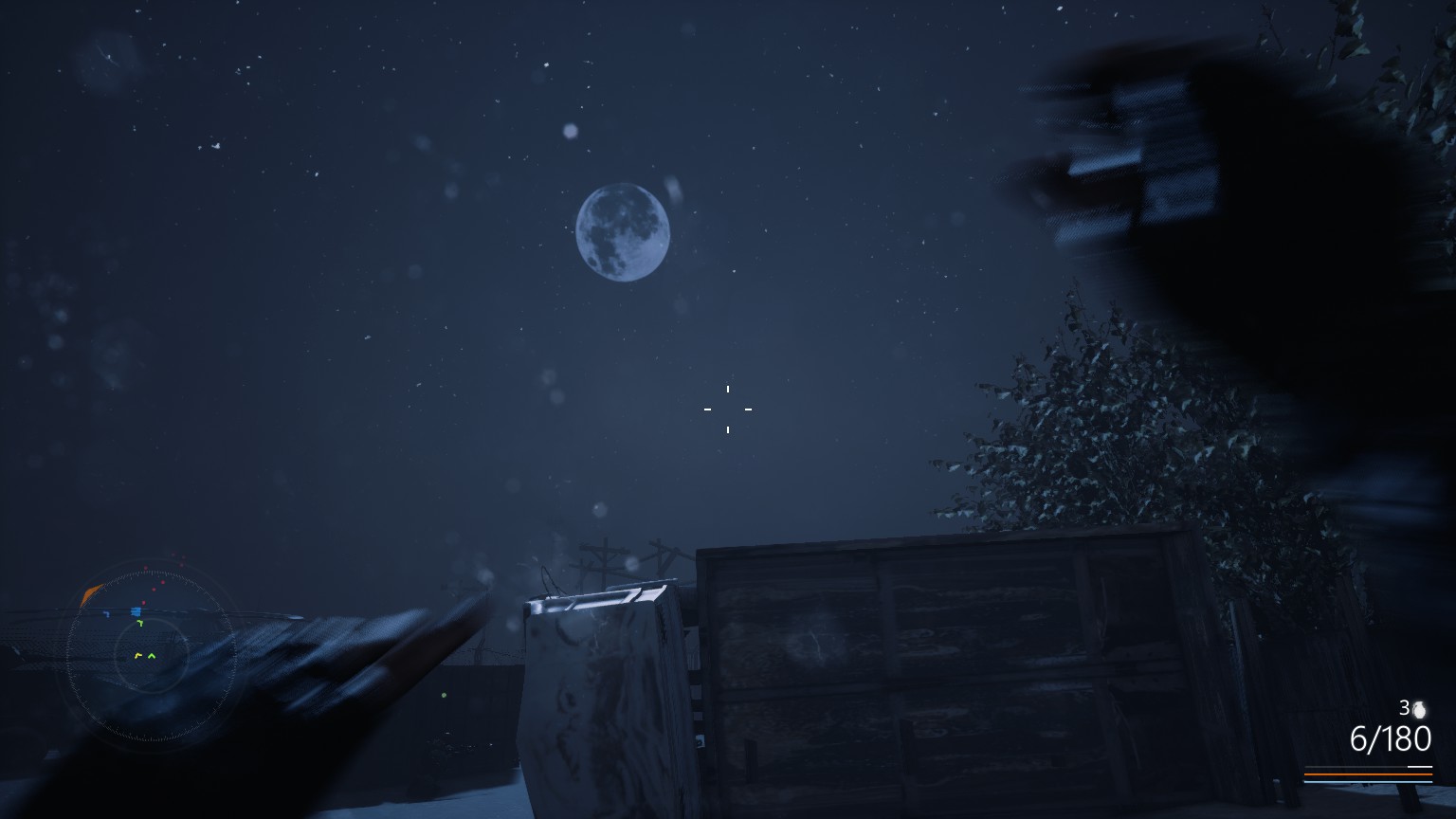
Some missions have players completing objectives at night, providing a subtle sense of change in the otherwise rote gameplay.
Where’s The Arsenal?
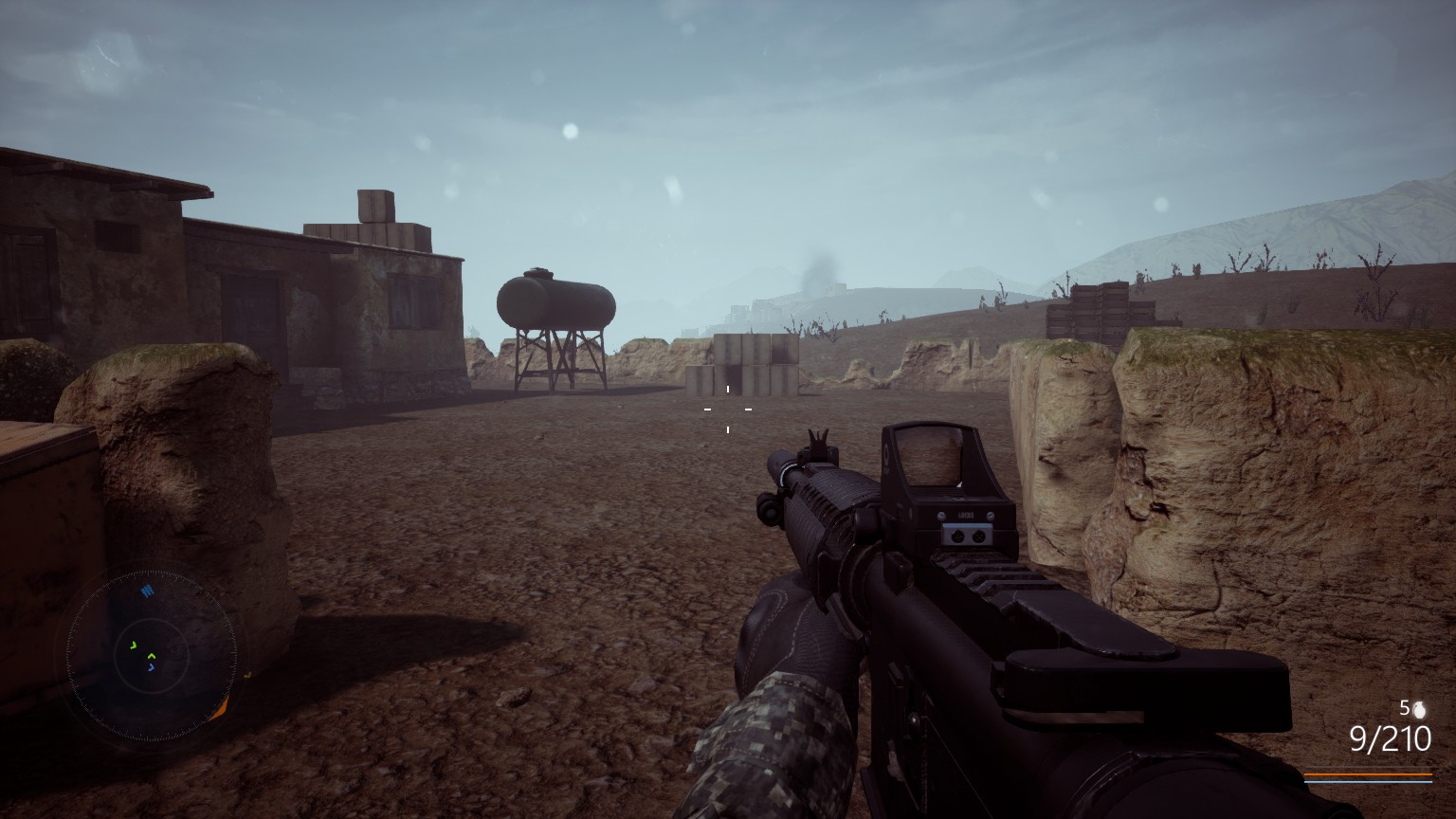
Starting a mission will net you three various weapons throughout the following objective. Typically two types of assault rifles equipped with scopes, and a sidearm pistol. Looting enemies for their weapons is a no go, and any sort of special ammunition ceases to exist. There is the grenade option, as what would a war game be without some impactful explosion to throw around? Finding ammo is as easy as refilling from one of your support members of your squad, as they have an unlimited amount of free ammunition. Of course, there are also ammunition crates scattered throughout the levels – these being the only interactive objects found in the maps – but there’s not much need to go out of your way for these when it’s easier to simply track down your squadmates and reap the same results.
The lack of discovering more weapons or explosives is a real sore spot in Soldiers of the Universe. Many fans would agree that unlocking or finding secret or powerful weapons is a massive adrenaline rush in many of the FPS games around. Forcing the player to adhere to specific weapons hinders any sort of unique experience found in shooters. Gamers love options; to have these stripped away feels cheap and presents a lacking atmosphere filled with predictable moments time and time again.
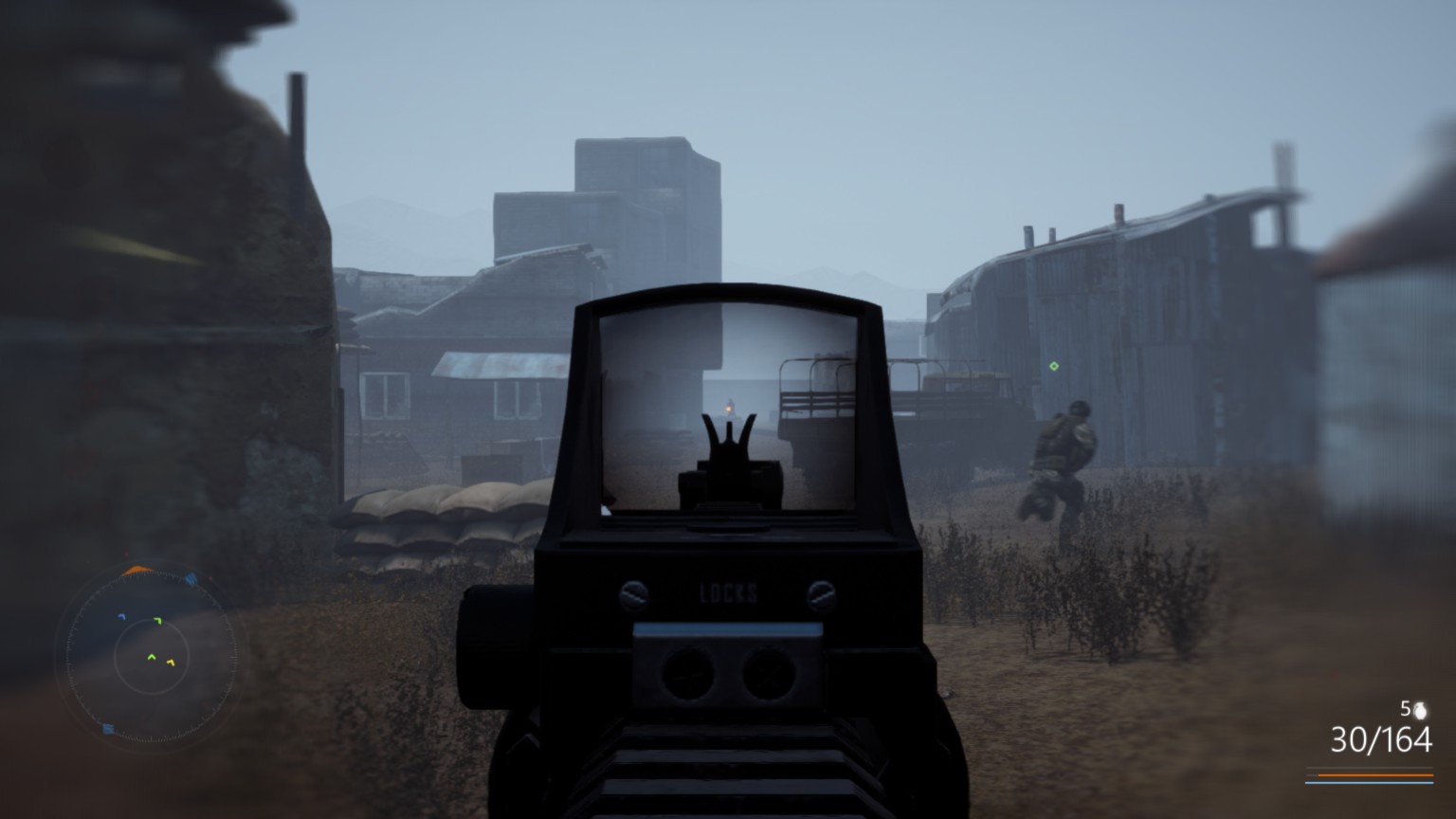
Enemies stay in position while you’re clumsy squad mates blindly run into enemy fire, showing off the number of issues with the AI in Soldiers.
As mentioned above, the maps are lacking creativity and content only pointing the player in the direction of your sole objective. The minimap and all of its minimalistic detail show a whopping three types of icons: you and your squad mates, upcoming enemy forces and the ever-present, but completely pointless ammo crates. The red arrow acting as the compass surrounds your mini map and points towards your objective; for anyone who is having trouble following the stale and linear path of the questline.
Though many FPS titles follow the same formula, most accomplish some sort of exciting essence in a dramatic storyline. Soldiers of the Universe – though it plays decently smooth and offers sub-par graphics utilizing the power of Unreal 4 – provides a lacking experience that can easily be left in the backdraft of stumbling shooters. Surrounding all of the negatives Soldiers has to offer, there is promise of something far greater from the indie development team, RocWise Entertainment. Let’s just hope future endeavours from the team prove more worthy than their tediously linear shooter, Soldiers of the Universe.
Turkish developer, Rocwise Entertainment, brings a military shooter to the PC in their debut release – Soldiers of the Universe. In this story-driven first person shooter, soldiers fend off against terrorist organizations from Northern Syria, Southeast Anatolia and Istanbul, players will take part in The Republic of Turkey’s military organization, The Akinci Warriors.
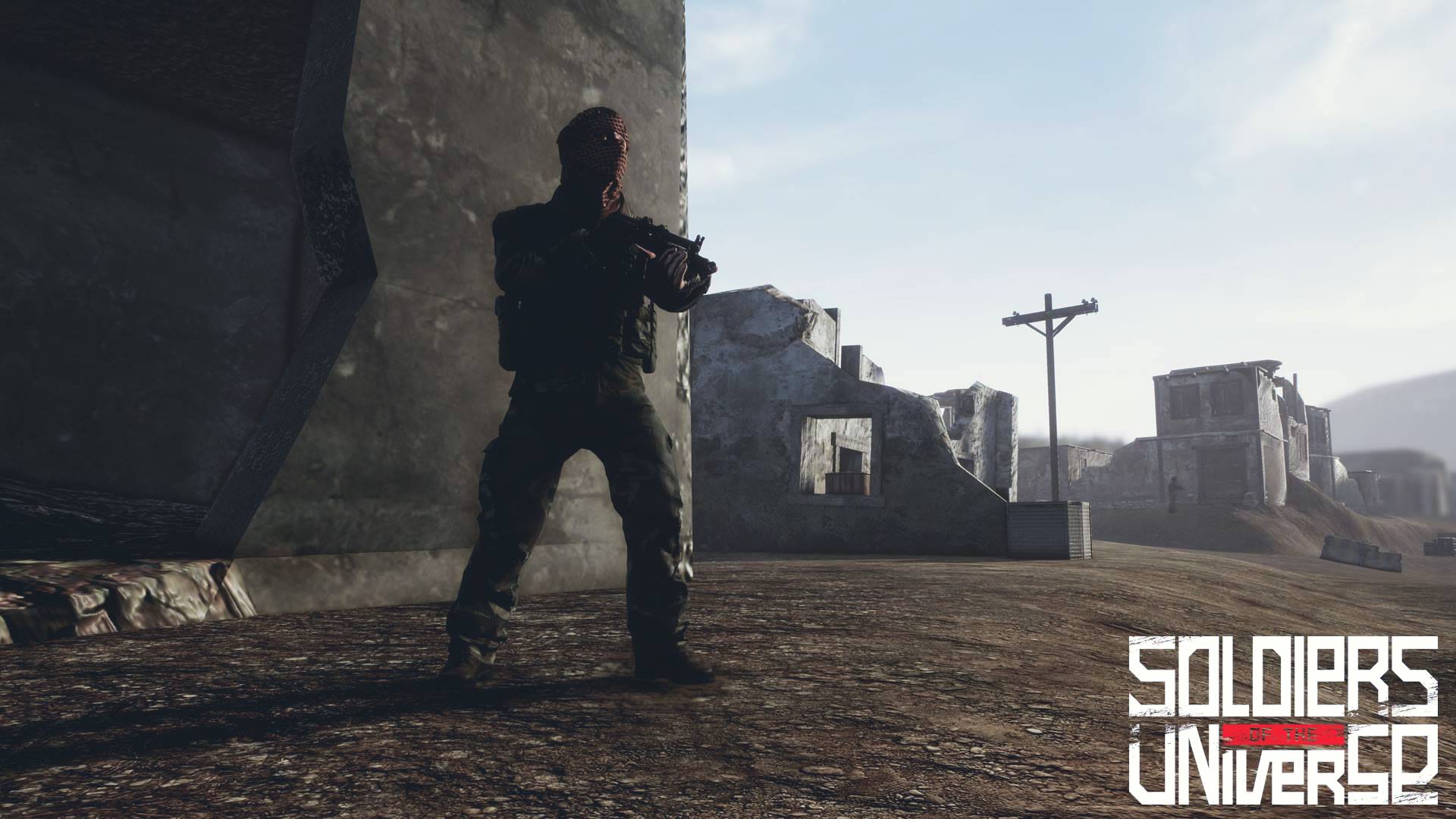
Soldiers of the Universe pits players against Middle-Eastern terrorist organizations.
Players take on the hero of Hakan, a soldier who has been thrust into the role of The Universe, of the Akinci Warriors; a position which was formerly held by his deceased father, Selim Kahraman. Seeking to avenge his father, Hakan will lead military organizations to take down the many enemies of the state. Of course, Hakan will not be alone in his fight for revenge, at his aid will be three other players to help stop the Middle Eastern terrorist organizations.
Start your reign against terrorist organizations with the four heroes featured in Soldiers of the Universe: the protagonist Hakan – or better known as Eagle, the serious marksman Hawk, the foul-mouthed technological nerd – Owl, and the intelligent, sarcastic linguist – Vulture. With these four men, take the fight of The Republic of Turkey, and give the terrorists of the Middle East everything they have coming to them.
Check out the trailer below from Rocwise Entertainment, and check back in at D-pad Joy later in the week for our official review of Soldiers of the Universe, which is available now on Steam.
Arelite Core invests players into a journey in which a master blacksmith embarks on an adventure to witness the secrets of other master blacksmiths based around the world. Played in traditional RPG fashion with gorgeously rendered sprites, established turn-based combat, unforgettable characters and a timeless musical score wrap it all tightly together.
In Arelite Core, a master blacksmith – Karden – from the small village of Arreal undertakes a journey to travel around the world to learn the secrets of his trade. From village to village the legendary blacksmith will meet and greet with other master craftsmen, accompanied by his savvy and egotistical battle buddy, Baeme. Picking up other companions throughout your journey and uncovering truths about the dangerous ancient Arelite stones, players will swiftly grasp the mechanics of this familiar looking RPG.
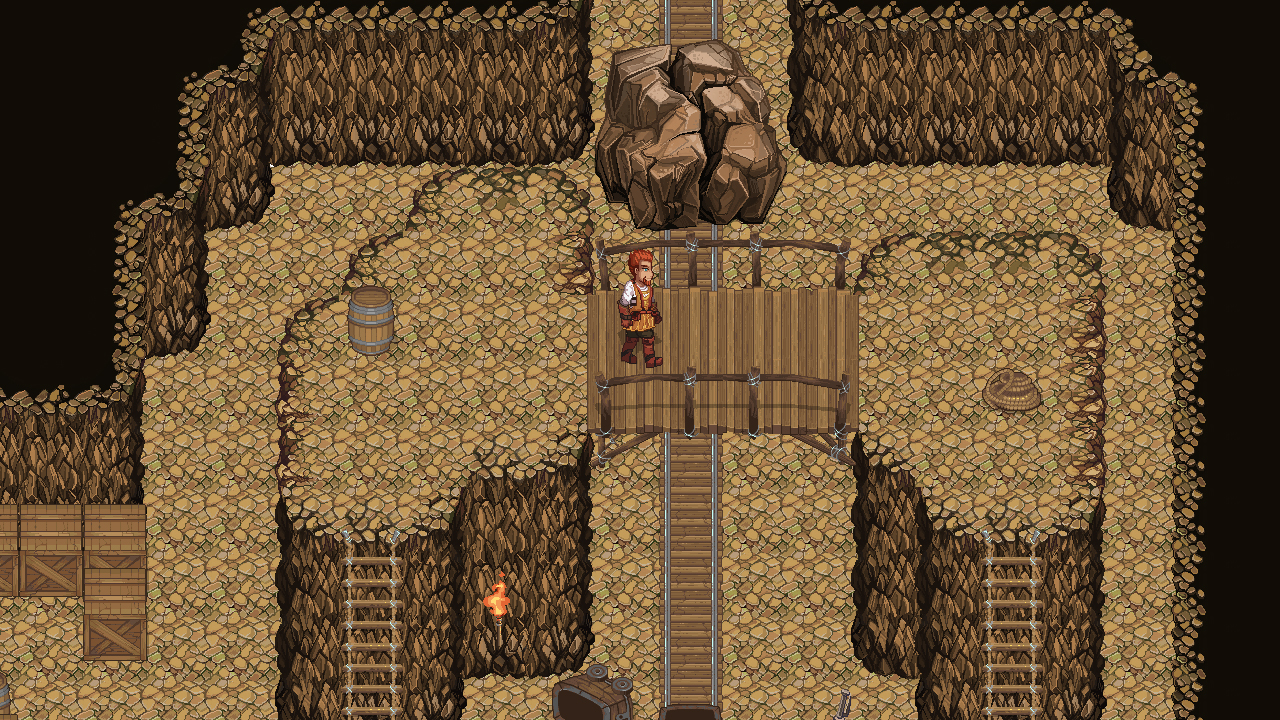
Traversing through dungeons may lead to hidden paths containing helpful items, as well as more monsters.
A Colorful World
As the simple story progresses about the dedicated craftsman and his cocky companion, the lurking dangers of Arelite – an ancient resource used to make absurdly powerful weapons – is now falling into threatening hands. Knowing the power of Arelite, increasing your knowledge and skills as a blacksmith is now crucial in stopping the evil forces and bringing peace back to the world.
The aesthetics of Arelite Core brings back the early years of the adventuring/RPG genre, with colourful and unique sprites, text-based narrative and an enthralling musical backdrop. Exploring, developing your characters/parties and easy-to-learn turn-based combat all provide for a thrilling ride atop the compelling story following the master blacksmith and his faithful and colourful companions.
The open areas and dungeons to roam are familiar in almost every sense of the word when compared to the 16-bit fantasy titles the gaming community remembers so fondly. Unraveling bits of lore and dialogue by talking to the wandering villagers, or bartering with charismatic business proprietors for useful items, armour and weapons are still the standard when entering new areas. Though the game doesn’t offer much difference when it comes to the traditional RPG mechanics, Arelite Core still manages to produce an immersive story full of role-playing tactics and a plethora of evil monsters.
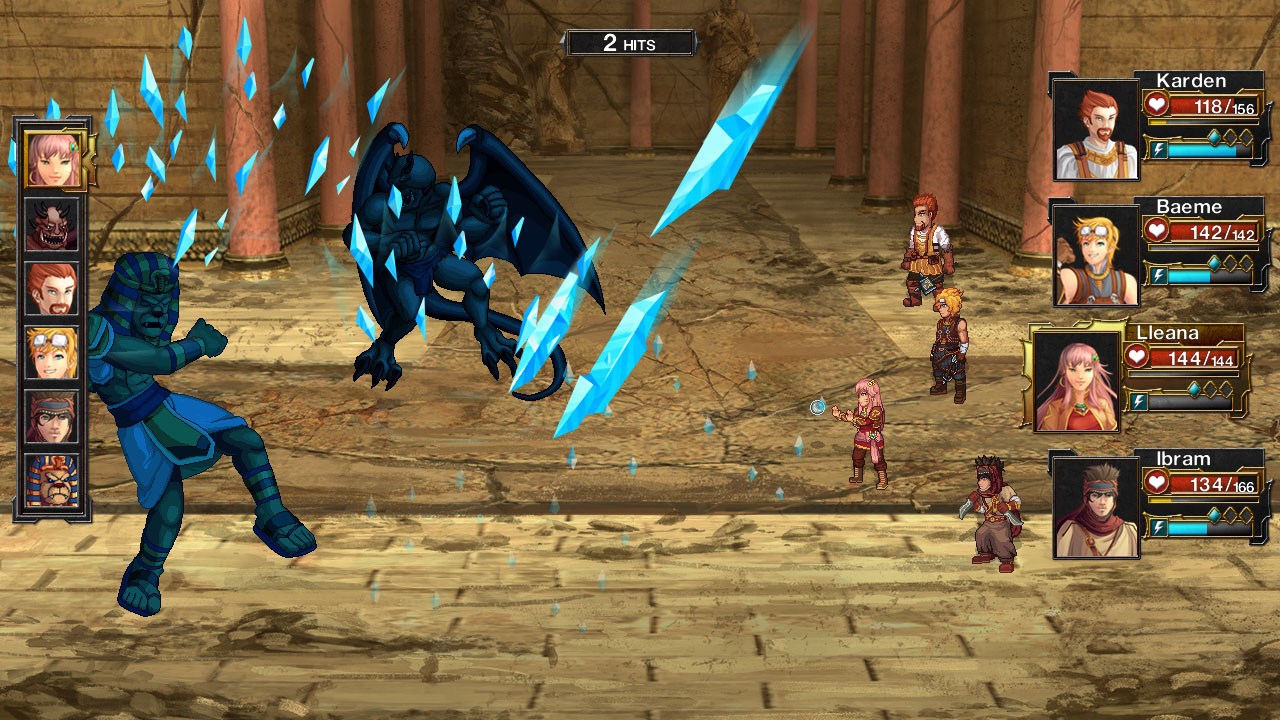
Traditional turn-based combat mechanics bring common tactics found in a heap of other RPGs.
Classic Combat Mechanics With A Few Quirks
The turn-based combat tactics involve all of the strategic – both defensive and offensive – manoeuvres, including physical strikes, magic, healing and special moves known as Blitz. Battles break out once the player (or the enemy) has made contact, spinning players into a bout filled with a number of powerful monsters. Standard strike attacks deal damage using whichever weapon is equipped by each character. By gaining levels and upgrading your characters, new skill points and weapons will increase the strength of these strike attacks.
Other tactics like parrying and the ultra-powerful Blitz moves offer unique abilities to raise defence, recover health or deal massive blows to tough opponents. Parrying acts as a form of defence to prepare the given player a stance against any incoming attacks, but also adds a touch of health to the character as well. With every landed blow or damage taken, each characters’ blitz bar begins to fill. Every time the blitz meter fills, a point is acquired and may be used to initiate a special blitz skill. Powerful elemental attacks, magic abilities like summoning monster allies, or healing/buffing your companions in battle are only a few of the unique tactics available through the blitz system.
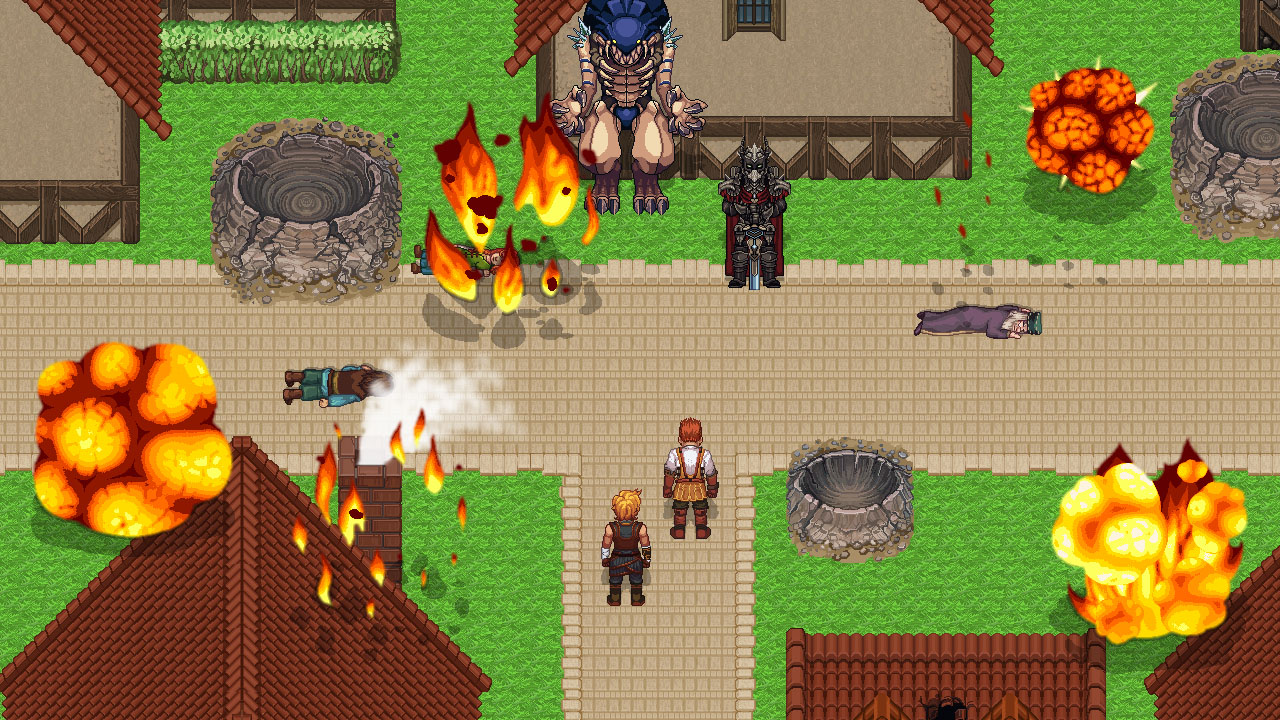
The world is in turmoil against a devious threat using the powerful resource, Arelite.
Strengthening Your Stance
Strengthening your party comes in a variety of useful skill and blitz upgrades. Adding skill points earned through multiple levels, three different categories known as Stances – one for each of the three combat moves – are available to increase in a manner of different ways. Increasing the Strike, Parry and Blitz skills provide a number of buffs, percentage increases in strength or defence, more effective blitz encounters or the ability to stun enemies more frequently. These skill categories act as the main form of character development giving each character a unique twist in combat and strategy.
Blitz, strike and parry moves are all vital stances in overcoming the odds, but having a strong weapon equipped can be just as important. Finding weapons happens, but more often players will find more success in forging their own weapons from resources and metals found throughout their journey. Taking gems and metals to blacksmiths will allow players to forge new weapons and armour for each character, also increasing your Smithing level in the process. The higher the Smithing level, the greater the weapons that can be forged at blacksmith shops.
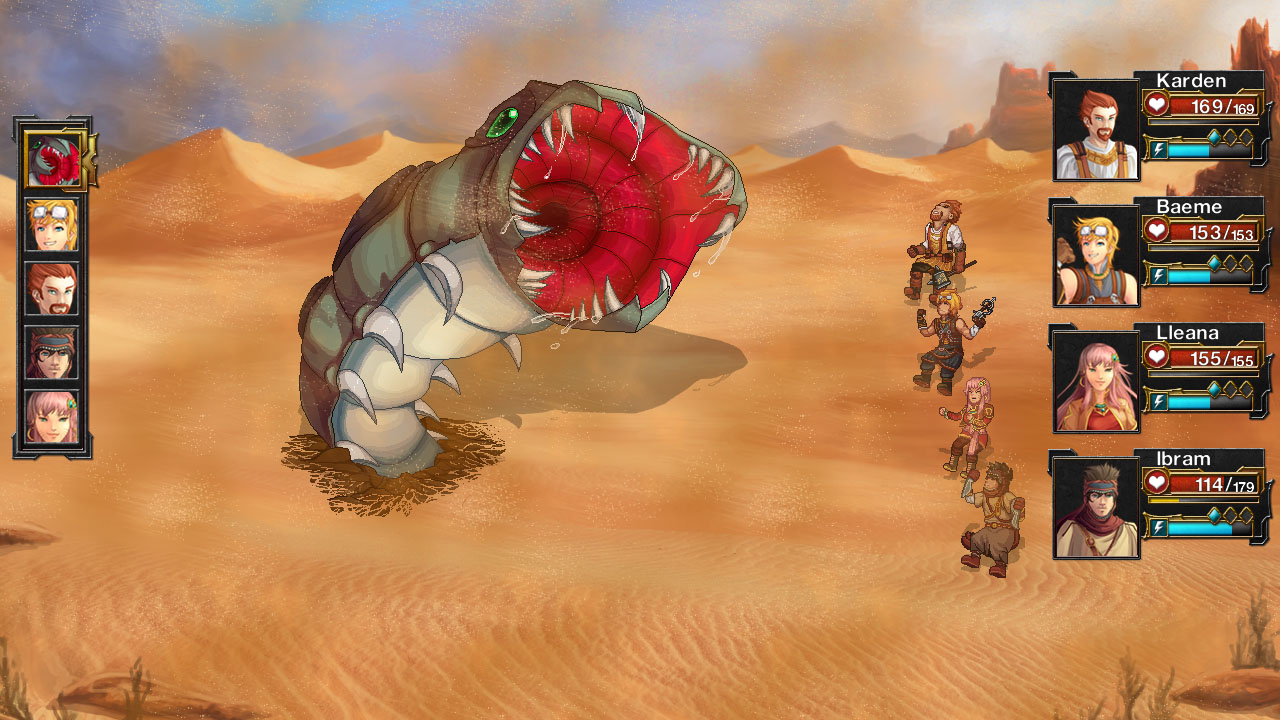
Tons of foul monsters loom in the vast world of Arelite Core.
Arelite Core Review
While traditional RPGs come a dime a dozen nowadays, it’s refreshing to embark on a journey from a different perspective. Playing as the blacksmith with unyielding determination to become the best at his craft is inspiring and charming. Dragon Slumber creates a riveting tale with intuitive perks, skills and useful upgrades. Tons of vile monsters and a cast glowing with interesting dialogue and deep character traits all fit neatly inside this tightly wound RPG. An experience rivalled by so many, yes, but it still brings its own identity to the saturated genre.
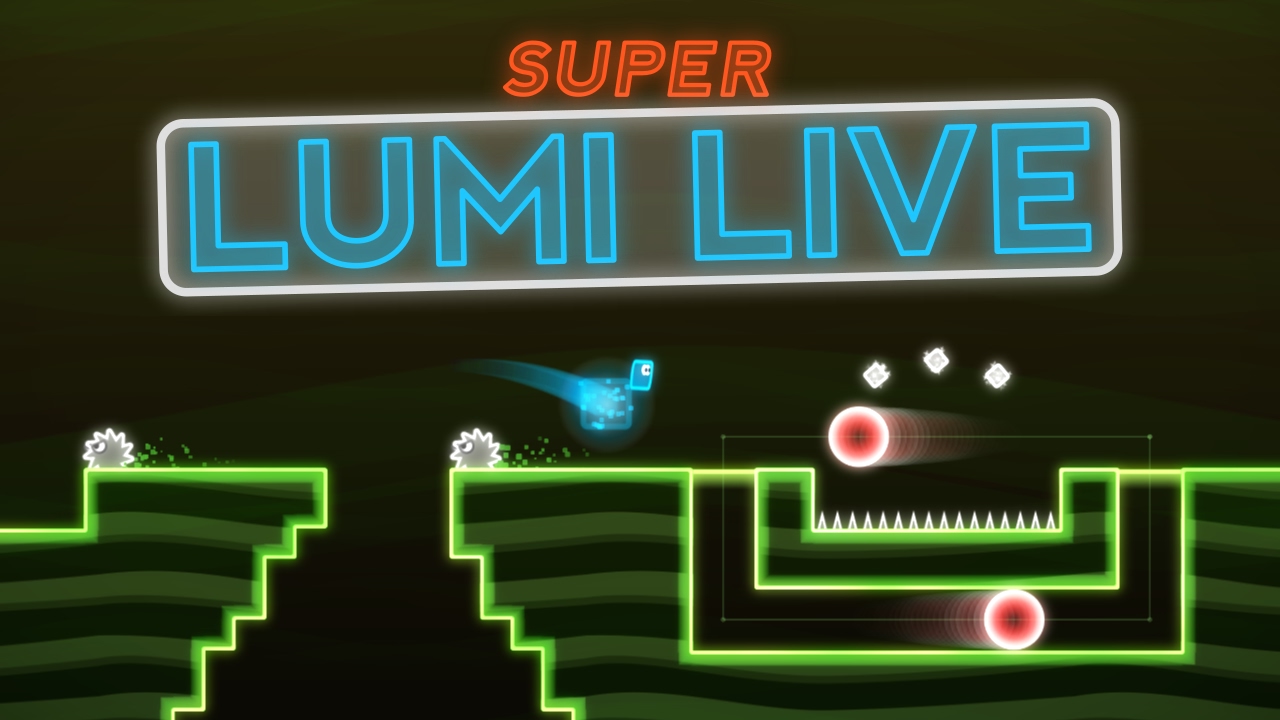
The 2D platformer has become something so popular, so uniformed that keeping track of all the forthcoming releases seems to be more of a chore than it’s worth. Thankfully, there are developers out there keeping the quick-paced genre from losing its edge, tenacity and flavour. Super Lumi Live sticks it to the die-hards of modern platformers and leaves an addicting, lip-biting good time in the depths of a super-sleek neon world filled with deadly hurdles and platforming innovations.
Levels Loaded with Challenges
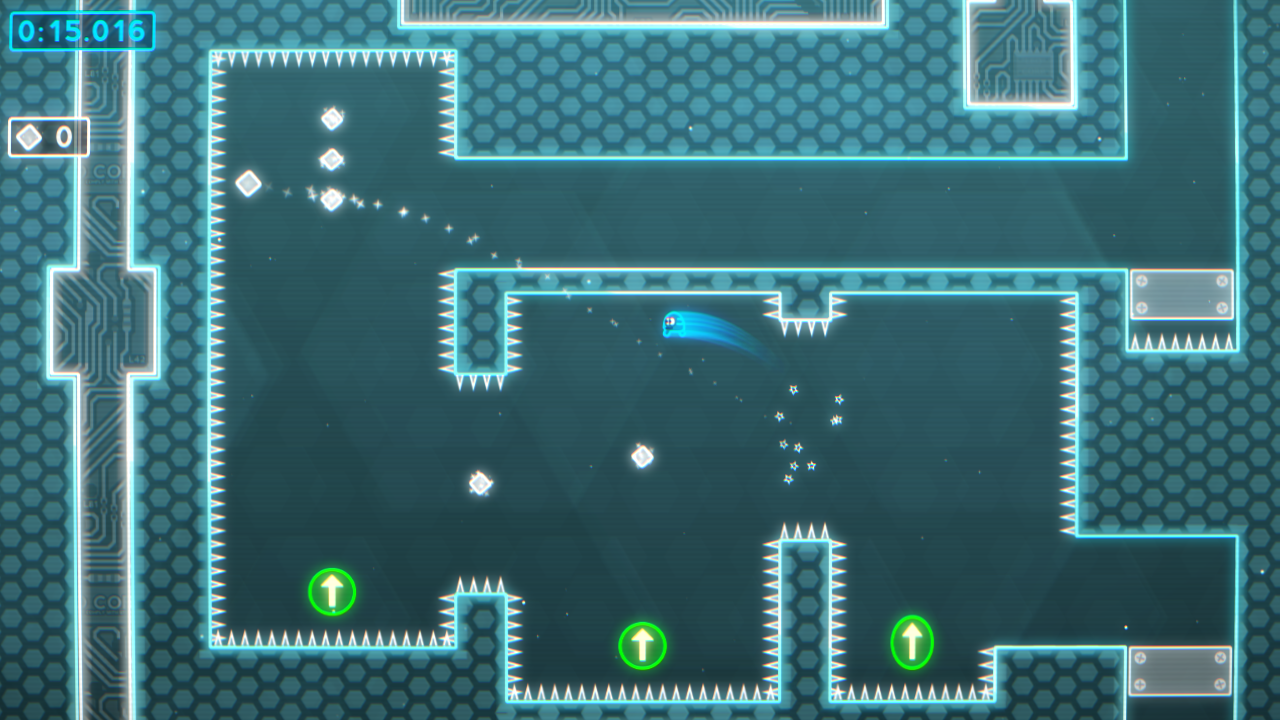
Running through the neon ripped levels, your little blue blob runs, leaps and double jumps their way from one thumb-bruising level to the next. Dodging a slew of obstacles ranging from bobbing spike-beds to shifting platforms, Super Lumi Live does an excellent job of giving the player control. With the absence of the frustrating “slide” annoyance found in many platformers, your blob almost satisfyingly sticks to the ground upon landing from every jump. This is an immensely helpful asset, found in an otherwise tedious and challenging platformer.
Various platforming mechanics are littered across the entirety of Super Lumi Live.
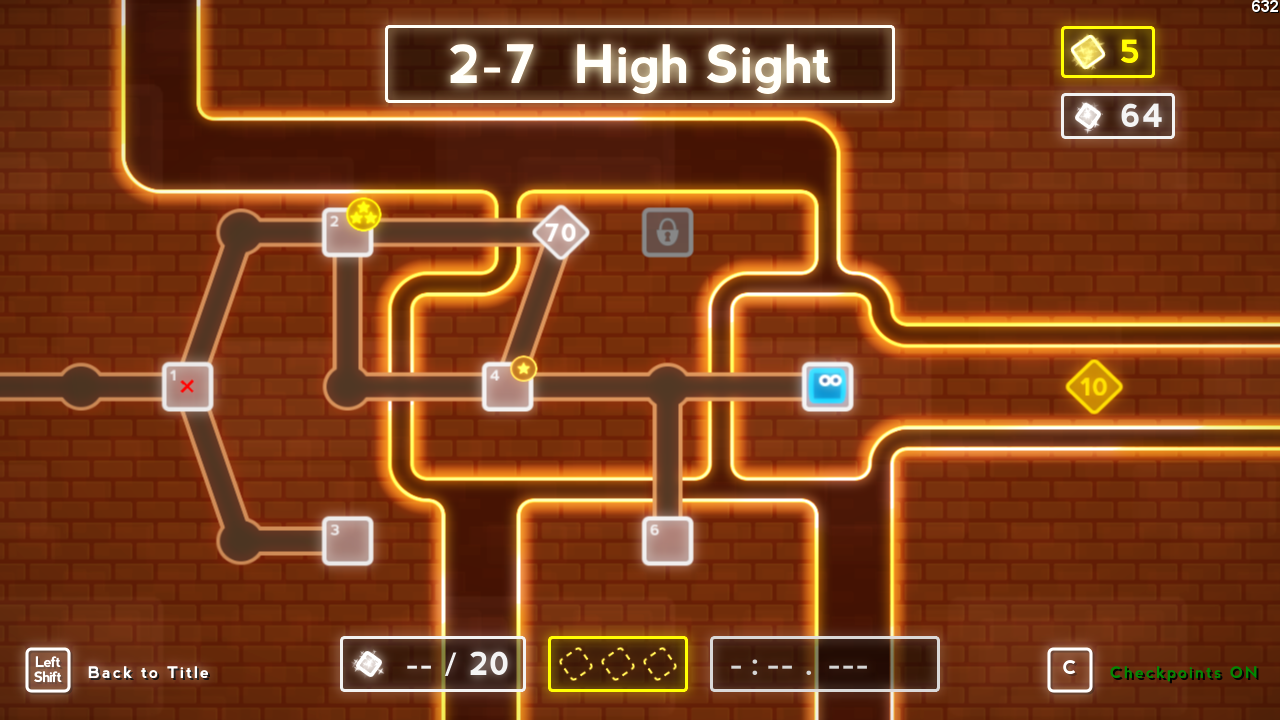
Levels are divided into themed Seasons, with every season containing a handful of numbered levels increasing in difficulty the further you progress. Levels are required to be completed in order to move on to the next. Some also require a specific amount of points to collect throughout the levels in order to unlock. Returning to previous levels and reaching for a higher total of points will provide the player with enough credit to continue forward. The last stage in each season serves as a Boss stage. With a heightened number of difficult obstacles, a lengthier run through and specific techniques to complete the end of the season.
Excellent & Precise Handling
As mentioned above, Super Lumi Live handles with excellent, precise maneuvers, leaving little frustrations with the controls themselves. Those frustrations are found in the level designs to purposely throw players off with unexpected obstacles and dangerous encounters. Whether it’s block dissolving upon touching them, assaulting cannons relentlessly firing upon your helpless blob, deadly ground saws or shifting platforms taking you to an untimely demise if not paying close enough attention, the game is plenty full of quick-acting annoyances to keep the player humble.
Levels are unlocked by either completing levels or acquiring the appropriate amount of points in each stage.
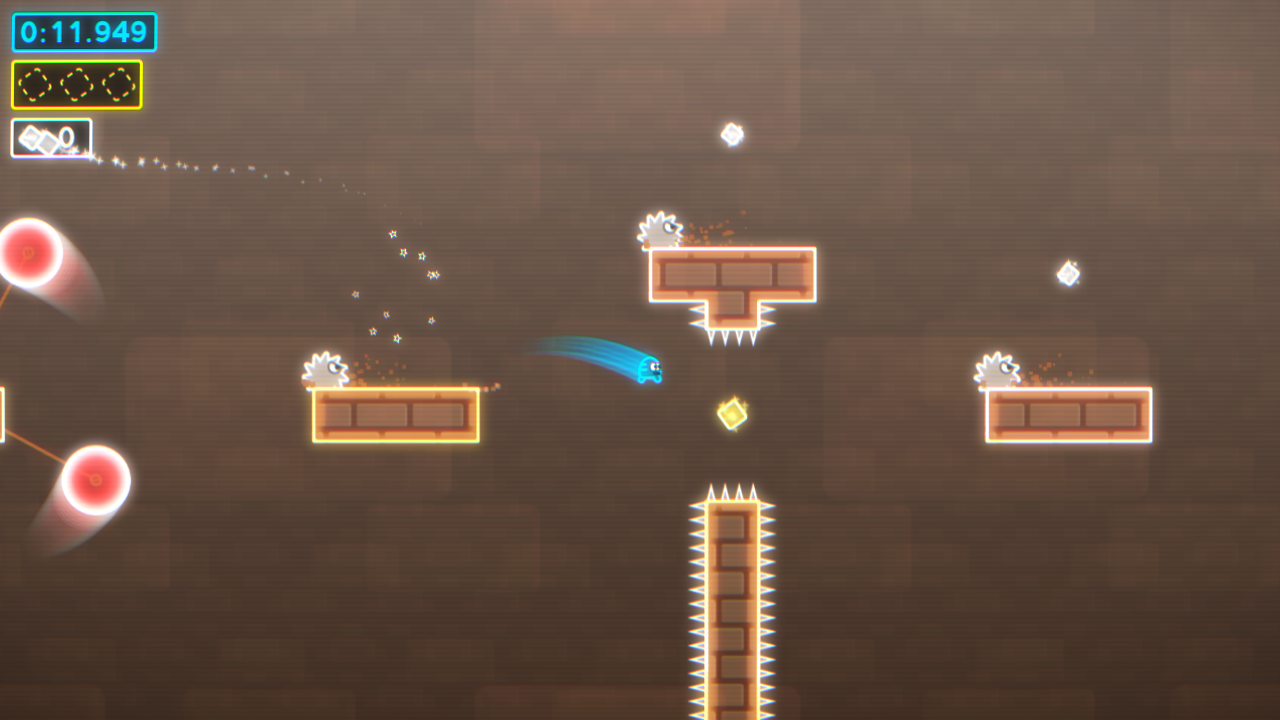
Throughout the levels are dozens of white points – placed in similar fashion to coins/rings in other popular platformers. The rare golden points are often found in hard to reach areas, making for a tedious playthrough for the gaming completionists. Your total number of points of both white and gold are tallied and kept in a score-style fashion at the stage select screen. Newer levels appear as you make your way through the game, and many are designed to be unlocked after the player has accumulated a total number of each color of point. The common numbered stages are unlocked with accordance to the white, while the gold points unlock tricky bonus style stages, not required to complete to move forward in the game.
Conclusion
Super Lumi Live is presented in a unique retro, neon stylized fashion with a modern platforming approach to gameplay. Providing a quality platforming experience, the challenge will turn many casual players off. The levels never feel unfair in any way, but many stages will leave you wondering if you have the knack to stick with it. Not to flush out the satisfying controls and mechanics of the platformer, the game truly shines in this aspect.
Many challenges stand in the way of grabbing that hard-to-reach golden point.
For a quick platforming experience to help bring the hard-core gamer back down to Earth and further question your abilities, Super Lumi Live is that type of hard-hitting title. Falling in line with the “quick to learn, a lifetime to master” areas of gaming, Super Lumi Live precisely maneuvers like a dream, but seems happily stranded in a hellish world of frustrating obstacles and platforming hindrances.
Find the quick-action platforming title, Super Lumi Live, available on Steam for the PC.
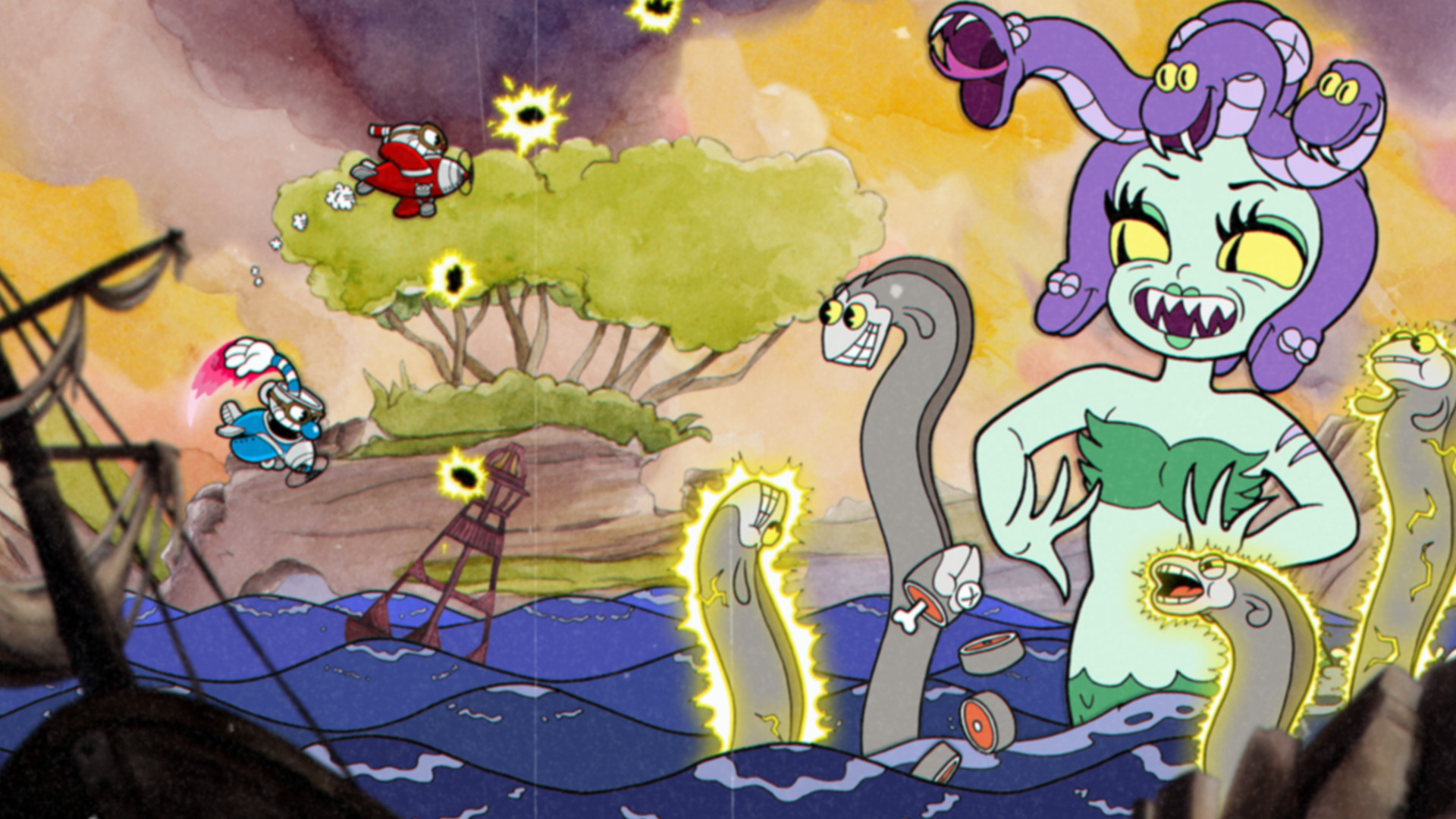
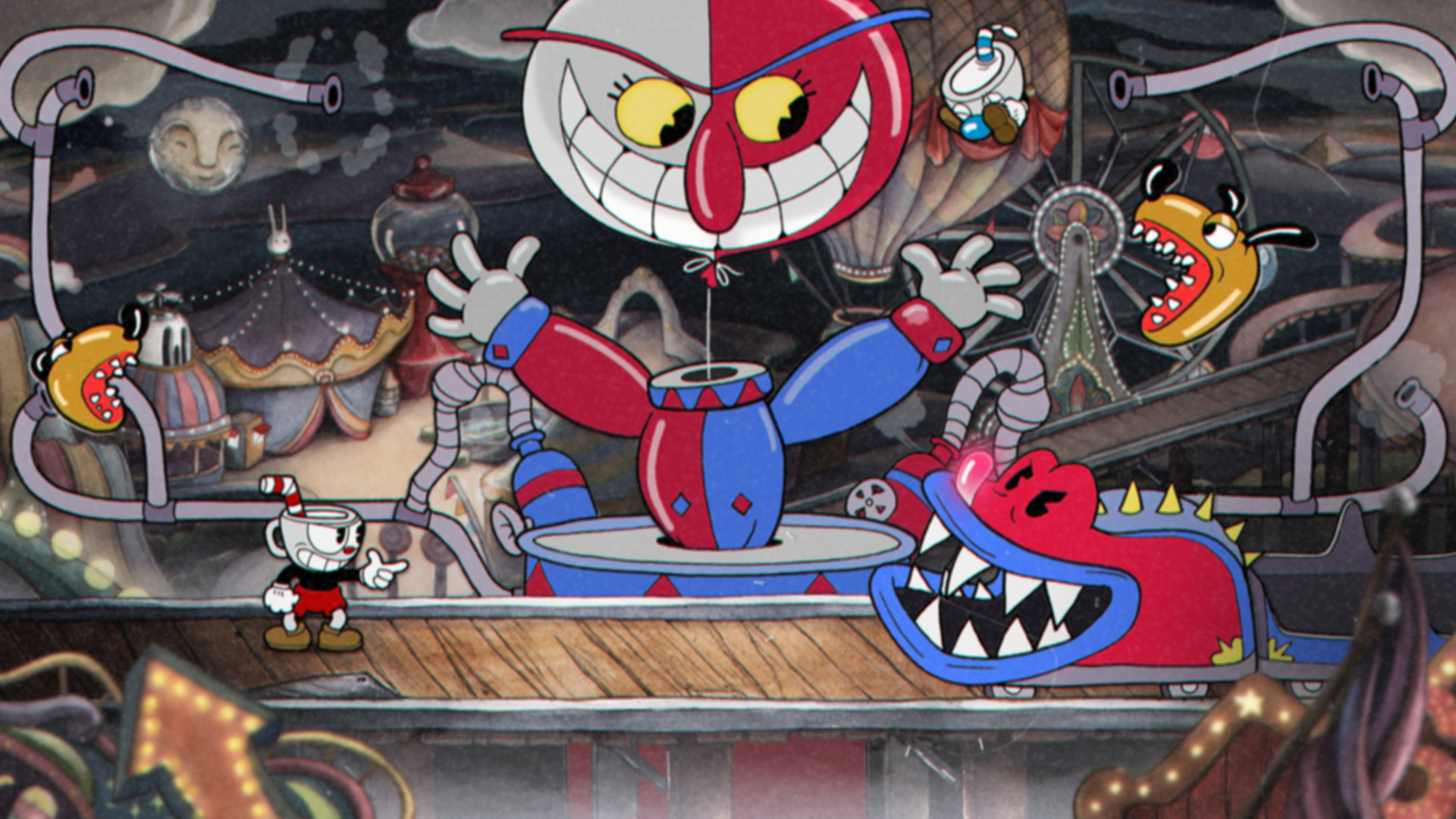
Cuphead takes a classic tale of moral propaganda and turns it into a romp through 1930s era animation that will both delight and challenge in equal turns. The tale follows the titular Cuphead and his unfortunate brother, Mugman, who are enjoying a good time at the Devil’s Casino until one misguided roll of the dice ends with a contract on their souls. But, the Devil tells the now damned duo they might be able to get out of their contracts if they can collect on other souls before their time is up. You can choose to play alone as Cuphead, or bring along a friend to aid you as Mugman during your treacherous journey.
A World Brimming with Bosses
The layout of worlds in Cuphead is fairly simple. You can select from a few run-and-gun levels, or pick form a plethora of battles with devious baddies whose soul contracts you now need to collect. Defeating bosses opens up new sections of each world and eventually allows you to move on to the next. Sounds simple enough, but this dance with the Devil is anything but slow and steady.
On a difficulty scale from Mega Man to Dark Souls, Cuphead hits much closer to the former. To succeed, practice and determination are key because death is practically guaranteed, but difficulty lands a little south of rage quitting. That isn’t to say boss battles don’t offer a very real challenge, but I rarely felt that I wasn’t able to make some progress with each run. It was this keen balance of punishment and progress that kept me aching to try again even after multiple failures. If you fail to complete a fight or stage, the game presents you with a meter showing how close you were to your goal. Depending on how you are doing, this can be both an encouragement or an indicator that it might be time to take a short break before another attempt.
Each boss has multiple attack stages, with an additional stage added if the game is played on Regular difficulty. However, the battles in Cuphead are dynamic enough that players cannot win simply through rote memorization. For example, in some cases, a boss can have varied versions of one attack stage. A particular battle involved a stage where the boss transformed into a zodiac character. I died before completing that stage and the next time around she transformed into a different member of the zodiac, catching me off guard with new attacks. Often, though, bosses follow a set of transformations that can be memorized, though getting through them is anything but simple even with some foreknowledge. Attack patterns can change within stages, and you often find yourself needing to battle against numerous peripheral attacks while at the same time avoiding main attacks from the baddie itself.
Boss battles are truly a sight to behold and a challenge even for a seasoned platform/run-and-gun aficionado. This is partly due to the intensity of the fights. During one encounter, I had to avoid a train while also dodging glowing horseshoe attacks from a clown riding on a donkey held up by a string. Sounds crazy, but aside from the spot-on 1930s visual aesthetic, Cuphead also solidly replicates the sheer bizarreness of the cartoons of that bygone era. I fought frogs that turned into a slot machine pitching coins at me, and a woman who became an airplane that became a terrifying version of the moon. And that is only a small, incomplete sampling. Somehow, it works. I never questioned the wacky and often unpredictable directions boss battles would go. The whole world is bright and bouncing, sometimes sharp and sinister, life and movement that I can only describe as what Jazz music must look like if animated.
An Arsenal of Abilities & Upgrades
During the course of your battles you will earn coins that allow you to purchase different types of shots that can be equipped during battle. You can even equip two different shots and toggle between them. Each comes with both a plus as well as a minor downside. For example, one shot gives a wider bullet spread and allows you to aim backward, but offers only average damage unless used while aiming behind you. Another allows greater damage but requires more precision. You can also purchase charms that can be equipped as add-on effects or life extenders. For example, early on I purchased a heart that gave me an additional hit point. It, however, also slightly lowered my attack power. The extra hit point saved me more than once, so the slightly lowered attack was worth the price.
The most important move in Cuphead’s arsenal, though, is the Parry. This allows you to jump off of pink-colored objects that appear throughout a level or boss fight. During battle, this allows for more dynamic movement, but it also charges up your Super Meter which, when full, allows you to discharge a number of powerful attacks.
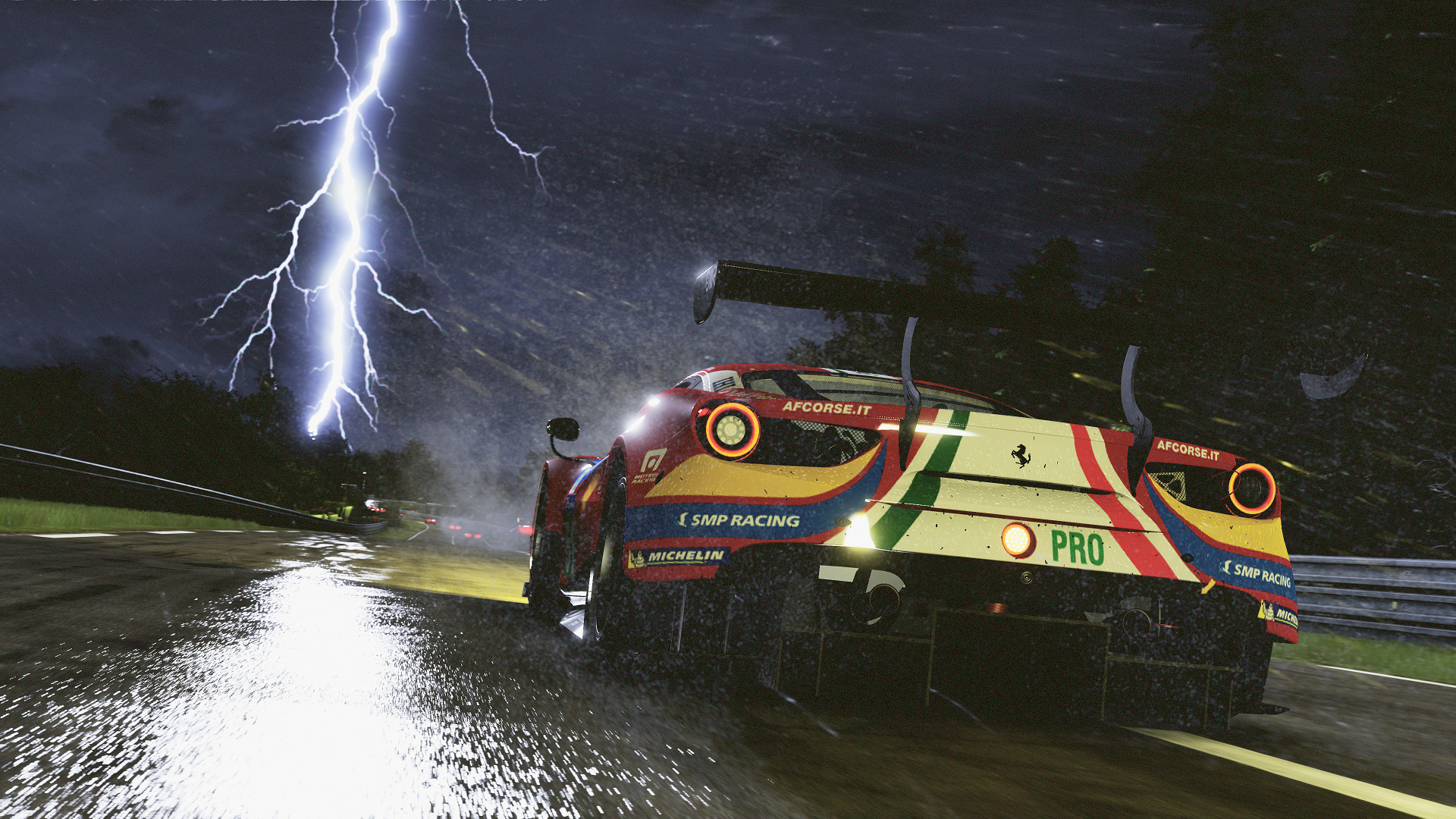
Racing simulation titles take an eager-to-win mindset and meticulously combines the precision and patience of careful maneuvering with high-speeds set on expertly crafted courses. In Slightly Mad’s sequel to their top-notch racing franchise, Project Cars 2 takes these very features and increases the magnitude of competition. Not by adding an increased difficulty on driving and control, but the excellent use of dynamic weather elements and various changes in the course throughout the duration of the race, leaving an attention to detail left out of almost every simulation racer to date.
Up-to-date Racing Mechanics
Firing on all cylinders, Project Cars 2 brings a true racing experience on the current gen systems. The default settings take away any type of racing assists, traction and stability control – leaving a swift, challenging and gorgeously designed racer. With a clear point of official racing rules, regulations and professionalism, cautious navigation plays an important role in the leading to a podium finish.
Every racing event, including the novice go-kart races, provide difficult elements and challenges all across the board.
With a variety of different race modes to explore, you’re offered many different solutions to scratch that racing itch. In the solo mode, you’re able to customize your race in virtually any manner possible. Creating your ideal race, set on the course you desire, blazing through one of the many licensed machines found in the impressive roster of Project Cars 2. Common changes like lap numbers, race limit and number of racers are obvious inclusions, but the weather dynamics is where things really get interesting.
Dynamic Weather & LiveTrack 3.0
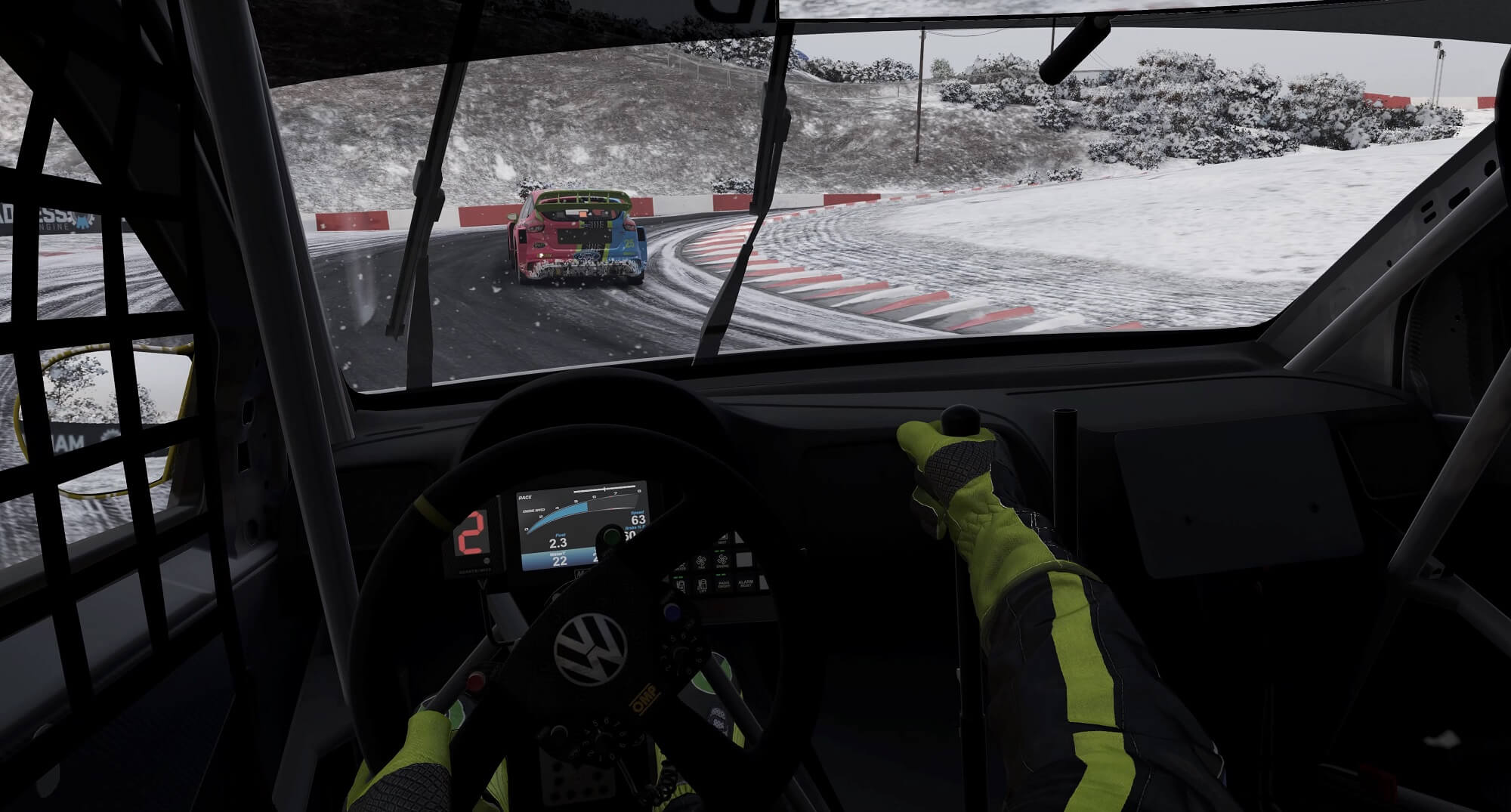
Changing the weather throughout the course of a race provides a heart-stopping thrill outside of the heated competition and challenging tracks. Adding severe rainfall, dense fog or heavy snow accumulation demands more attention to your racing. As rain puddles develop, fog blinds the next hairpin turn, or piling snow no longer makes your previous racing line accessible, thinking on the dime and adjusting your strategy to conquer the ever-changing weather becomes the only viable option to staying ahead of the herd.
The dynamic weather and excellent use of the LiveTrack 3.0 system keeps racers from feeling too comfortable during long race sessions.
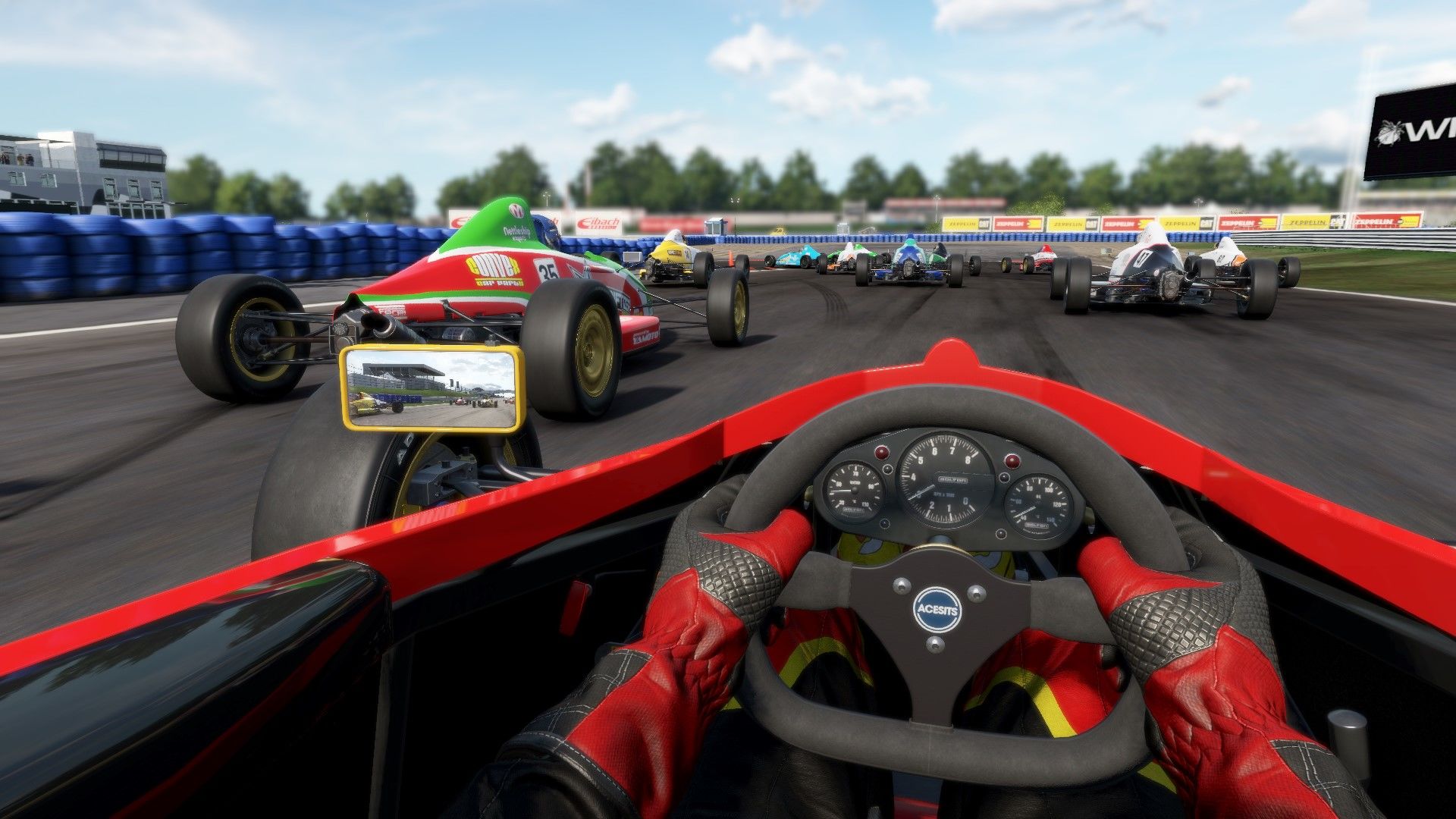
Racing around sharp corners and switch-back driving behind the wheel of a Formula One style racer, or gliding around S-curves in the off-road rally events show off outstanding physics in this modern-day racer. The lighting from sun-up to sun-down colors the lively courses and decorated racecars superbly. Dirt or snow pulled onto the track from cars sliding off-road throughout a lengthy race. Aggressive drivers smashing the throttle to the floor-board waiting eagerly for the smallest chance to take your position. As tires wear, fuel depletes and the mental awareness begins to drain, every turn on the horizon becomes a an exhausting, yet thrilling ritual. As more enduring races take hold, these increasing instances create exhilarating races.
180+ Racing Machines to Conquer
Of course, the difference in dominating the demanding weather and detailed courses could very well rest in one of the 180+ racing machines available. All with intricate details in aesthetics, handling and proper motor sounds; the roster of high-quality vehicles found in Project Cars 2 is next to a perfect list of proper machines. Though you may notice a few left out of the mix (180 is nowhere close to the total amount of excellent racing machines available throughout the generations of racing), the selection that is available brings many different styles of Motorsports to the table.
A wide selection of powerful racing machines are available right from the beginning, ranging from dirt wrestling rally cars to street gripping Indy cars.
Across the board of the Career mode, you’ll find yourself entering tons of championships and invitationals. From novice style go-karts to full throttle Indy cars – and everything in between – Project Cars 2 takes the player through the difficulties of modern Motorsports. The races are there to bring a true sense of competition by providing strategic cornering and acceleration, with a fleet of aggressive professional racers. Not only specified for hard-core racers, there’s a variety of sliders and options to help increase the odds for even the most amateur racers.
Customize to Your Liking
Decreasing lap numbers, giving yourself a boost with stability and traction control turned on, braking and steering assists, as well as the useful feature to decrease the AI difficulty and aggression; while you may not receive the full “racing sim” experience by tweaking these options, it does help ease the frustrations of the professional racing environment. Though designed as a simulated racer, players can easily use a casual approach to Project Cars 2 with the healthy dose of difficulty settings found in the Options menu.
Much like the custom race settings, in the multiplayer modes, you are able to host a number of events with anywhere up to 32 players in a race. A vast amount of customization is available, changing the class of vehicles, the weather and weather patterns, the track and how many laps, on to of tons of other settings. Championships, tournaments and other eSports focused events litter the lobbies creating a true sense of competition available to those outside of the AI challenges.
Players are free to customize many different race options to give a truly unique racing experience not found in most other racers.
Conclusion
Project Cars 2 adopts the formula that brought Slightly Mad into the arms of car lovers everywhere. By pushing the focus on a broader selection of Motorsports, powerful cars and ambitious courses effected by a wide range of weather patterns and settings, the new generation of racing just became deeper than ever. While the car list doesn’t stretch beyond the limits of previous racing simulators who have featured close to a thousand different racing machines – Project Cars 2 does offer a broad selection, nonetheless, respectfully dipping into the wide array of each motor sport featured throughout the Career Mode.
With tons of customizing options, difficulty settings, a moderate selection of racing modes and online competition, and the aforementioned vehicle selection, Slightly Mad’s enhanced sequel is exactly that. An impressively polished adaption to the franchise, adding exciting events like Rallycross, Indy Racing and high-speed oval courses, with a mix of randomized weather occurrences properly keeps the series right on track for continued success.
Antiquia Lost shows off its deep roots from the early years of the Final Fantasy saga, but deep down the game sits quietly with a mold of its own identity. Powerful and heroic characters mixed with emotionally charming plot lines and dialogue, Antiquia Lost brings a surprise nostalgic experience to the broad circle of traditional RPG titles.
Deep Roots
Starting the game in the small town of Crysta Village, you take control of Bine – a red-haired demon hunter engaged in the beginnings of a warm and exciting adventure. With the help of his mysterious power and newly acquired friends, you’ll dive deep into the fantasy world full of intriguing towns and villages, dungeons, as well as plenty of turn-based battles along the way.
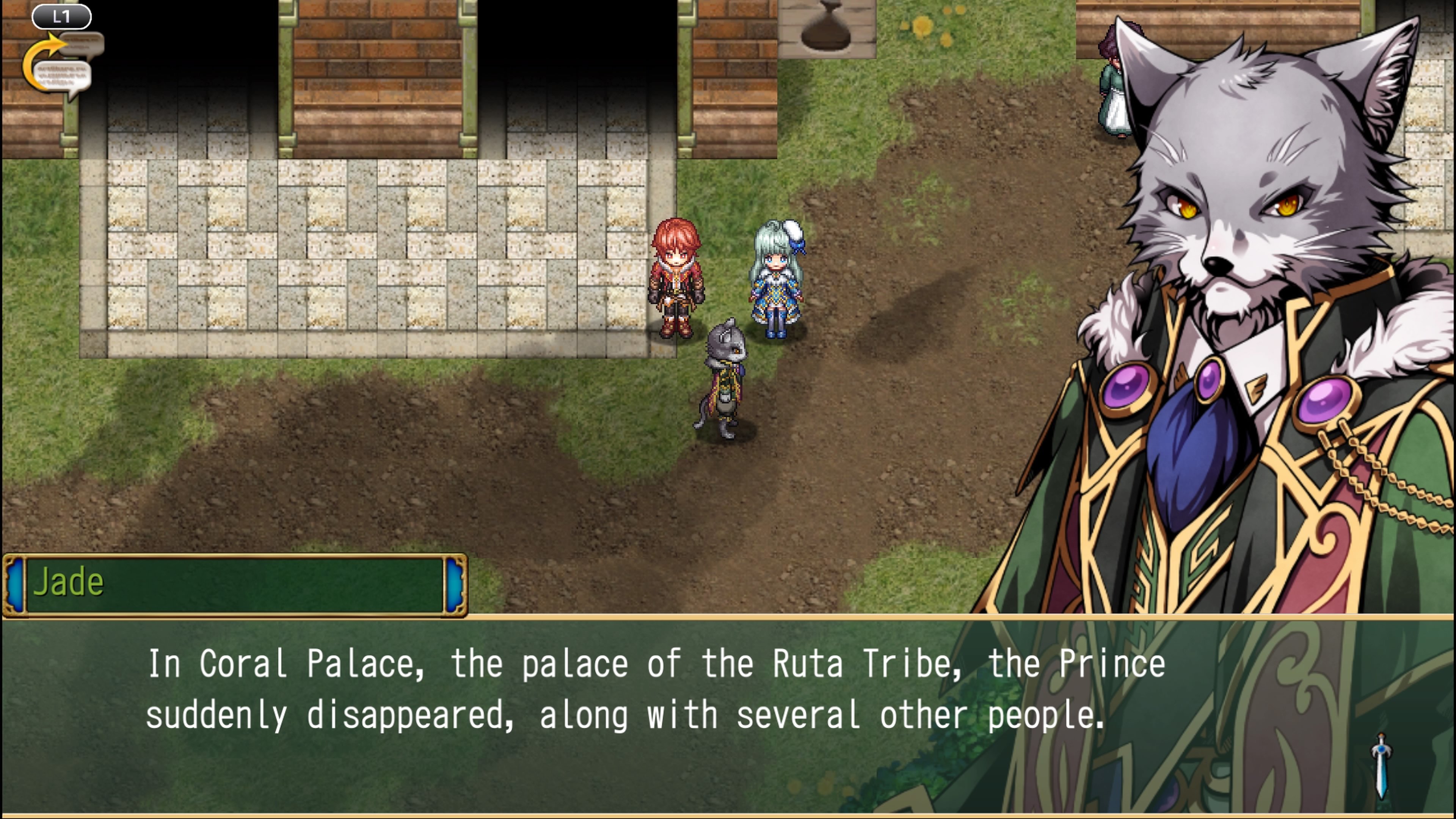
Bine and his cast of powerful allies are full of interesting and eventful dialogue moments in the charming story.
Lunaria and Safira hail from the goo-like people of the Ruta tribe, Jade – an elder of the cat-like species from the Eeth tribe and the protagonist Bine is home to the Fai tribe. Each represents one of the three elements being Earth, Fire and Water. The peaceful tribe lives in harmony with one another in the vibrant world of Antiquia Lost, until important figures from all over the lands begin to disappear. Venturing to the Capital City with your trusted group of friends, you’ll begin to uncover the truth behind the mysterious disappearances that are taking place.
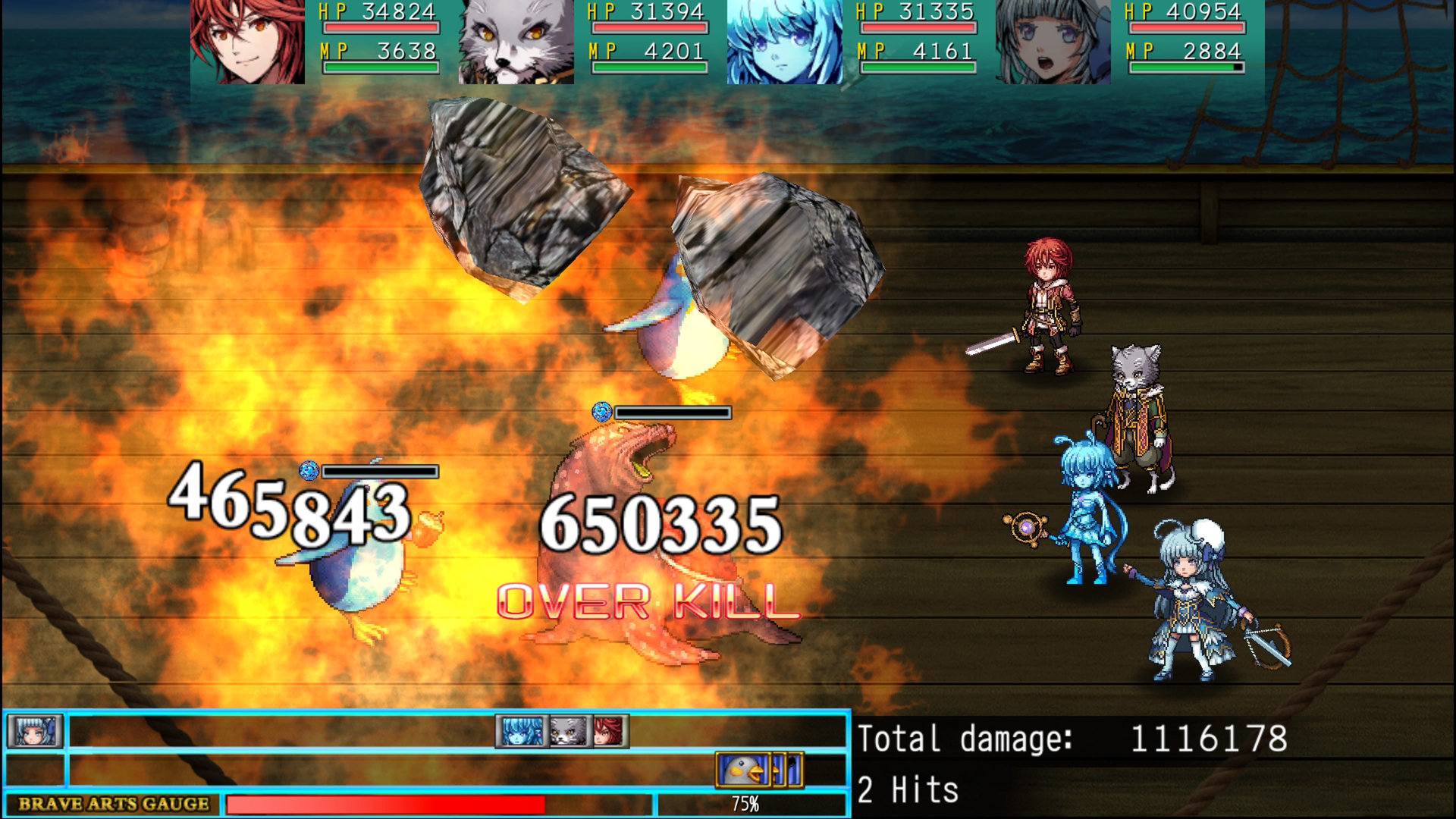
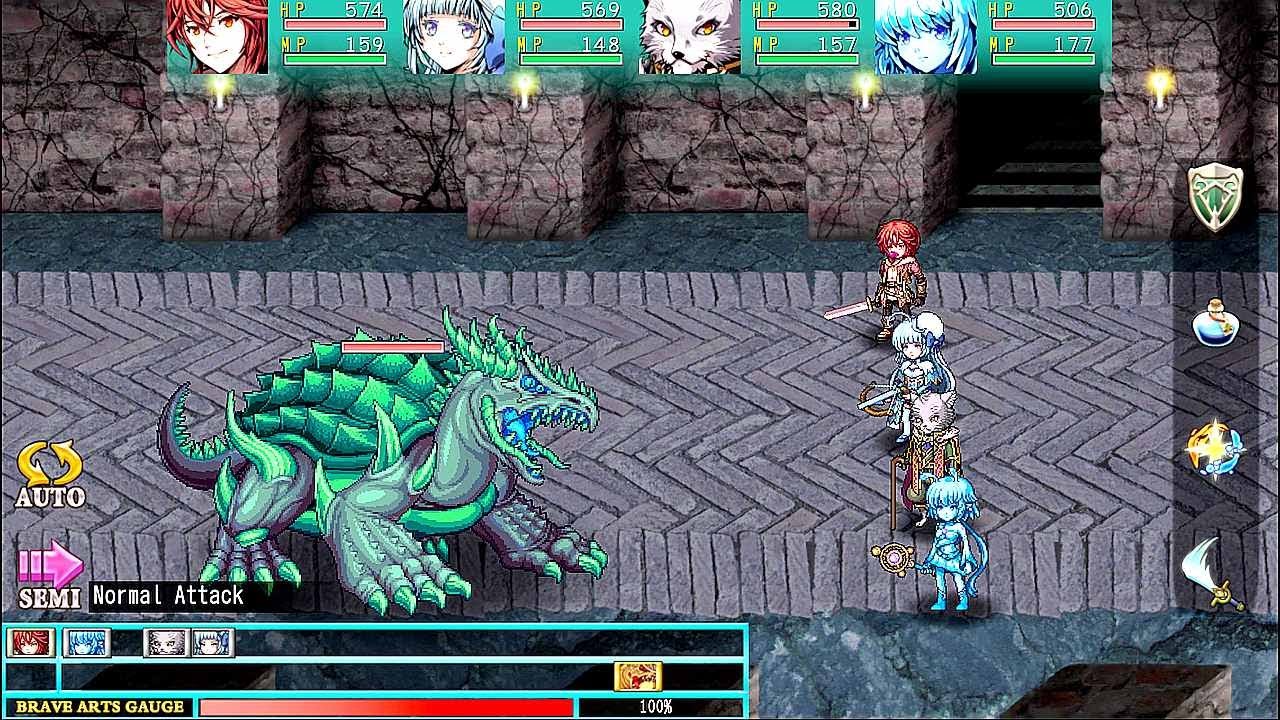
The battle system is set up in a traditional turn-based RPG format, only now with a few enhancements and quirks that help keep the game original. Each character in your party is capable of common physical attacks with whatever weapon is equipped, and of course various magic spells ranging from fire attacks, healing water abilities to ancient powers and the unique Brave Arts ability. Random enemy encounters occur throughout the sprawling world map, rewarding the player with experience points, useful items and equipment and tasty gems which act as Lunaria’s special method of leveling up.
Many different physical and magical abilities are crucial in defeating the monsters found throughout the world.
New or Robust?
The storyline in Antiquia Lost doesn’t offer anything new or robust coming out of the stale isometric RPG genre, but creates a wonderful cast of friends and dialogue to keep fans of cheesy narrative lines and fantasy tales playing throughout the campaign. Talking with your party members during down time in between quests will give you the opportunity to either boost your status with each individual – or lose trust – based on the response you choose in dialogue selection areas. Paying attention to each ally’s personality will give subtle hints as to which direction to take the conversations.
Traveling from town-to-town, each small village has a number of villagers, some with additional side quests to add to the playability. Traversing back through previous areas in search of a lost item, piece of equipment or even a stray sheep, more often will result in ending these side quests with a powerful demon fight to cap off your short journey. Once you’ve fully explored the current village or dungeon to your desire, the option to move along with the story remains in your trusty quest log for quick ease of use.
As your party members battle their way through waves of enemies, gaining vital experience and gems to help build the power of their abilities and other attributes, enemy encounters become increasingly more difficult, featuring various forms of every monsters. Color-coded by specific strengths and weaknesses, some monsters require unique weapons to be defeated, while others just require more persistence and strength.
Boss battles require careful strategy and powerful skills to defeat the monstrous enemies.
Antiquia Lost Review
Using your attacks and defenses to your advantage is crucial, such as strategically using multiple-hit skills to strike down every enemy in specific rows and columns. These techniques prove useful against large mobs of enemies that out-number your party.
A large variety of supporting items are also present, curing status ailments, healing items and various fruits to help boost important stats in your characters. These fruits can be grown in potted soil kept in your inventory. After obtaining seeds labeled for specific skills – i.e. strength, vitality, speed, attack , defense etc. – as well as other rare items, you’ll plant them in one of the desired planting pots located in the inventory menu. After the timer ticks down, the fruits are ready to be harvested and saved for a time in need to help sway the tide of battle in your favor.