There’s a famous saying that good artists copy and great artists steal. To a large extent, that saying is very true in the games industry with the trends that come and go and the mechanics that are shared across the board. But what happens when, rather than steal one great idea, you copy several good ideas?
Radiation Island Review [Nintendo Switch]
Well, Radiation Island is a result of the former where it picks the pocket of many other existing games and puts them all together. But it almost feels like it’s trying to complete a jigsaw puzzle with pieces that just don’t quite fit.
Originally launching on the mobile platform, Radiation Island graduates onto Switch and brings itself into the limelight, joining many new games on the eShop. This naturally means it has been adapted for button and stick controls rather than that of touch controls. The screen still serves a purpose, in some respects, but not to the same level of its mobile predecessor.
Radiation Island Review
What is Radiation Island though? Well, it’s hard to say because I don’t think it knows itself. You find yourself washed up on a mysterious island, that has been exposed to some form of radiation, and it’s up to you to discover how and why. After a brief tutorial, you’re set on your way to roam the island and do your thing. But, before you proceed, you choose what mode you wish to play in; which is where some of the confusion begins, I feel. You can just go explore, play the game the way it’s intended, or, play a hardcore mode which is more difficult.
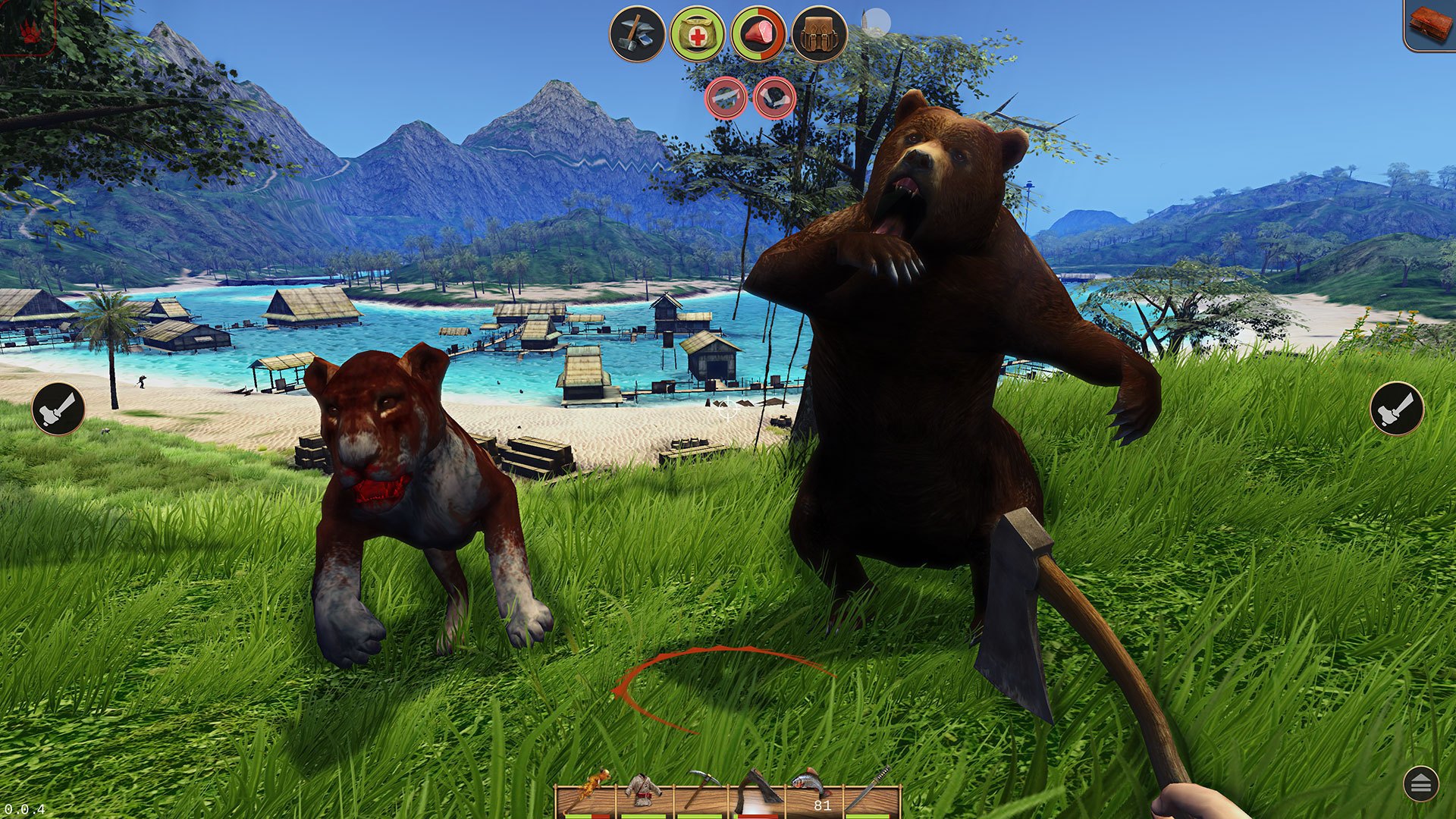
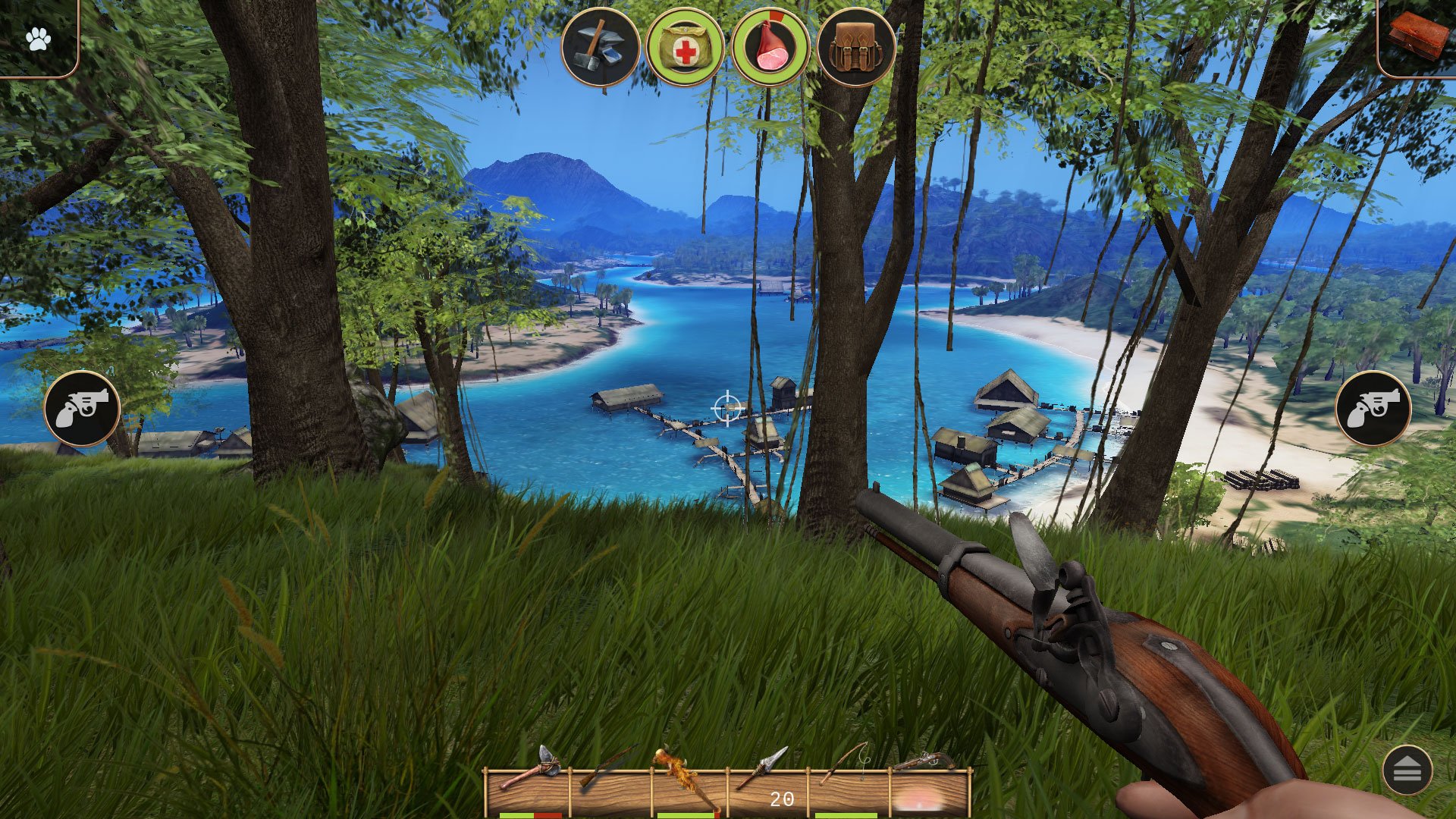
It combines elements of survival, crafting, exploration, hunting, shooting and melee combat. So it’s a bit like Fallout met Far Cry, saw Minecraft on the way and then DayZ tagged along for good measure. In theory that would make for a great result but it doesn’t quite make the grade. Of course, you can forgive some of its shortcomings due to its origins (graphics and general performance bugs) but you’d like to think that they’d be fixed for the launch on Switch.
Radiation Island Review
The all too distant military and conspiracy storyline shows early promise too but doesn’t keep you hooked to necessarily want to find out what went wrong. Radiation Island’s world is a good size and has its secrets to share, including dangerous and deadly zombies, but I’d be surprised if most had the fortitude to play for any great length of time. Which is a shame really as, given its sources of inspiration, Radiation Island could be really something quite good.
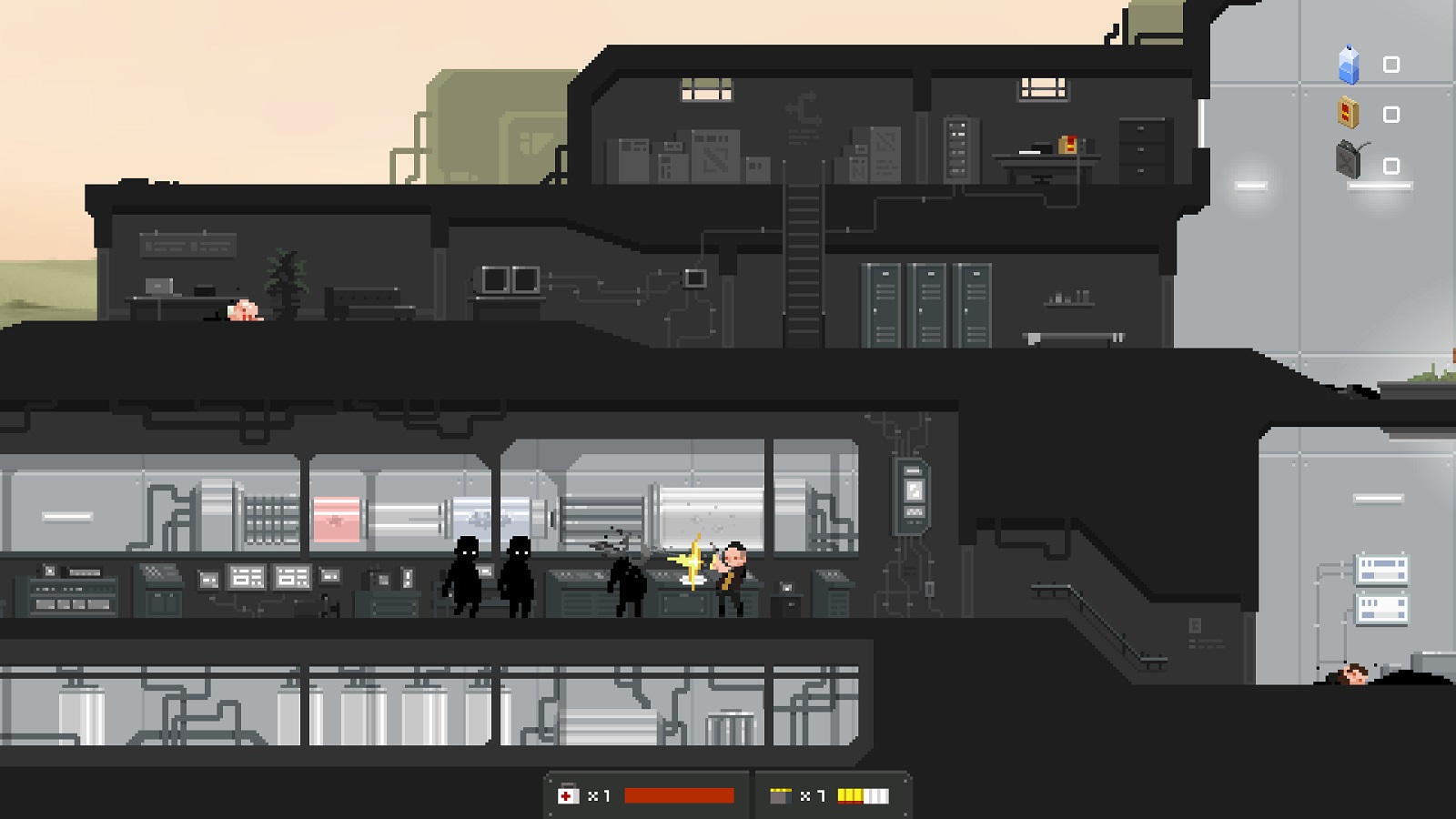
Do you sit at home wondering why no one has ever made a game that combines the ingenuity of a train simulator with the all-out fun of blasting away hordes of zombies? I knew you did, which is why I have great news. Do My Best Games has brought their 2016 opus The Final Station and its follow-up DLC The Only Traitor in a combined offering to the Nintendo Switch. I know I sound like I’m being sarcastic, but as random as that pairing may be, it all works exceptionally well to create a rather engrossing post-apocalyptic journey.
The Final Station Review [Nintendo Switch]
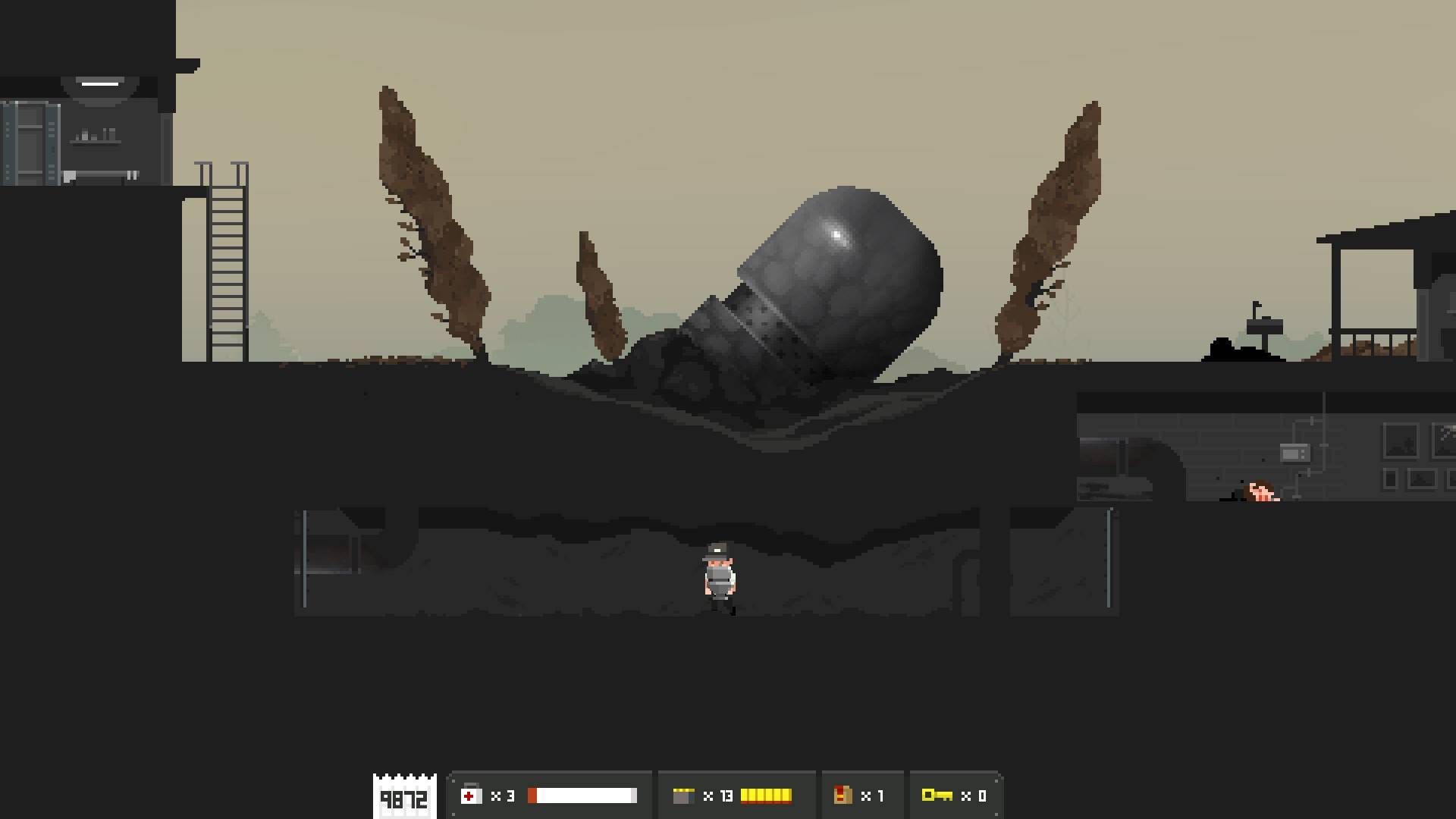
It’s been quite a while since the Visitation brought death and destruction to all. Mysterious canisters of no known worldly origin crashed landed on Earth, releasing a viral toxin that turns people into mindless zombies. In The Last Station, you take control of the train operator who travels across a dying world in search of supplies, passengers, and perhaps the salvation of all mankind. As you go from station to station, you must piece together what happened and wonder if another Visitation would or could happen again.
The Final Station Review
The story of The Last Station is told through a narrative environment. Notes, text messages, letters, and books from those no longer alive attempt to fill you in on what exactly happened over a hundred years earlier. This combined with conversations with the living, help to paint a picture of everything that has, is, and will occur. It’s a great way to unveil how the world came to be, but I did at times find it slightly confusing and hard to piece together.
After beating the game in under four hours, I was still a little hazy on what exactly happened, what the Visitation was, and who or what was behind it. You’re led to believe it was an alien attack from countless light-years away using advanced tech to send the poison gas to Earth. By the time the game ended, I wasn’t quite sure if this was the case. Whether it was manmade or extraterrestrial, that’s for you to decide.
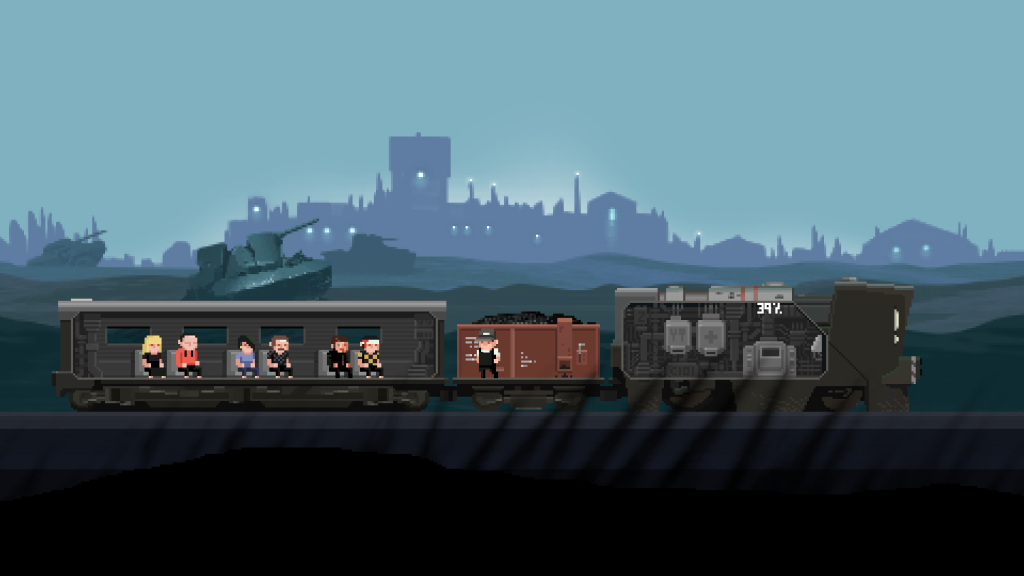
As stated above, there are two distinct aspects to this game. On the one hand, you must operate the train as it goes from abandoned station to abandoned station. While travelling, the train operator (you) must make sure the equipment doesn’t break down and the passengers (whom you rescue), don’t die in transport. Various components of the train start to break down in route, and you must act fast to counteract the faulty parts. It’s not difficult, but if you’re tending to sick or dying passengers, you might not realize the train is about to go offline. Ignore the train issues long enough and the whole thing just stops in its tracks. The longer you take to get moving, the higher the odds someone will die.
Speaking of dying passengers, you need to pay attention to their health and hunger meters. Once either meter reaches the bottom, times up and they die. Each passenger you successfully bring back to a shelter will yield money and other necessary items. Furthermore, the more passengers you bring home safely, the more achievements you unlock. This is simply for those who love achievements, but it has no bearing on the actual content of the game.
The Final Station Review
There is a crafting element to the game as well, which you will need to utilize in order to make more medicine and ammunition. You often find food and medkits at the stations, but if you’ve run out while travelling to a new destination, you can craft more while in transit. The medkits can be used on your own wounds or for your sick passengers. When it comes to food, only those seeking refuge on the train will require it, but it’s found sparingly so use food kits wisely.
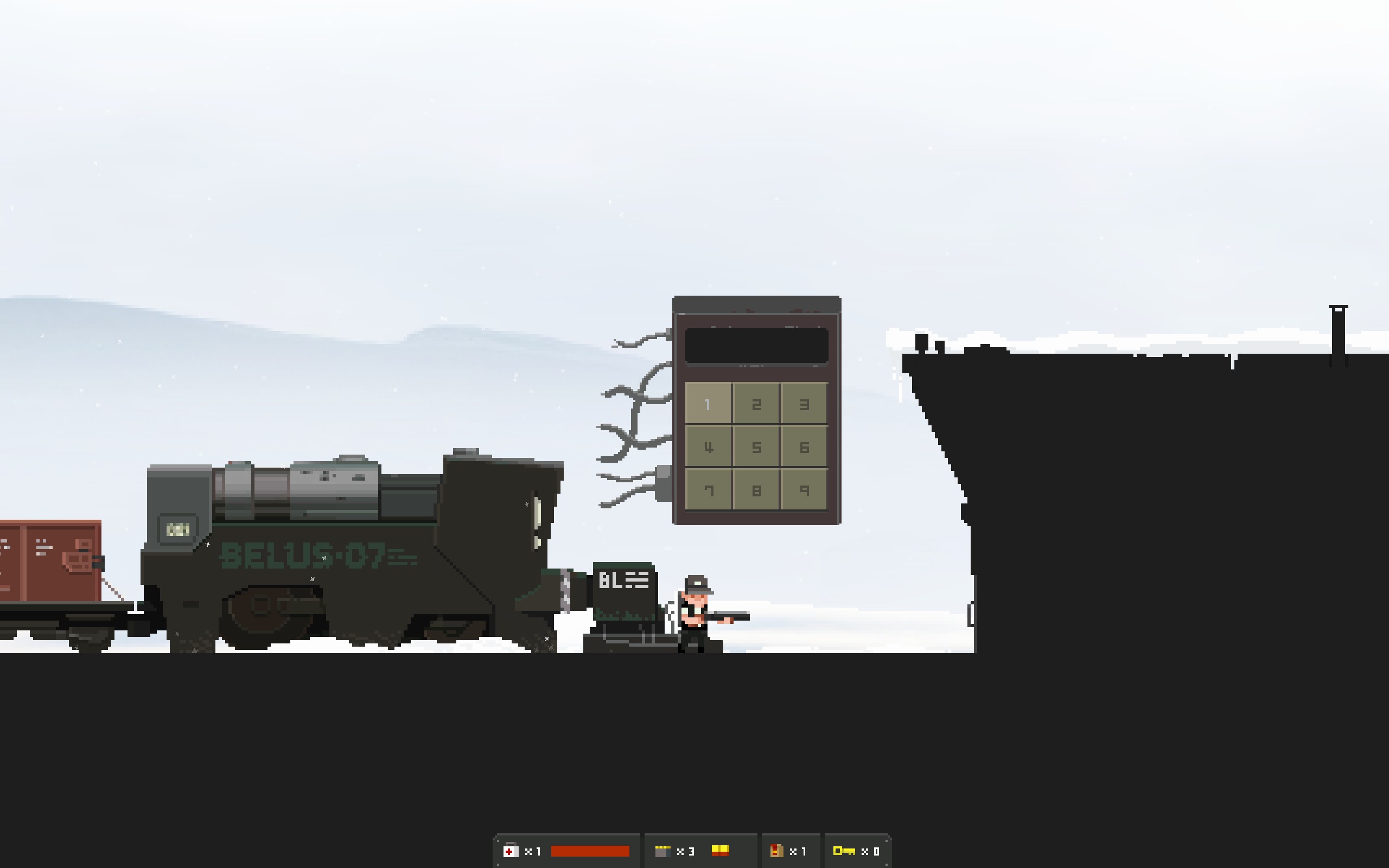
Once the train reaches a station, it’s your job to go exploring in order to find more equipment, passengers, and most importantly, the code needed to reach the next station. That last part sounds confusing, but I assure you it’s not very difficult. Armed with a handgun and your fists at first, eventually, you find a shotgun and a rifle to aid in your protection.
The Final Station Review
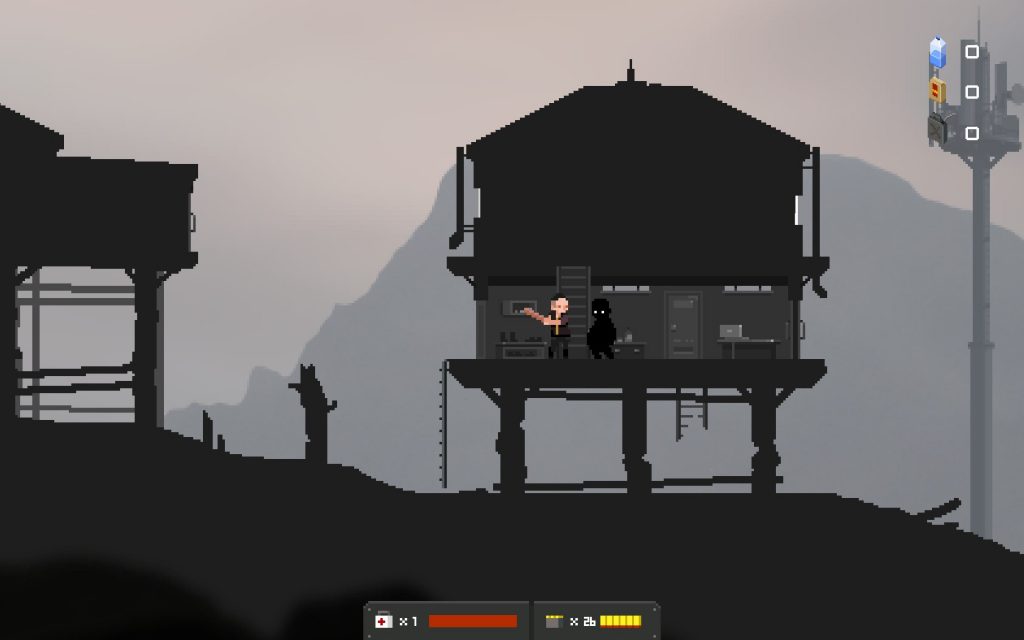
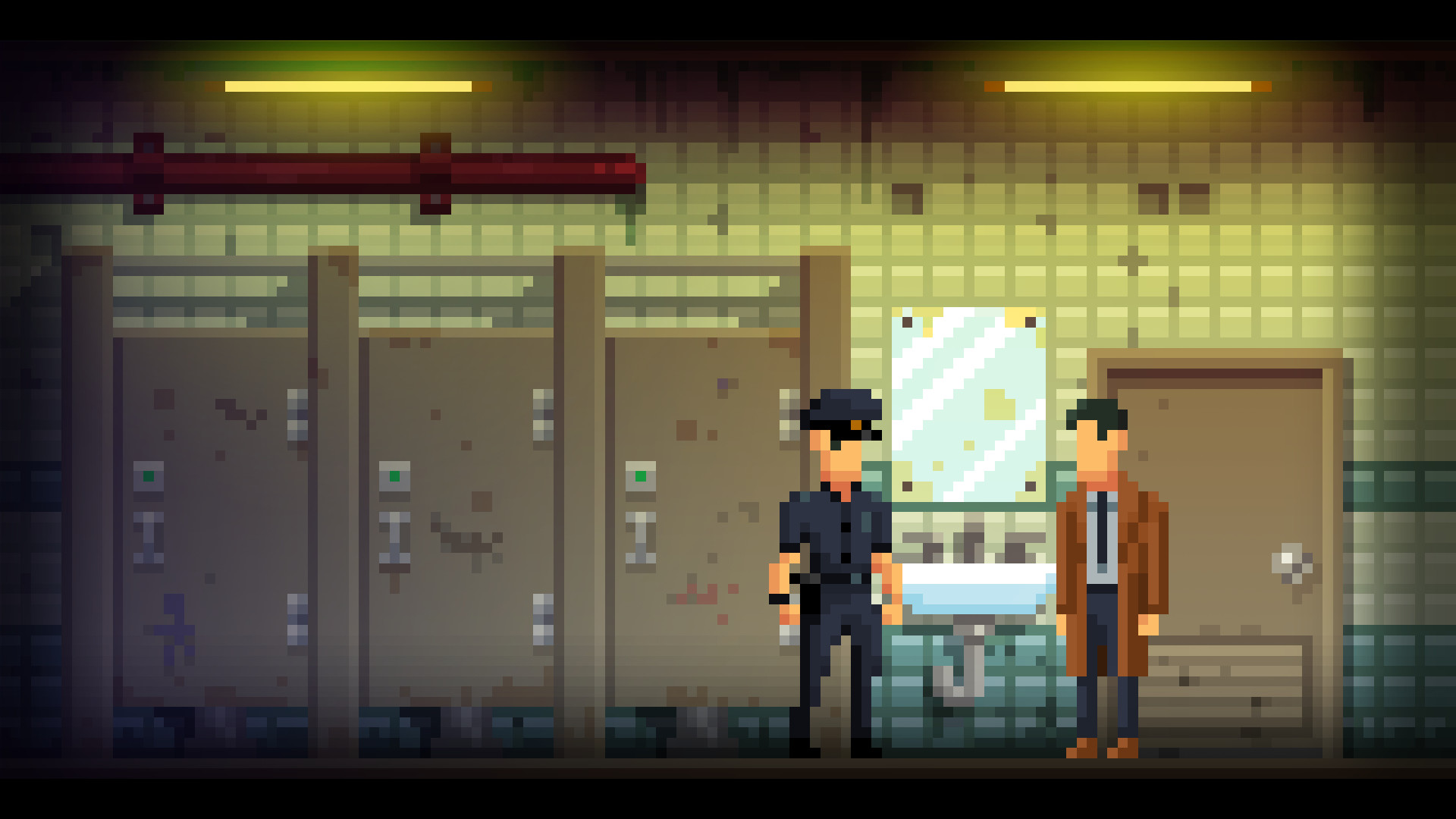
The station designs are rather creepy and add to the dark ambience of a zombie outbreak. You never know what’s behind a door or lurking inside a bathroom stall. Yes, the game is obviously using retro designs, but it effortlessly creates anxiety and apprehension. The graphics aren’t going to sell everyone, but the game isn’t supposed to be Resident Evil. It’s simplistic, but exceptionally well done. By taking away all the modern advances, Do My Best Games is allowed to focus on the story, and that’s what really matters.
The main quest contains four types of zombies. Fast animal-like, slow and traditional, armoured, and explosive. The first two can easily be beaten, but don’t underestimate them. The armoured ones take an extra step, but once you knock off their helmet, a single shot to the head does the trick. The explosive zombies are the ones you really need to watch out for. A single bullet will ignite them, but you better run, or they’ll take you and everything out around them. Using the pyro zombies to your advantage in clearing a room works quite well.
The Final Station Review
In terms of difficulty, I would say it’s on the lower scale of things. Throughout the experience, I typically punched enemies to death eighty-five percent of the time versus using a weapon. Between low amounts of ammo and the fact that they’re taken down without much effort, it just seemed easier that way. I would have liked a little more of a challenge, but I am by no means saying the game was a breeze.
Finding passengers is optional throughout the game. You can easily search for supplies, get the next code and move on, but then you won’t earn any money to buy more supplies down the road (and you won’t get those achievements I spoke about earlier). Plus, it’s fun to explore the stations in their entirety, and you won’t get all the pieces to the apocalyptic puzzle if you don’t.
The Final Station Review
The music in the game adds to the dystopian feel. It’s a planet long in the throes of death, and that’s the exact feeling I got through the music. I don’t feel enough people take the time to really listen to the subtlety of the notes in the background, but for me, it puts me in this world and holds on as I navigate my way. Slap on some good headphones and you’ll have an amazing auditory experience.
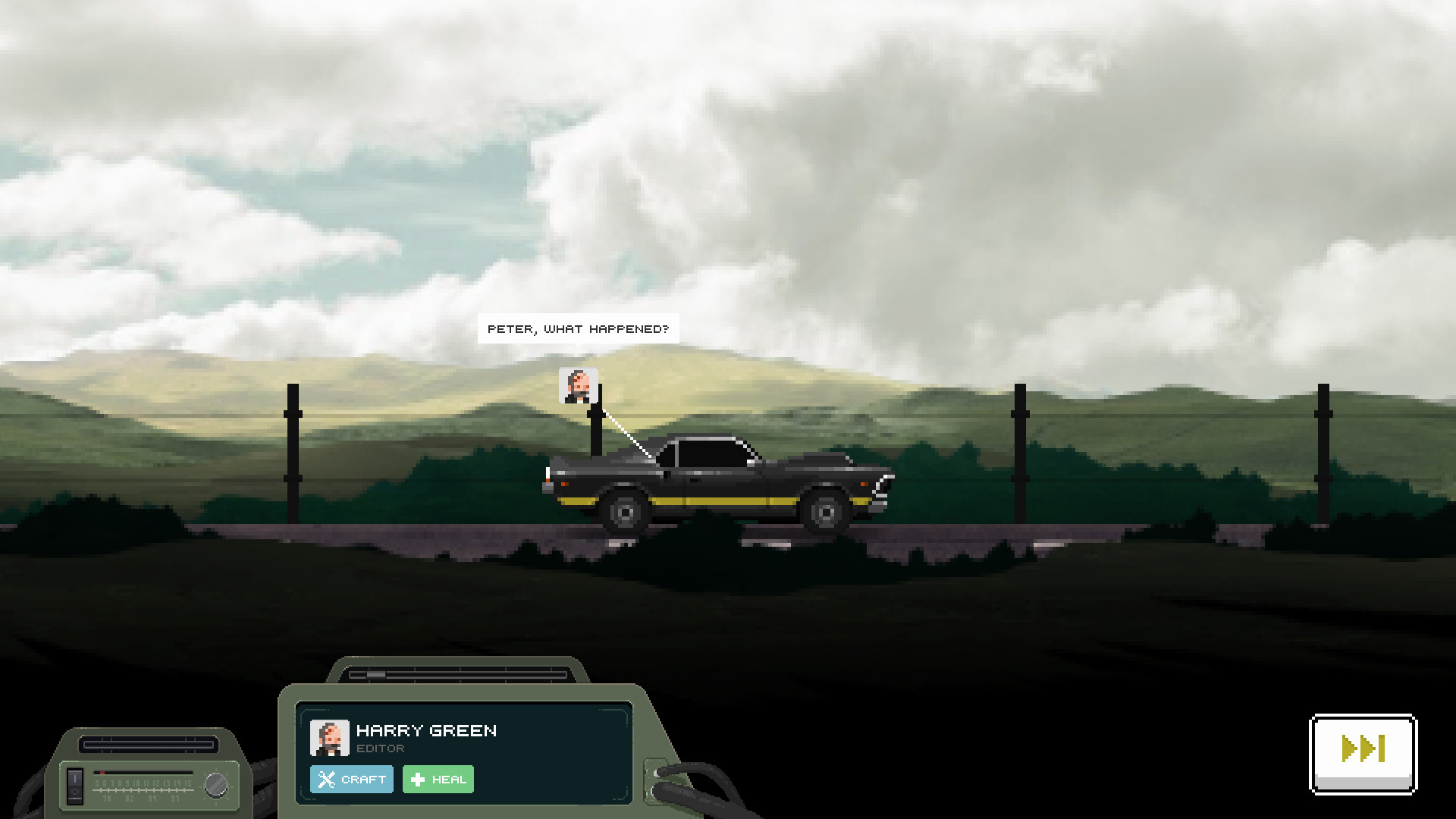
Switch owners are lucky enough to have both the main game and the DLC content The Only Traitor. In this, you play a man driving across the wasteland, looking for the last remaining shelter, picking up passengers along the way. You’ll revisit some of the places from before, and learn more about what happened to this world. There are new types of zombies (the acid spitting one was a treat), which I was very happy to see. Seeing as how you drive a sweet muscle car, there is only room for one passenger. As you discover new people, you must decide if you want to take or leave them based on the stats provided. It’s great the devs included this content for free, as it extends what would have been a rather short experience.
The Final Station Review
Storytelling is an art that has spanned ions, and when one comes across a compelling narrative, it’s a breath of fresh air. The Final Station isn’t graphically superior to anything, it’s rather short, and its simplicity is apparent from the get-go, but what it lacks in sophistication, it heavily makes up for with story. To be honest, I’m still not a hundred percent sure what exactly did and will happen, but my curiosity is overwhelming.
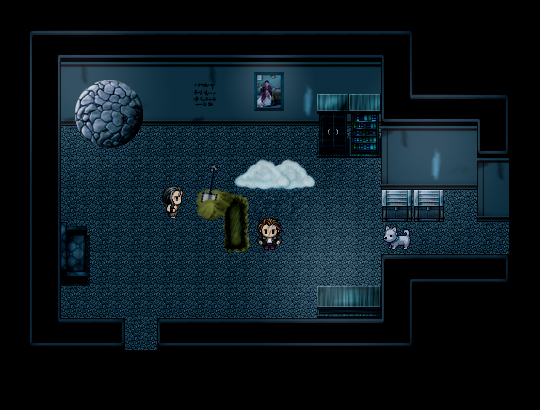
Even the best of us have something hidden within ourselves or our past we prefer to keep buried. The monsters of self-pity, jealousy, bitterness, and anger are always battling with our better self. For some, these inner demons can be just as dark as any denizens of Hell. Later On focuses on what it might be like if the murky recesses of the mind found their way out into a reality of their own.
Later On Review [PC]
You play as David, an individual who clearly has a less than lacklustre view of the world and the people in it. David often refers to people as “trash” as he makes his way around the neighbourhood. It is clear from the get-go that something is a little off about the town of Later On, and David seems a little too calm about it. For example, your daily routine involves disappearing into the back of a . . . research facility? Lab? Whatever it is, it has something to do with David’s “job”, and whatever that might involve doesn’t sound good based on the noises coming from the back area. Of course, David shows no sign that any of this is bizarre or out of place.
After “work” David runs into a friend, Nico, an ally complaining he needs David’s help because he just developed a tail. David isn’t quite certain how to assist, so he decides to do nothing and walk away. This decision to abandon his friend in a time of need sets off the game’s events as David attempts to make things right with Nico. But, this is only the beginning of David’s deep dive into his own motives. What kind of person is he? And if the world around is any clue, David has some skeletons in his closet that are going to be something much worse than that time you got drunk at Christmas no one prefers to talk about.
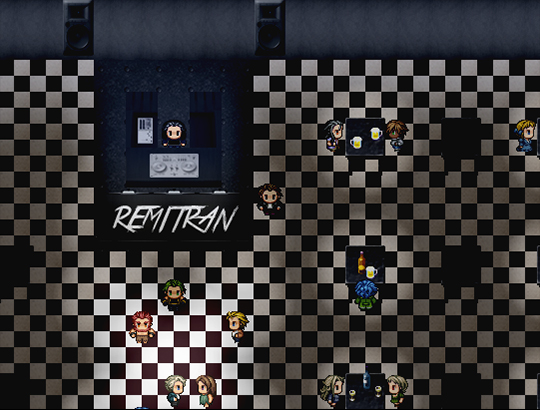
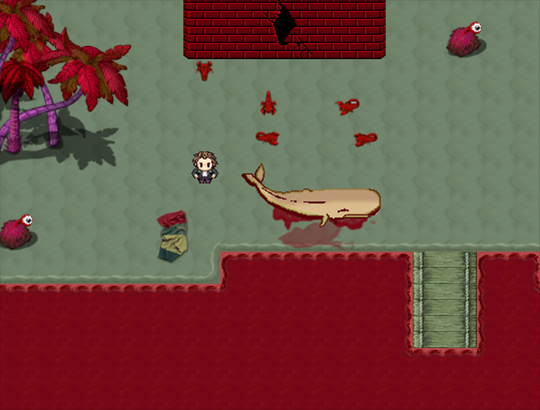
Later On does well in sustaining a sense of unsettling anticipation. In part, this is accomplished by well-placed and well-orchestrated sound effects and music. Another way is through an unpredictable narrative. Whether you are tasked with finding a mermaid or encouraging a sentient towel to allow you to pull it off the wrack, you never know what might come around the corner. When the game takes its darker turns, this unpredictability feels even more disquieting because it appears to be a normal aspect of David’s life. Environments take on a bloody hue at times and monsters present themselves as if they are a natural part of the everyday. Dreamlike conversations with fellow residents who seem totally at home in nightmarish situations only add to the unease.
Puzzles are usually simple and equally as surreal, requiring you to think about objects around you in a way that is contrary to their natural use. For example, you might have to utilize a painting as if it were a certain appliance, or figure out how to awaken a sleeping manhole cover so you can move it. In these instances, some trial and error along with just a little ingenuity are enough to find the solution. But, there are also instances where the game sends you on a hunt for an object without any clue where to locate it. In one case, I needed to find something to cut down some bushes that were blocking my progress. I wandered around town until I found it in a location that felt random rather than a natural place to seek them out. These situations made the puzzles feel a bit inconsistent.
There are only a couple of what might be called “boss battles” in Later On, and though these were clearly meant to serve as emotional epiphanies for David, I found them the least enjoyable interactions in the game. You are confronted by a monster that represents an aspect of David’s past or character that he wishes not to face. You are challenged with accusations to which David must respond accordingly by choosing from a set of replies.
For example, you will run into a monster of self-pity who can only be defeated if David responds in ways contrary to that emotion. However, there were times when the exact meaning of a sentence is not quite clear, so I had to guess which one would cause a blow to my enemy. If you guess wrong, you still have to complete the interaction only to fail and go through the whole thing once more. It also felt lacklustre as a tool for making me empathize with David. From the world around him and some of the later story elements, I began to understand just how disturbed David was, but I never felt close to David. This made having to try to answer questions as him a rote effort, particularly at the very beginning.
The characters around David feel charming and full of life. In fact, it is everything around David that gives the world both its vibrancy and horror. David himself is simply a vessel often removed and unaffected, which is fine and fitting, except when we are asked to get into his head and pretend to be him. It is for this reason that Later On doesn’t quite hit its mark as an emotional narrative that wants the player to connect with David in a rather visceral fashion. The horror is conveyed just the same, and perhaps natural empathy can help bridge the disconnect between David’s story and the player, but I left without ever feeling a strong sense of attachment when it seems clear the game intended that I should.
David’s story isn’t quite original. A number of indie horror titles have dealt with taking on the role of a protagonist whose mind has seriously affected their perceptions of the world around them. Home does this quite well and far more subtly.
“All that we see or seem, is but a dream within a dream.”
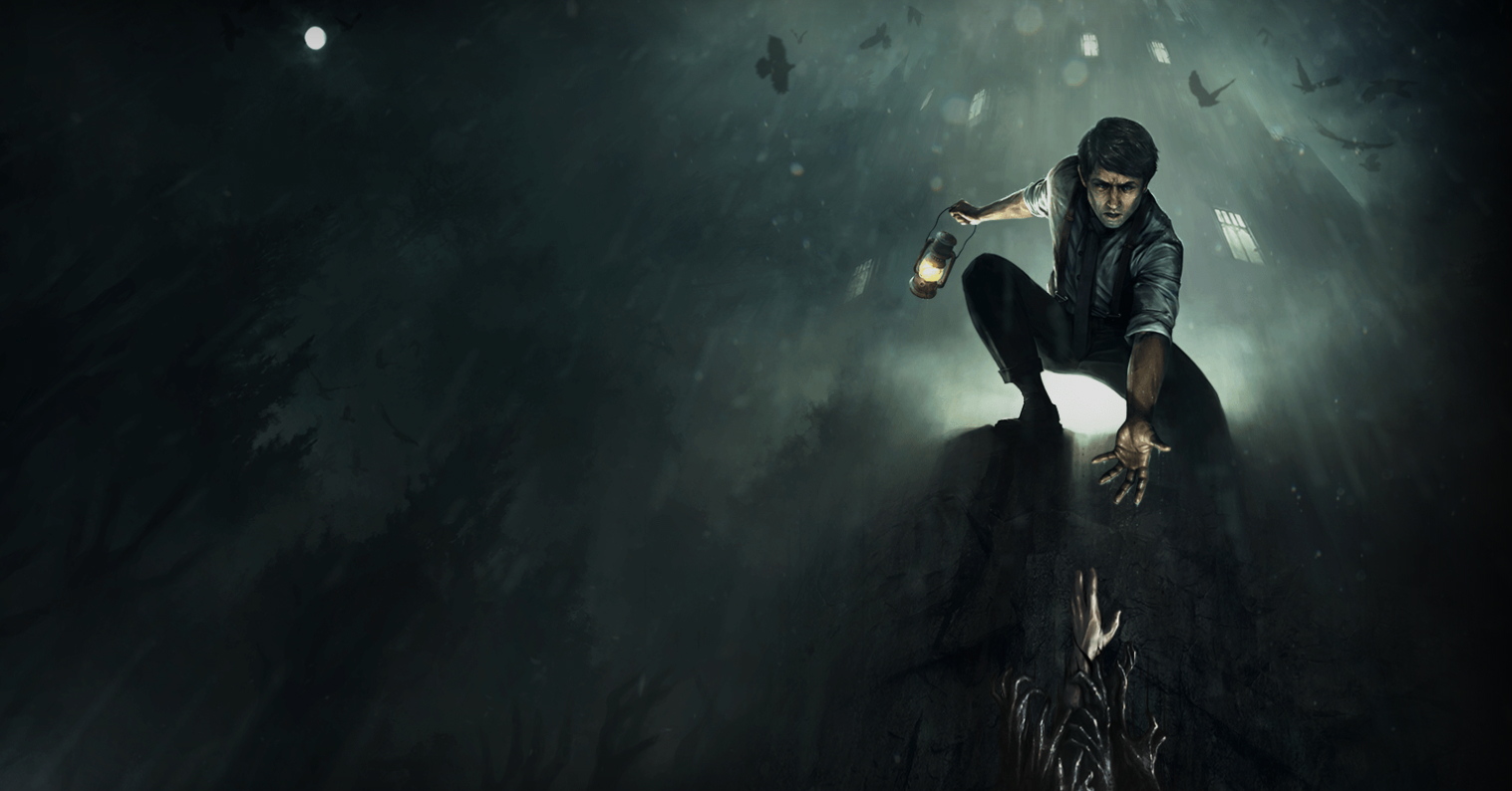
Are you a fan of Edgar Allan Poe and H.P Lovecraft? Then listen closely. THQ Nordic have resurrected the old classic Black Mirror for a new and improved version. Admittedly, I have not played the original, so this remake was my first experience with Black Mirror. Let me just clarify this right away for those who might visit the thought; this game is unrelated to the Netflix series!
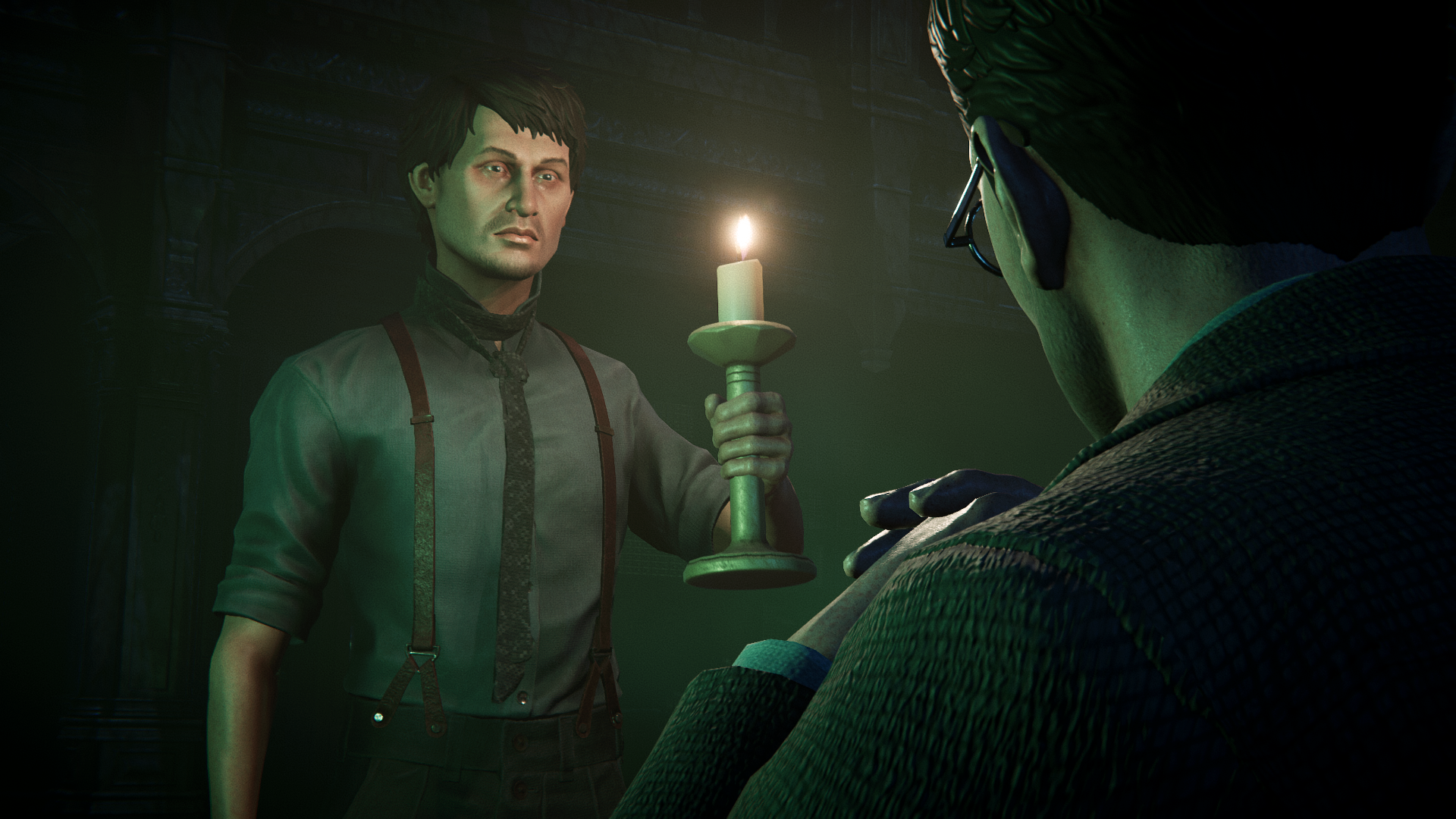
The story takes place in Scotland, year 1926. Following the death of his father, our protagonist David Gordon visits the home of his ancestors for the first time. But upon taking our first steps onto the property, we quickly discover that the Black Mirror mansion is filled with dark secrets that play with the sanity of those who wish to learn the truth.
David believes that his father killed himself. However, that theory is quickly debunked when you discover that it’s never that simple. The family has a history of deaths at a young age, and as you get deeper into the Gordon family history, one unwillingly ventures into the more supernatural elements that dwell inside the walls of the gigantic mansion. The more we learn about the history of the Black Mirror house, the more we delve deeper into David’s sanity.
“I became insane, with long intervals of horrible sanity.” – Edgar Allan Poe.
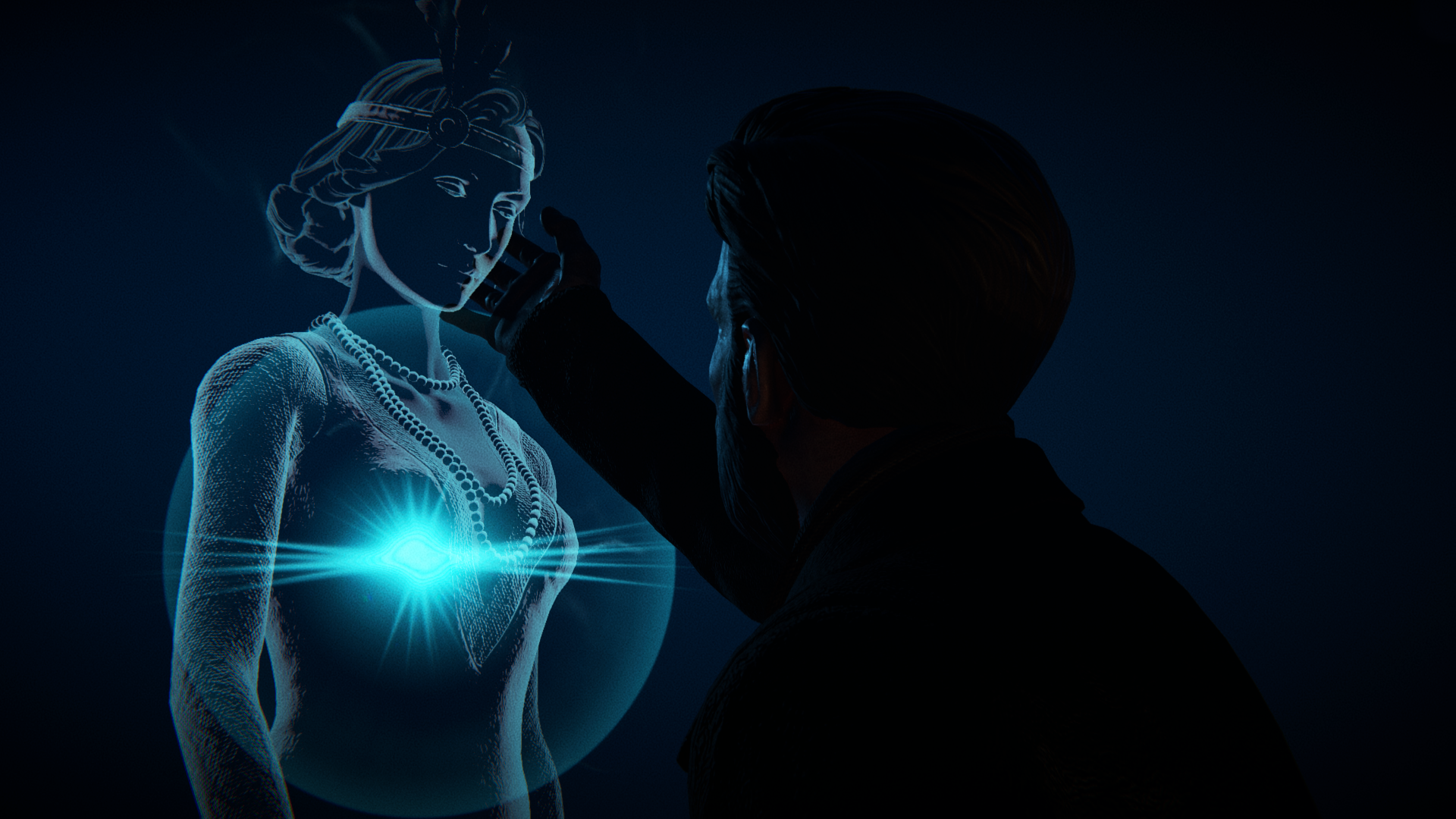
Storywise, you are immediately thrown into a mystery that feels like one Agatha Christie would enjoy. Having clear inspirational sources from the legendary gothic horror writers Edgar Allan Poe and H.P. Lovecraft, the universe include elements of the gothic, romanticism, and the uncanny. As Gordon explores the many rooms of the Black Mirror house, he often quotes the previously mentioned authors. As a big fan of this genre, this alone made the game seem worth playing. What helps fulfill the gothic horror fantasy, even more, is the fact that there are not only living human beings you can interact with and receive help from; you also have to interact and talk to spectral apparitions of the people who died there a long time ago.
On our arrival to the Black Mirror house, one doesn’t have to have watched several horror movies to understand that the tingling coming from your spine means that there is definitely something weird going on. The staff immediately put up a cold front, obviously not telling you everything about the history of the house. The residents of Black Mirror mansion are quick to establish that their relationship with Gordon (our protagonist) is one to be had at arm’s length. Why? Some of the first advice I get is to not leave my room in the late hours, because “ticking clocks are not the worst things I may encounter in the house at night.” You feel that it’s them against you. That you’re the invader. I feel like I entered a very hostile environment.
“They who dream by day are cognizant of many things which escape those who dream only by night.” – Edgar Allan Poe.
The artstyle and the graphics clearly show that the game originates from an older generation. The camera is locked in a traditional style, forcing our protagonist to move in a given way; which is fairly understandable, considering it’s a point-and-click adventure game. Gordon is a little bit hard to navigate, most likely because of the locked camera. I encountered some glitches here and there, that frankly, should not exist in a remastered game. While the cutscenes are beautiful, I can’t help but still feel annoyed at the bugs I encountered, requiring me to restart the game several times. I was also forced to Google some of the puzzles because I thought I couldn’t solve them on my own – but it turns out that the puzzles were bugged!
With that said, the puzzles are initially fairly complicated and well thought out. You have to search the environment closely and find clues to solve the mystery. The game is pretty fast-paced, depending on how quickly you can solve the puzzles (and if you manage to stay clear of the mentioned bugs). Considering the puzzle and narrative heavy game that Black Mirror is, what was unpredictable was the fact that, if you failed some of the puzzles, the results could prove fatal.
My obsession with video games came at a later stage of my youth than most; I was a late bloomer. Growing up in the 90s, I dabbled in Crash Bandicoot and earned all the gym badges in Pokémon Red (FWIW: Charmander is and will always be the best starter), but that was the extent of my gaming experience. No one played Doom or Wolfenstein in my neighbourhood, Mega Man was barely in my periphery, and abandon any hope for seven-year-old me trying to figure out which Final Fantasy to start with.
Why Is Pixel Art Still Around?
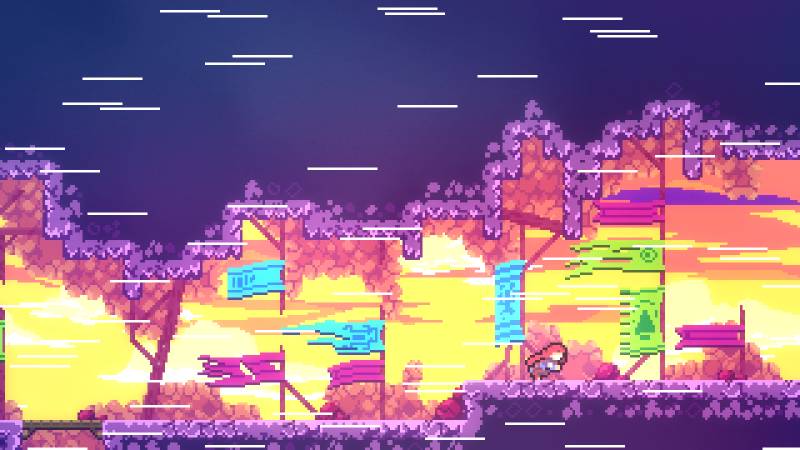
It wasn’t until the late 2000s (a less embarrassed me would claim the early 2010s) that I finally sunk my teeth into gaming. That’s all to say, I pretty much cruised past the first pixel art era – a time when pixel art wasn’t an aesthetic choice, but a hardware limitation. However, as someone who’s invested more than a handful of hours into Stardew Valley and watching Let’s Plays of Celeste and Hyper Light Drifter, I sought to understand why pixel art has resurged in a new era – an era in which popular indie games insist on returning to this stylistic well.
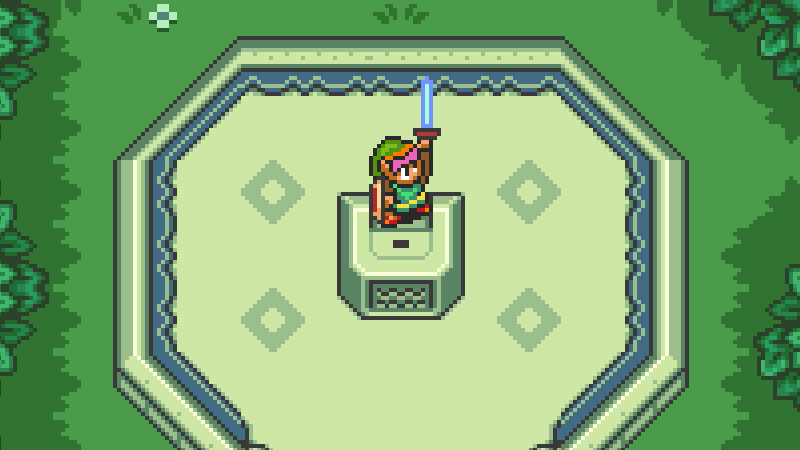
Screenshot from The Legend of Zelda: A Link to the Past, originally released on the Super NES.
In the article “Pixel art games aren’t retro, they’re the future,” published by The Verge in 2014, author Sam Byford spoke with game designer Jason Rohrer. Rohrer claimed that he saw pixel art as “a digitally native [form of] cartooning.” His argument here is that pixel art is intrinsic to computers. Even though the technology has evolved towards high definition, the idea of breaking art into blocky pixels is something that transcends innovation. It’s a basic understanding of how computers display 2D images. To an entire generation of (older) gamers, pixel art is the simple, underlying language of the computer. The reason it has had such a lasting presence is partly a bid towards nostalgia, but more so because pixel art is a two-dimension expression of digital minimalism. It is, at its core, simplistic.
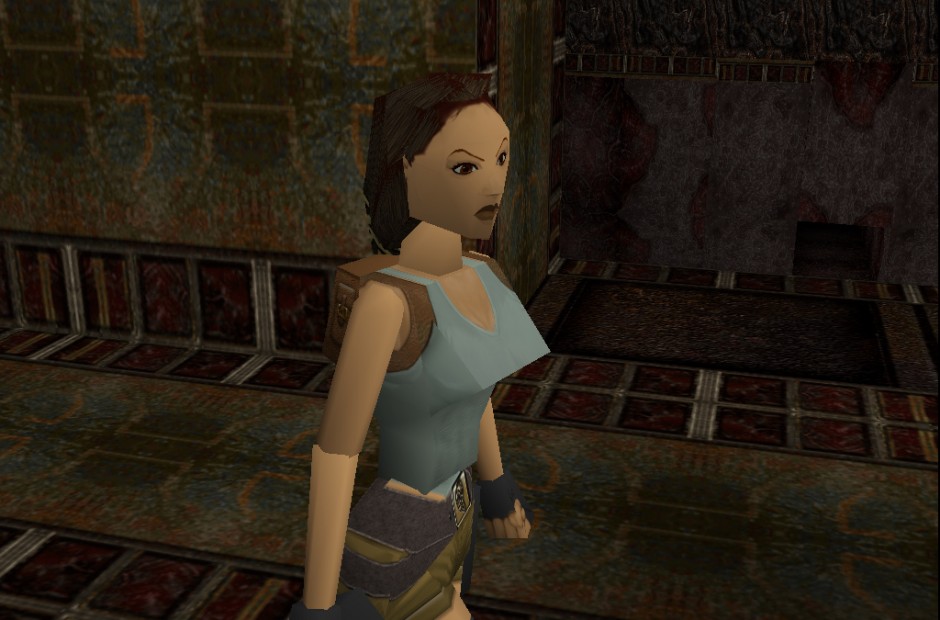
Compare an image of Lara Croft from the original PlayStation Tomb Raider to an image of Link from the SNES. The latter has aged well, while the former looks dated and low-tech. Tomb Raider’s low-poly aesthetic strived to push the technology towards complicated realism and landed too far away from the finish line to not be judged by time. In seeking to create the next-best thing, Tomb Raider moved away from graphical minimalism for flashy, groundbreaking effects. They didn’t embrace the jagged edges that they were limited to and, instead, attempted to mix curves and exaggerated body structures to hit a point of realism that they couldn’t achieve. Over the years, the low-poly aesthetic disappeared by way of graphical evolution but re-emerged after taking note from pixel art. Superhot, Minecraft, and Grow Home are just a handful of modern day examples.
Screenshot from Tomb Raider, originally released on the Sega Saturn, PlayStation, and MS-DOS.
As oxymoronic as it is to say, the resurgence of dated low-poly art and the longevity of pixel art lie in the ability to evolve with the technology. Designers of today who wish to re-connect with old gaming trends continue to refine the aesthetic and improve upon the capabilities of the original consoles. They take advantage of colors, expressions, and angles that were foreign to those classic machines.
In a blog post published on Gamasutra, Shovel Knight developer David D’Angelo talks about how their intention was to evoke the feeling of older games while simultaneously “breaking” the limits of the NES. They wouldn’t box themselves into old specs. He mentions the integration of parallax scrolling, an expanded color palette, and particle effects among other ways they improved the game’s pixel art aesthetic compared to its original era counterparts. While the style may originate from the 16-bit era, it owes its lastingness to its adaptability.
Ultimately, gamers are ageing into game designers who are seeking connection with their youth. They are embracing the technological shortcomings of the past and re-appropriating these aesthetics to become timeless art styles by paring them down to their most minimal, simplistic expression.
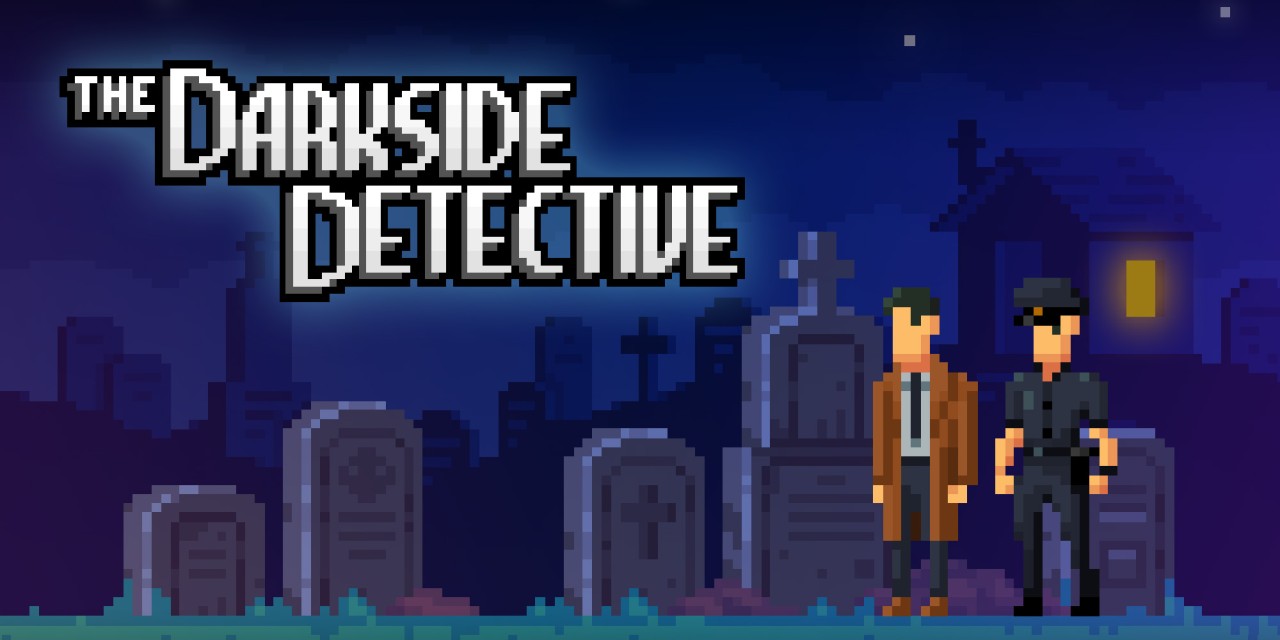
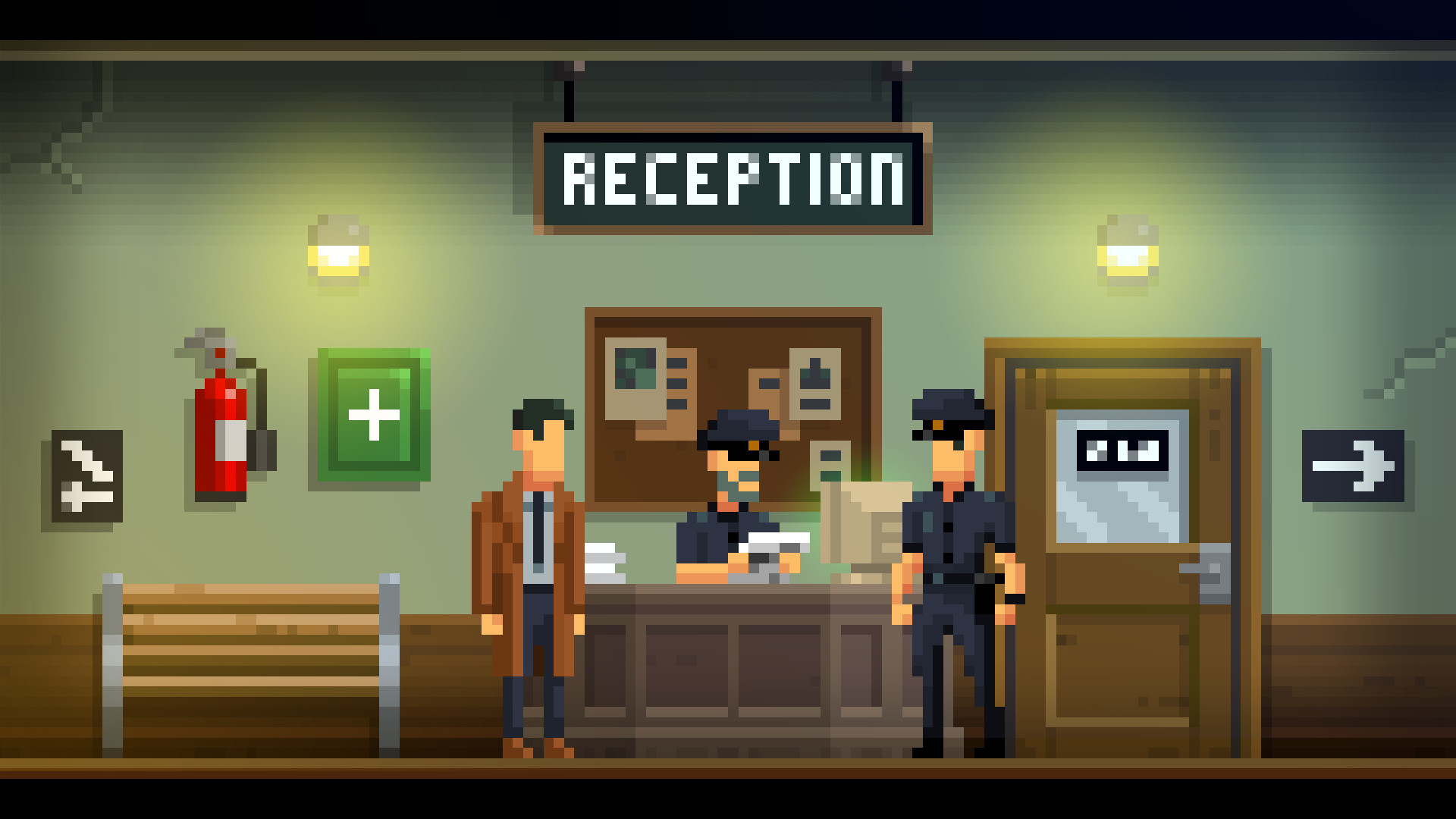
I tend to harp on the overly simplistic ports that have inundated the Switch since its release. The one to ten-year-old ports that have crowded the eShop can be annoying, and it’s that over crowdedness which can bury a great indie game under all the clutter. If you can manage to wade through all of the nonsense, you might just be lucky enough to find The Darkside Detective, from Spooky Doorway and Isometric Dreams. I simply adore everything about this title, with the story, humor, music, and overall premise of this game overjoying me. What could easily be dismissed as yet another title from a bygone era, is actually one of the more fun and entertaining titles in the Switch library.
The Darkside Detective Review [Nintendo Switch]
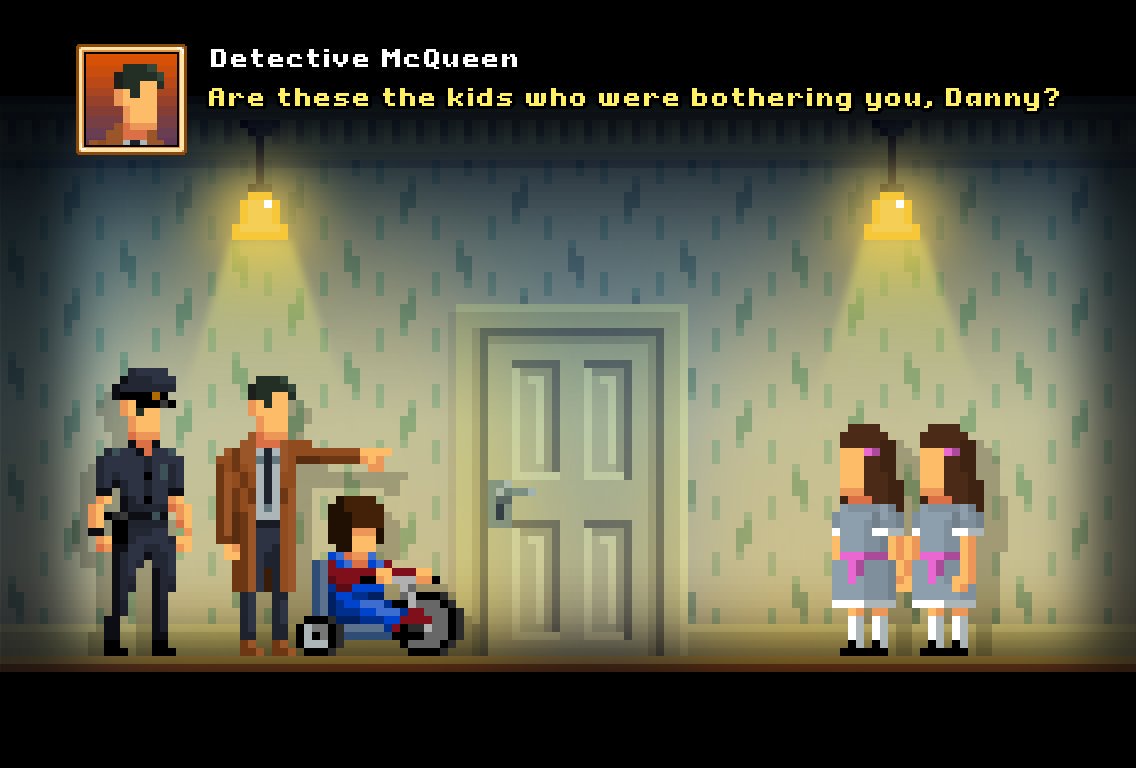
The Darkside Detective is a cross between the The X-Files, Kolchak, and Twin Peaks, and follows around Detective Francis McQueen as he attempts to solve mysteries of the supernatural. Following the Detective on his cases is officer Dooley, a dim-witted, but hilarious beat cop who adds little help to the case, but a whole lot of entertainment to the player. As the pair work on cases involving members of the occult, ghosts, monsters, and the paranormal, the detective must put all the pieces together to uncover the mysteries of the Darkside.
The Darkside Detective
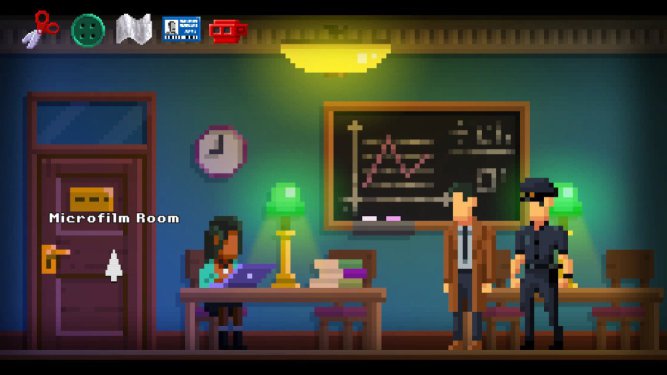
The game is rather simple at its core, and is mostly a point/drag and click adventure. There’s no free movement, but rather you click on the direction or room you want to go and the slide changes. Each room and environment (which are all beautifully animated), can be interacted with and searched for clues. As you hover the pointer over objects and people, you’re given the option to either talk, examine, or take. It’s very important to listen to everyone, as clues to the case could, and most likely would, be blurted out.
From haunted police stations, spooky libraries, and eerie subway tunnels, the town of Twin Lakes where this is all set is unique and filled with mysteries. McQueen must make his way throughout each location in order to solve the case, and the objects you find can be combined in order to help. A missed clue or object could mean endless searching for what you’re supposed to do next. The game is about being a detective, so go and detect!
The Darkside Detective
Making the overall experience even more enjoyable is a laugh-out-loud tongue in cheek humor. From the names/puns of the missions and characters to the witty banter, I found myself bursting out into laughter on more than one occasion. I don’t want to ruin any of the funny lines, but in one instance, McQueen and Dooley are standing in a room with a giant marble statue of an angel. Click on the statue, and Dooley simply blurts out “Don’t Blink.” For any Doctor Who super-fan such as myself, that little reference is just about as close to perfection as a nerd can get. These pop culture references and humorous one-liners pop up throughout the game and help to set the adventure apart from similar titles.
The Darkside Detective
The only true negative I can think of is that it’s all too easy. There are only six cases to get through, and I was already on case four by day two. The only time I felt challenged was when I failed to find an important object or didn’t talk to someone and missed a vital clue. This isn’t a bad thing necessarily, but as someone who is in love with the game, I really wanted the journey to last longer. It’s my hope that the developers release some new cases in a future DLC pack.
When I say I am in love with this game, I mean everything about it, including the music. As I was playing in handheld mode, the music sounded amazing. I slapped on some Bose headphones, and the experience magnified. From composer Ben Prunty, the man behind games such as FTL and Gravity Ghost, the music in Darkside Detective is just beautifully done. Befitting the supernatural tone of the game, Prunty’s score is some of the best music in recent gaming memory. Just remember, this is a simplistic game, so the fact that they put this much effort into the music really shows the passion surrounding the project.
In South Park and The Simpsons we’re shown as internet trolls, in Future Man we’re a lowly janitor still living with our parents, and in The Big Bang Theory, we’re a group of gangly and awkward nerds with social anxiety. The stereotype of a “gamer” is not one that is often shown with tact. Often these characters are reduced to a trope that is tired, lazy, and incredibly inaccurate. It would be easy to blame these portrayals on the “others” who don’t play games, but the problem is only exacerbated by the sense of ego and console class wars that the gaming community has seemed to foster.
If you scroll through the comments section of any big gaming site you’ll notice there’s often a litany of rallying cries around the “PC Master Race,” or the declarations of the death of the “Xbone” or the idiotic ineptitude of both “Nintendo and Sony fanboys.” As a community, we have created a toxic class system in which one console, or more broadly speaking one medium, has power and a status above another. For example, there is an entire Wikipedia page dedicated to the idea that PC gamers are ‘superior’ to their home console counterparts. The PS4, Xbox One, and Nintendo Switch are subservient. Do PC games look and run better? Yes, if you have the right set-up they generally always will, (the technology advances at a quicker rate). Does that, therefore, make a PC gamer better than everyone else? Of course it doesn’t. Even within the said latter console communities, there is a further hierarchical debate considering power, portability, and exclusives.
It’s this very immaturity that propagates the gaming industry into not being taken as seriously as it should be. This ‘class’ system has done more than just fueled poisonous debates about which console or platform is the ‘best’; it has also stunted the very definition of a “gamer” and is a key reason why the industry as a whole is still looked down on when compared to films, books and TV. It has created a rubric for what constitutes a “good” game and has set in place a structure for how serious or dedicated a gamer is based on their choice of system.
Under these guidelines, it would be a stretch to consider anyone who plays three hours of Candy Crush Saga a day on their phone a “gamer”. A game on a device that is graphically substandard and comparatively low-powered. And yet the gamer is sinking the same amount of time in as someone who is playing a game purchased on Steam. Obviously, comparing the capabilities of a PC and the gaming abilities of an iPhone is a fool’s errand, but does that mean we should discount someone who chooses this type of user experience? That should be celebrated, or at the very least tolerated, but is instead often crucified by a community that is seeking to organize their players by superficial graphics and frame rates.
With The Legend of Zelda: Breath of the Wild winning Game of the Year at the D.I.C.E. Awards, we have definitely made an effort to discount the power of the console – the Wii U and Switch stand nowhere near the other platforms when it comes to frame rate or graphics. Let’s extend this trend to mobile gaming and acknowledge that people who seek enjoyment from a mobile device are putting their knowledge of power behind them and simply embracing the game experience. If they devote ungodly amounts of time to Alto’s Adventure on the iPhone, they are no less a “gamer” than someone who spends an equal amount of time playing Overwatch.
In a 2015 study by the Entertainment Software Association, they reported that four out of five homes owned a device to play games on. Further, 42% of Americans played video games regularly. This is not a community that is devoted to one system, but a population that is spread out over many different gaming experiences. I’ve personally played games on every format imaginable: a “gamer” is a “gamer” if they’re dedicated to playing games. Like a “reader” of books is a “reader”, regardless of the length of the book.
We should celebrate our wide range of mediums if only so our portrayal in the mainstream is not so inaccurate and narrow. We should put the console/system ‘war’ (the silliest war I’ve ever heard of) behind us and admit that wherever, whatever platform we choose, we’re all just gamers trying to navigate an increasingly harsh reality.
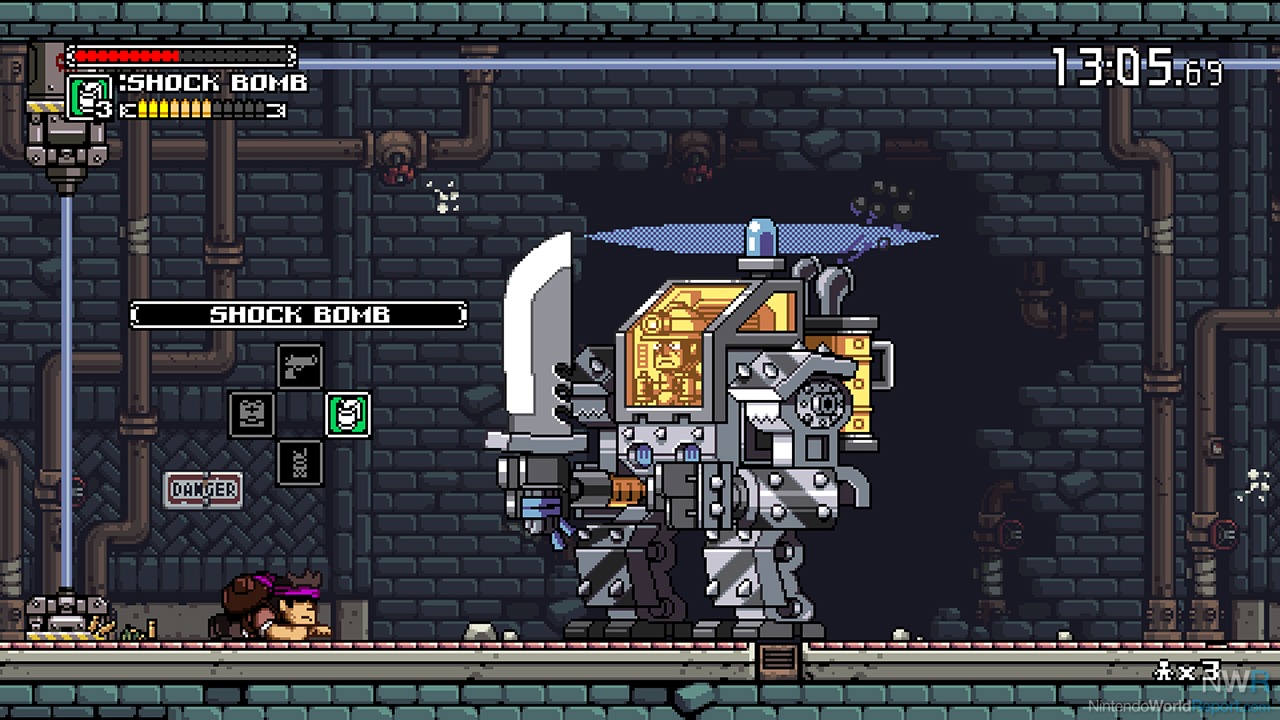
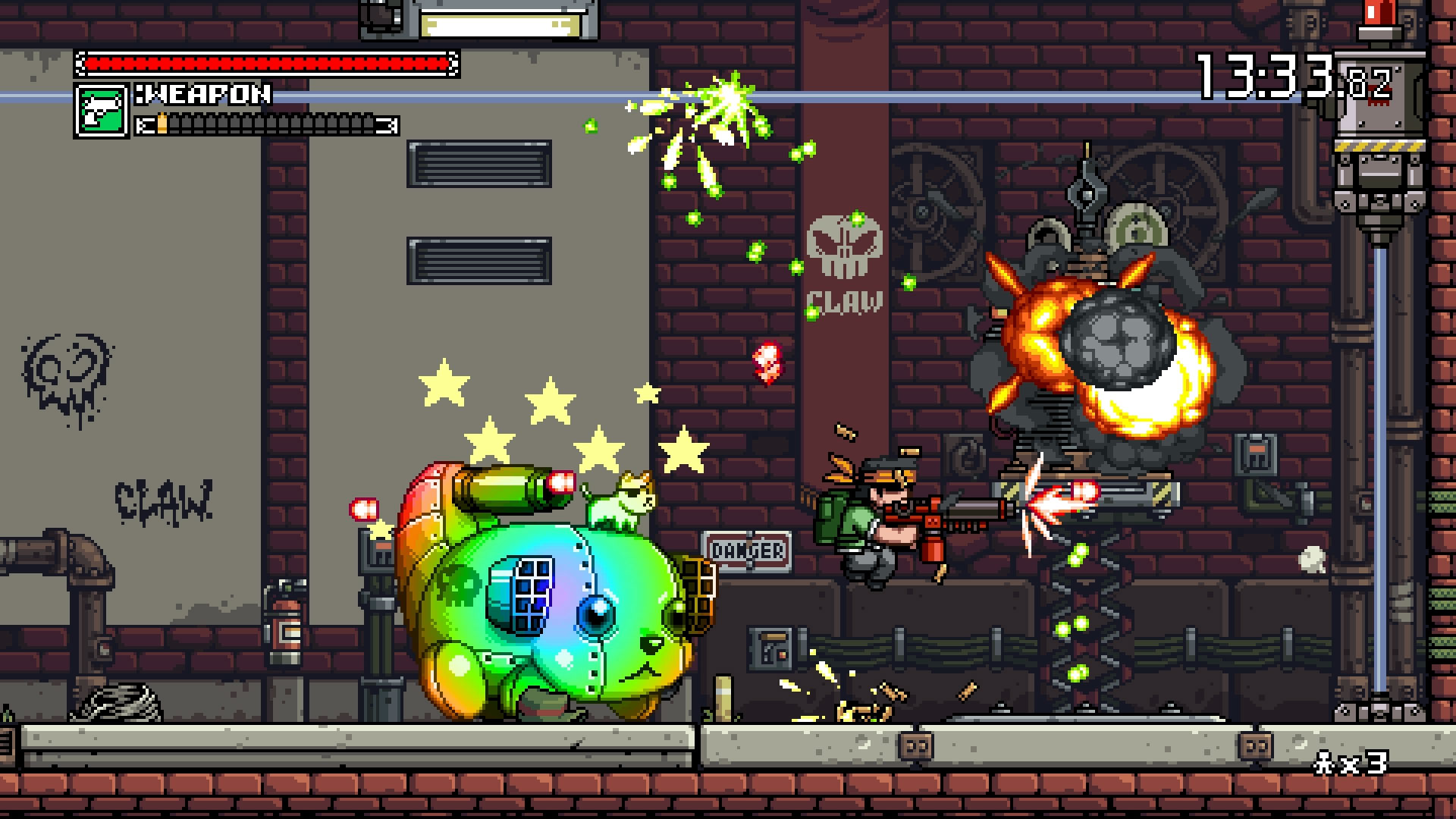
Four years after its initial release on Steam, Mercenary Kings from Tribute Games Inc. has made its way to the Switch. With two parts Metal Slug, one part Contra, one part Metal Gear, and a tiny dash of Fall Out, this Kickstarter led 2D action game is not without flaws but does manage to entertain and be a great addition to the Switch’s portable lineup.
The premise of Mercenary Kings is straight out of a 1980’s action fest. As part of the Mercenary Kings, you are a member of the greatest gun-for-hire groups on the planet. Without warning, the majority of your team is wiped out in quite the gruesome fashion by the sinister group known as CLAW (I guess someone loved inspector gadget as a kid). With only two survivors, you must rebuild the group and go after CLAW, who have just taken over a secret island laboratory base and the dangerous weapons contained within.
Mercenary Kings
Players get to chose from different characters to play as, each with different sayings, attributes, and a few unique weapons. I don’t feel the game plays any different based on your choice of avatar, but I’m sure players will have their preference. The first few missions of the game have you rescuing more team members to add to the ranks. Each of these individuals are experts in a specific field, such as weaponry, knife making, piloting, medicine, etc. After you rescue each teammate, they are able to help you on your missions.
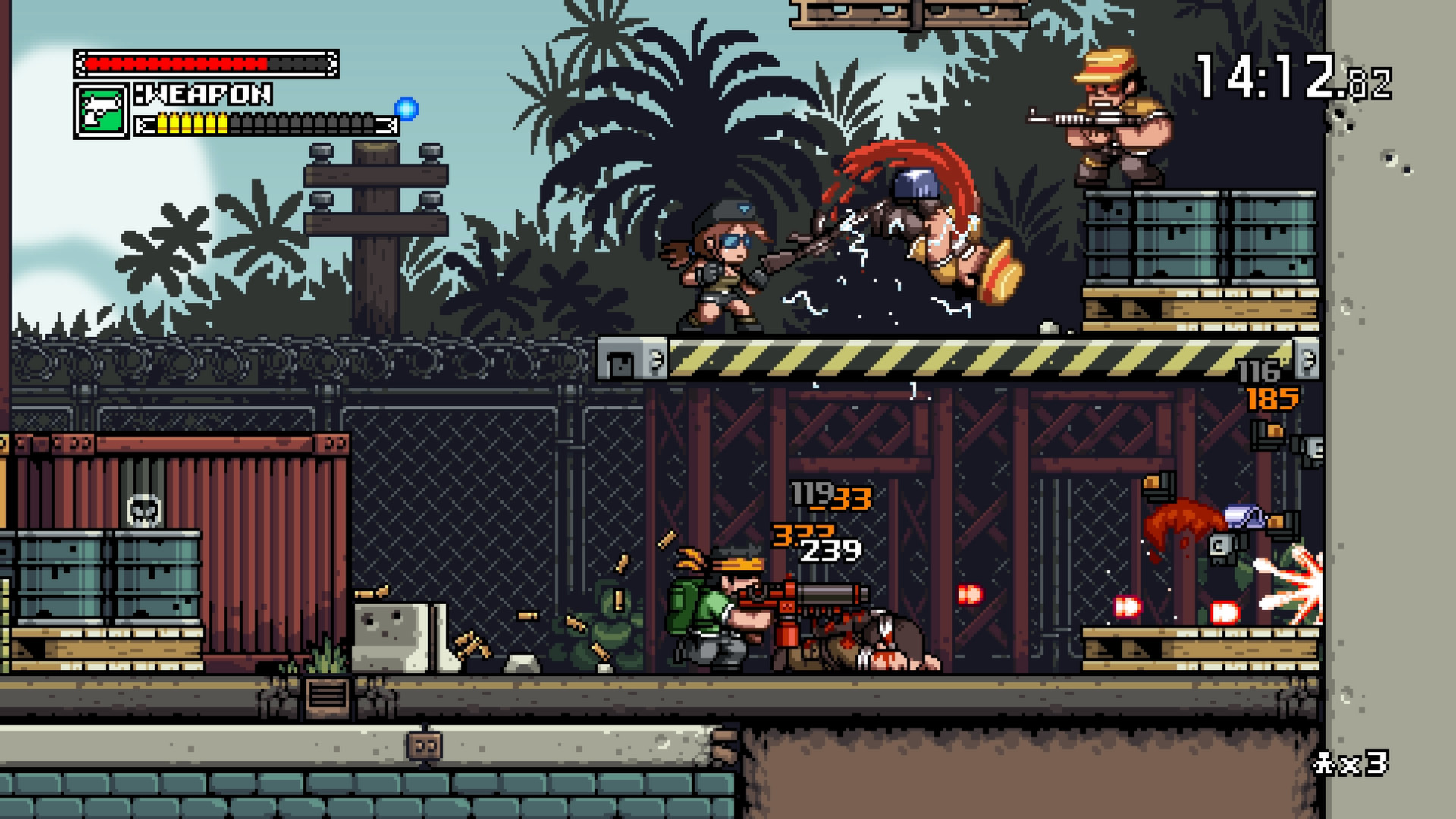
As you run-and-gun through each of the over one-hundred missions, you’re able to pick up various items to aid in the crafting of better weapons and necessities. Once you’ve gathered enough of the required material, simply visit one of the aforementioned genius teammates who will upgrade your weapons, body armor, and overall equipment. When it comes to crafting, I typically think of big open world games like Fallout, but having the option to do it in what’s especially a 16-bit game that I could have played on my Neo Geo, is actually quite fun.
Mercenary Kings
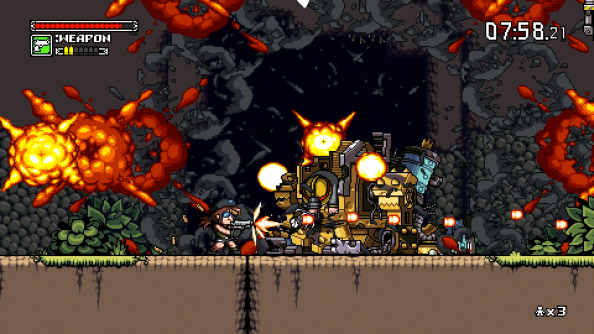
The jungle setting does get a tad repetitive after a while, as there is only so much you can do and change to make things look different or unique, but the varied nature of enemies to blast away does tend to make up for it. From normal grunts that are easily killed with one shot, to giant behemoths and mechanized warriors, players will enjoy the challenge. This is not to say the game is extremely difficult, but it certainly isn’t a breeze either. I found I had to restart a mission more than once because I either ran through my limited lives or wasn’t able to complete the mission in the time allotted. Once the timer runs out, the mission is lost, and you’re sent immediately back to base (the same happens if you lose all your lives).
Each mission comes with a monetary reward for completing it in its entirety. The more things you miss or fail to pick-up/achieve, the less money you get in the end. Throughout the mission, you’re able to use a transceiver to call in favors from your crew. Need some health, a different weapon, and mission advice? Just dial up the right person in a similar fashion to the old Metal Gear codec. These requests cost you, so keep that in mind before going crazy. You’ll need to save up as much of the bounty you receive from missions in order to craft/buy better weapons and equipment. As nice as the standard gun is, you’re really going to want to upgrade to something better as the levels increase in difficulty.
Mercenary Kings
Gamers can most definitely go at it solo, or they can play both online and offline 4-player co-op. Like the original Contra, this is one of those games that is exceptionally fun with two or more players. There can be a lot going on in these missions with enemies flying at you from all directions. I can attest to the fact that having an extra gun or two on your side would greatly relieve some of the pressure. It’s another instance where the Joy-Cons and the overall portability of the system really shine, and we had a ton of fun playing co-op with this one.
As an added treat, the character animations in Mercenary Kinds have been designed by Paul Robertson, best known for his work on Scott Pilgrim and Pixel. Robertson’s designs fit the game perfectly, using a great balance of 80’s camp and pure machismo to give each character a unique look and feel. It’s the little touches when a developer goes out of its way to bring in someone like Robertson that I really appreciate. To me, this makes the game stand out from the clutter.
Mercenary Kings
Overall, I really enjoyed blasting my way through Mercenary Kings. It’s nothing entirely new, but the little things like crafting and calling in for supplies really adds to its enjoyment. I do enjoy a good run-and-gun game, especially ones that remind me of stuff from back in the day, but even I have to admit it got a little repetitive. I know this is a common complaint of mine, but I call it like I see it. I also felt the difficulty was a bit erratic, with some levels being exceptionally easy, while others unnecessary difficult.
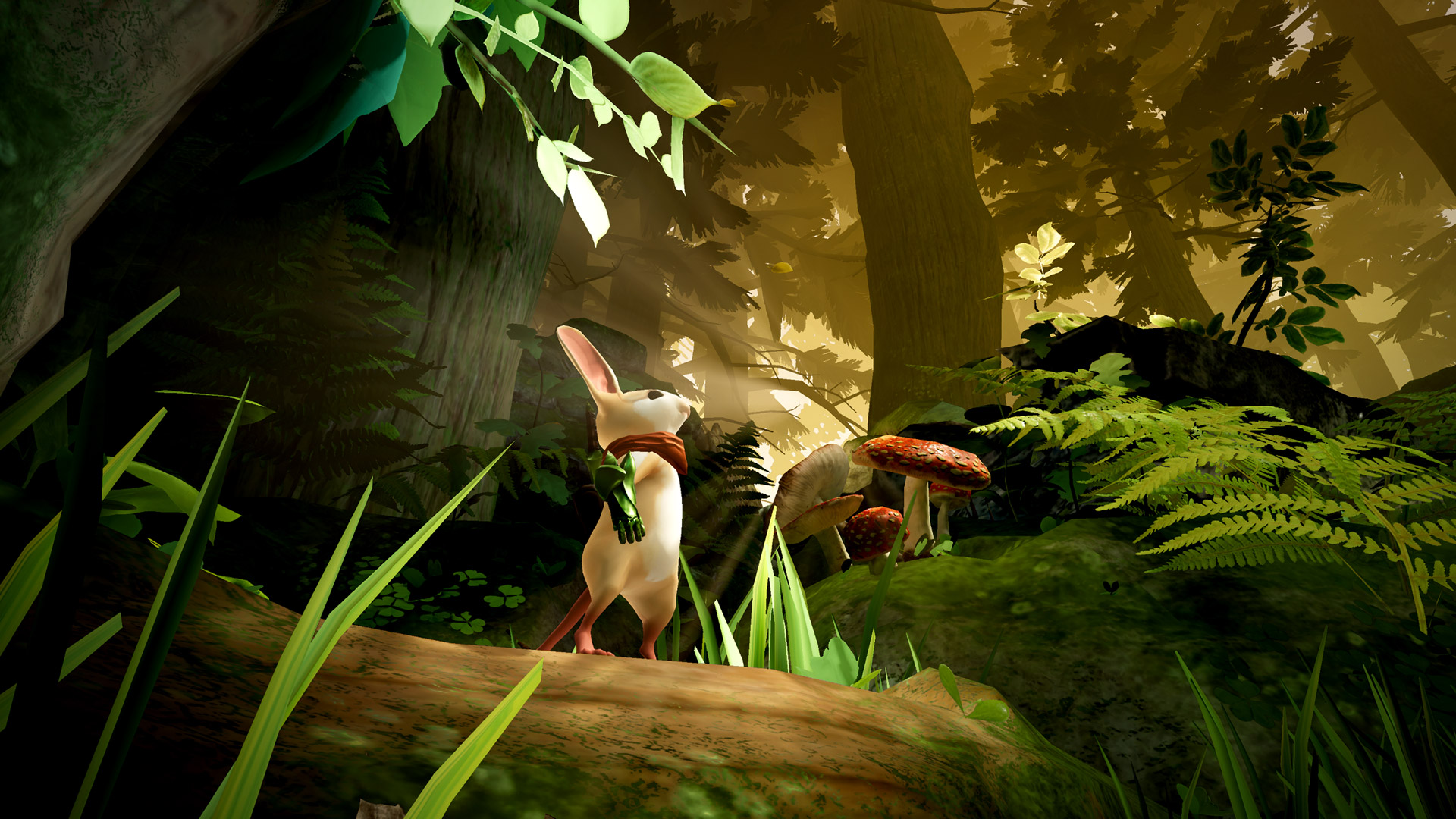
Developer Polyarc has released some new gameplay from their PS VR platformer Moss. In short: it’s looking promising and, most importantly, quite distinct. Did I mention it’s really cute?
Moss – Exploring The Magic Of VR
For those that haven’t been following, Moss is a single player, platforming puzzle game. Built for PS VR from the ground up, the title reimagines classic action-adventure gameplay in an immersive virtual reality environment.
In Moss, players control Quill, a young mouse who has dreams of greatness beyond the confines of her own little settlement. While exploring the woods, she finds a mysterious piece of glass and an ancient magic is awakened… The rest is up to you!
What we’re seeing in Moss hasn’t really been done before, and that makes it all the more exciting:
“From the beginning we wanted to take the core of what makes a game great and bring it to life with the magic of VR. We’re so excited to finally share Moss with the world.” Tam Armstrong, Co-Founder and CEO of Polyarc.
Moss is due out on the 27th Feb, exclusively for PS VR at a price point of £24.99 in the UK. You can try it out while you wait via the free PlayStation VR Demo Disc 2.
No matter what anyone says or how adamant they are, no one truly wants to be alone. Sure we like our solitude from time to time, and having the option to go anywhere and do anything we want at a moment’s notice, but that becomes old after a while. Eventually, we realize that being alone is nice, but enjoying life with a partner is even better. The person who wanted to go anywhere and do anything comes to the determination that doing things and going places with a significant other, is a whole lot more enjoyable than experiencing life on one’s own.
Gaming Your Way To A Soulmate
Recently I asked the online community for stories of people meeting their loves through gaming, and the community let me know that gaming has brought people together in amazing ways, and it gave me hope for the future.
According to a 2017 StatisticBrain survey, there are approximately 54.3 million single people in the United States, with about 49.6 million who have tried online dating. The revenue from internet dating services, as of 2017, has reached almost two billion dollars annually. These are pretty incredible numbers if you think about it. We are apparently a very lonely country, and people are doing whatever they can to meet their soulmates.
Traditionally, before the age of the internet, the main way to meet someone was either through a mutual connection, going to the local pub, or possibly through work, where you and a co-worker hit it off and would live happily ever after. These days, online dating has taken the crown, and what was once a stigma, is now almost universally accepted. As Match.com, OKCupid, Bumble, and the plethora of other sites and apps dominate, there is something less than organic about it all. You create a profile and fill it with truths and half-truths; making yourself look amazing enough to break through the clutter. Once you connect with someone and actually meet (amazing how many people flake), you then have to have awkward small talk until the alcohol lowers inhibitions and you can finally relax, if only a little.
The thing is, it all feels forced at times (ok, most of the time), but meeting people in bars or at work, which I don’t recommend, is increasingly difficult. As you get older, it’s harder to meet people through friends, because most of them are already married and only hang out with other married couples. I hear stories of people who met their partners randomly on the street, subway, grocery store and even waiting in line at the DMV (yes, I actually have a friend who met their future wife while waiting to renew their license). With all that said, what about gaming? Is it possible to comb through the clutter of a billion inappropriate twelve-year-olds who are ecstatic they can use as many derogatory words as humanly possible in a fifteen-second window? Apparently, it is.
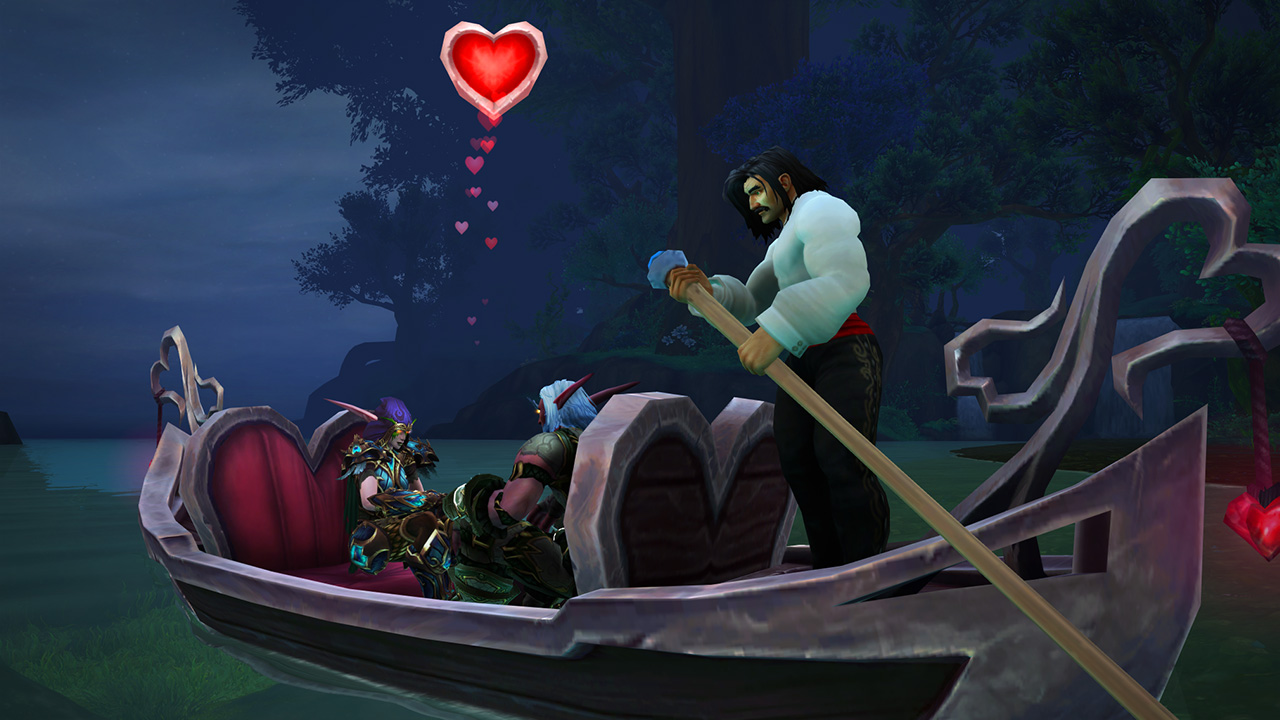
One individual who reached out to me was TM (yes, I am clearly not giving their actual name for privacy sake), who had a lovely story about how she met her husband. Life had thrown TM a curveball, wherein a short period of time, her father passed away and she called off a long-standing engagement with a man she knew wasn’t right for her. Not wanting to be alone, TM regularly hung out at a close friend’s house and watched him play hours worth of World of Warcraft. TM didn’t think she’d actually enjoy playing WoW, so her friend issued a challenge; play just a little, and if she didn’t get hooked, he wouldn’t make her play again. Wouldn’t you know it, TM fell in love with WoW, and like most people who are finding the real world a difficult place to navigate lost herself in the online gaming community.
After meeting several amazing people and making new friends, TM met J, and it was the beginning of the end. First becoming close friends, TM eventually decided (against the advice of others), to fly out to J and meet in person. From there they began a two-year long-distance relationship, and eventually, J moved to be with TM. The happy couple has now been married for six years and together for almost ten. This all happened organically and both individuals took the time they needed to really get to know one another.
Video gaming is the predominant topic of choice on our site Nitchigamer, but gaming is all-encompassing and includes many different types, genres, and styles. Although we hardly talk about board games in our reviews and articles, we can’t discredit that they were, in fact, the predecessors to the video games we play today. One of the stories I received was from LJ, who met her husband through gaming nights via meetup.com.
LJ didn’t want to go the online dating route, as she felt it was awkward, misleading, risky, and usually unfulfilling. Instead, LJ decided to join a 20s/30s singles board game meetup. She loved games and knew a room full of like-minded people were all there to have fun, enjoy some games, and maybe, just maybe, meet someone.
Having a great experience, LJ went to a few other groups centered around gaming, and eventually asked out one of the guys who she had been friendly with during her repeat visits. It was a singles group, so they knew they were both sans partner, they both loved gaming, and after spending time together in the groups, they definitely realized there was a connection. Now married, LJ and her husband still play games and have made a plethora of friends in the community.
I am one of the almost fifty million people who use online dating (or at least I did until I decided to take a break a month ago), and it’s extremely difficult to find “The One.” People say one thing, but mean another, they want a real relationship, but then don’t, or they lie about everything for whatever reason they feel that’s necessary. I’ve met people and dated, some for a lengthy period of time, but in the end, none lasted. I can wholeheartedly agree that online dating is awkward. The dates are uncomfortable, the trust levels are non-existent, and the “rules” you’re supposed to follow are ridiculous.
We all look for a partner with similar interests, values, morals, likes and dislikes, and overall compatibility. For those lucky people who had it happen organically via random happenstance, I am overjoyed for you. With online dating, people pretend they’re someone they are not, but with gaming, you’re allowed to be your true self. We all escape into the gaming world because it tends to be a better place than the one we are trying to temporarily shut out. When you meet people who are playing the same game(s) you are, there is already a connection and a starting point of mutual interests. I’m not saying it’s easy to find your soulmate while diving deep into Minecraft, but perhaps if more people got into gaming, we’d all be a little less lonely.
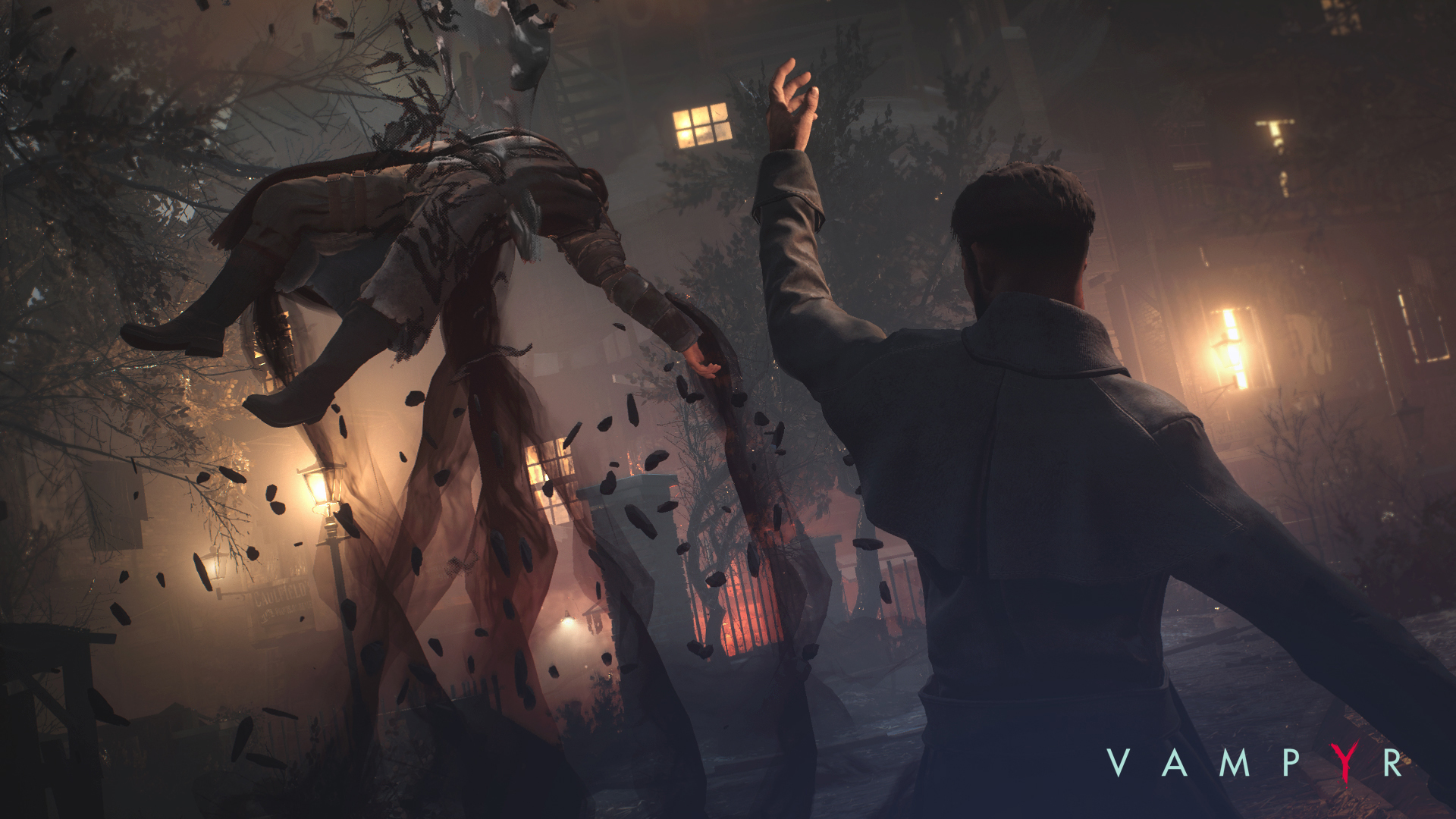
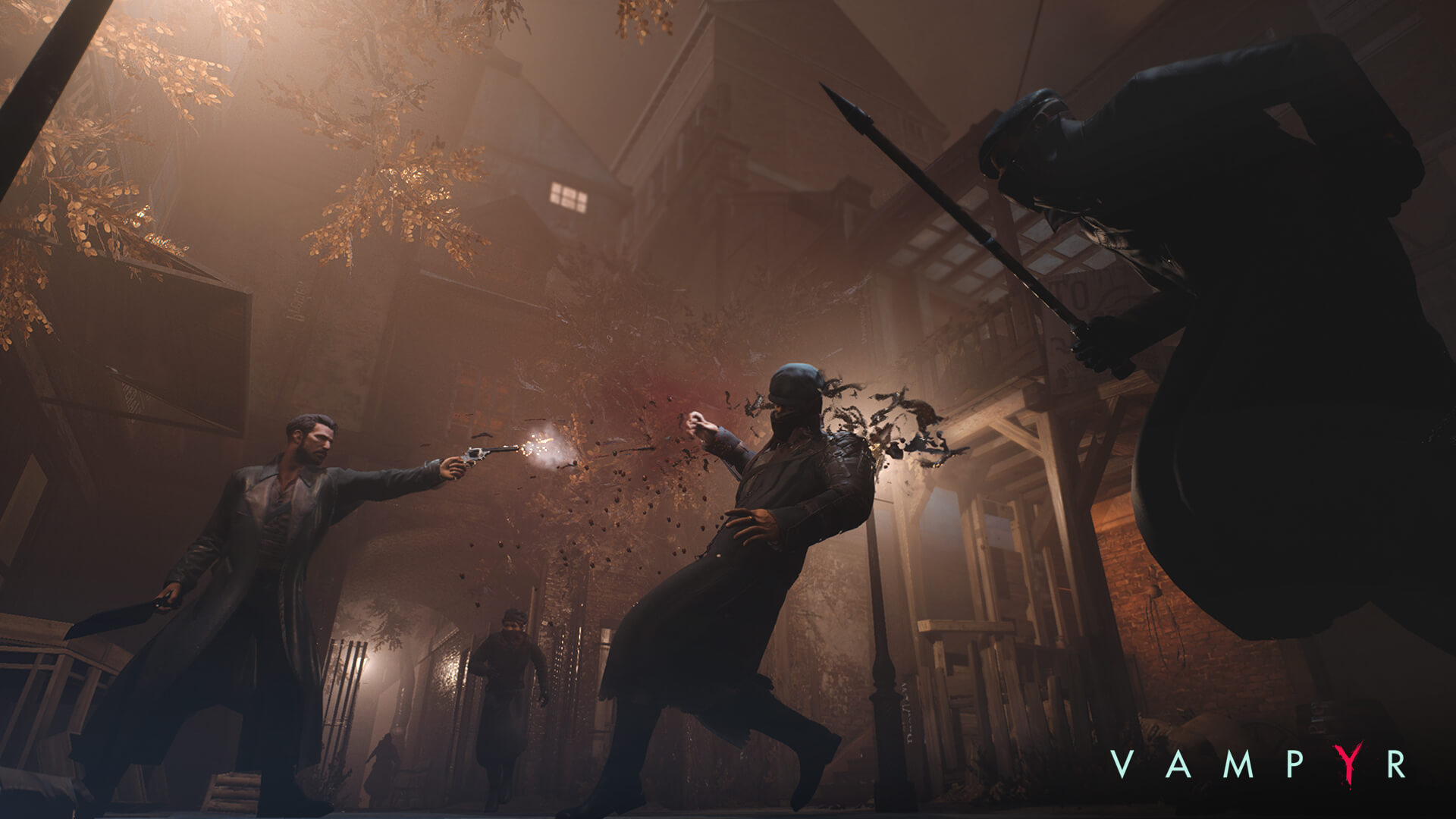
June 5th: A date in which fans of horror games will be able to arise from their cobwebbed coffins and sink their teeth into a new, delicious looking slice of horror gaming courtesy of DontNod, the developers of Life is Strange. DontNod’s previously delayed Vampyr is finally on its way, night people.
Life Is Strange In Vampyr
Originally scheduled for a 2017 release, Vampyr seduces players into the world of Dr Johnathan Reid. Dr Reid is a doctor working hard to develop a cure for the Spanish flu in early twentieth century London, but Dr Reid is a vampyr. When he isn’t busy trying to develop the cure for Spanish flu, Dr Reid is busy cracking into the arteries of London’s denizens and drinking their blood.
Of course, the choice of how much time will be spent devoted to developing a cure, or to feeding on London folk will be left up to the player as players control Dr Reid. Despite the way that last sentence read, Vampyr is not a time management simulation. Vampyr is an action-adventure styled RPG less focused on combat and more focused on presenting players with an immersive, narrative-driven experience. Deciding whether to feed into your vampiric urges or abstain from feeding on innocent citizens will play an integral part of Vampyr’s experience.
Every London citizen with which Dr Reid interacts has their own schedules, lives, relationships, and stories. According to Vampyr’s official website, affecting one character will affect all characters. If you affect someone in the wrong way, you may find yourself under attack from vampyr hunters or clergy. As a means of defence, Dr Reid will be equipped with pistols, sabres, and an arsenal of supernatural vampire abilities.
Vampyr will be available for purchase on PC, PS4, and Xbox One on June 5th. Purchases of Vampyr do not come complete with cloves of garlic, holy water, or wooden stakes; you’ll have to pick those up separately.
When reading about indie games it used to be that the bar was set a little bit lower for the small teams that made them. We used to be more forgiving if a title didn’t have quite the sheen that you’d see out of an ‘AAA’ studio. I mean, what do you expect when you’ve only got a team of 5 people working on a game?
Iconoclasts Review
This isn’t the case anymore. Nowadays smaller teams are measured on the same scale as anyone else. Still, it’s hard not to be impressed by Iconoclasts’ development story. This is because Iconoclasts is a smart, challenging and gorgeous ‘puzzle-action platformer’ that was made by one person. The music, the programming, the writing and the visuals – everything.
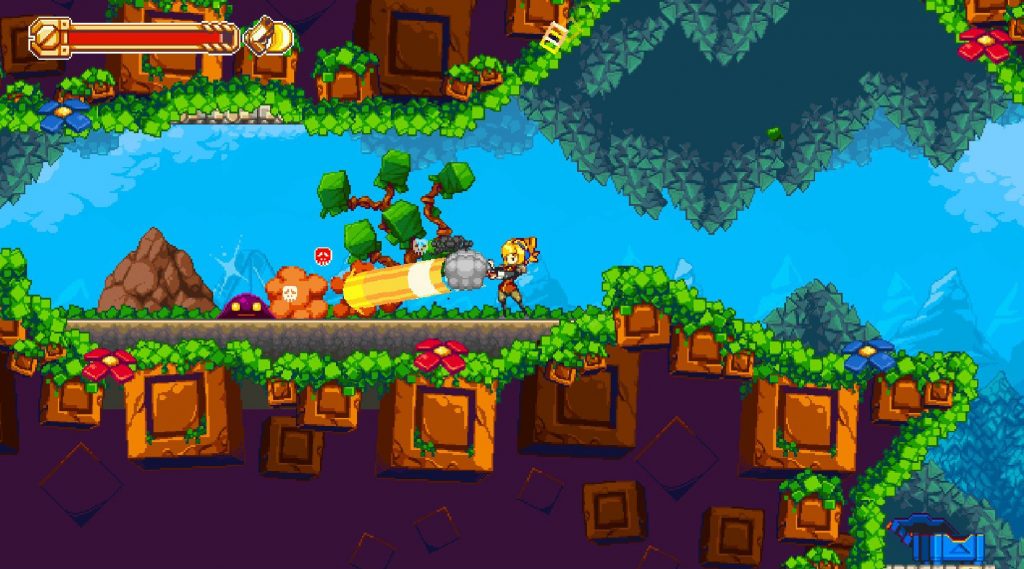
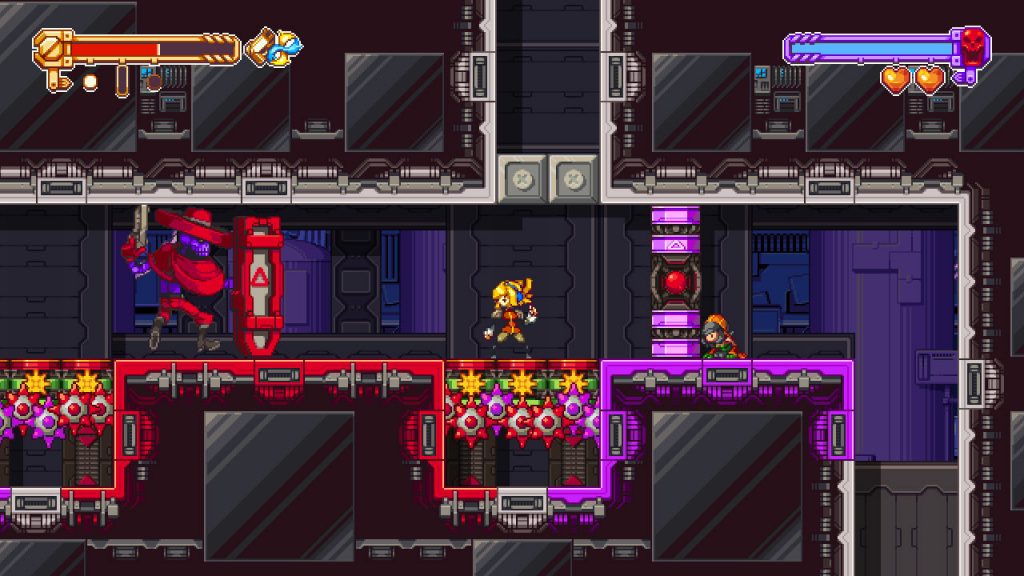
So maybe you’ve read the term ‘action-puzzle platformer’ before or maybe it’s a new term I’ve just made up. Who’s to say? In simple terms, Iconoclasts has you playing as Robin, who’s a mechanic with a spanner and a stun gun. This means you jump from platform to platform, using your wrench to fix things, move platforms around and solve puzzles. You’ll also use your stun gun to shoot at the numerous nasties that litter the levels too.
Yes, I could have said ‘this is a game similar to Metroid’ but that would be lazy of me, wouldn’t it? Also, whilst there is some backtracking to do, as you upgrade your moves, your wrench and your gun, there’s not as much as you’d find in a Metroid game.
The puzzles and platforming challenges are well-designed and leave you feeling clever rather than frustrated. The puzzle elements are smartly paced and placed. You’ll rarely encounter something that you ‘need to come back to’ and it’s often fairly clear what you need to do, with the challenge coming from figuring out how to do it. Some of the puzzles require a little too much controller dexterity, as you’ll need to be fairly quick on your feet to do what needs to be done.
What will also require some dexterous button pressing is the fighting and, particularly, the boss battles. Much like the puzzles, most of these are great and ask you to put into practice the skills that you’ve already honed throughout the last area you’ve just spent time in. Sadly, two or three aren’t that fun and introduce unique gameplay elements that don’t appear anywhere else in the game. One boss has you switching characters, which would be fun if you knew how the character controlled. Sadly, the first time you play as this new character and get to try out her entirely bespoke control scheme is during the middle of a hectic boss fight.
Another element that doesn’t always work is the story. I think the fact that I’m even going to talk about the story in a game of this type is pretty astounding, but Iconoclasts has a story that is worth talking about, is better developed than most ‘narrative-driven’ games and will engage mostly everyone.
I don’t want to give away any spoilers but it’s safe to say that Iconoclasts has a story that is full of character and covers some heavy topics. It’s a story about religion, challenging authority of any type and it wants you to question the things you’ve been told by your teachers, preachers and parents. It has a heavily atheist tone, which people that have strong religious beliefs may find off-putting, but it’s brave to see what looks like a simple platformer contain such a fleshed out story, setting and cast.
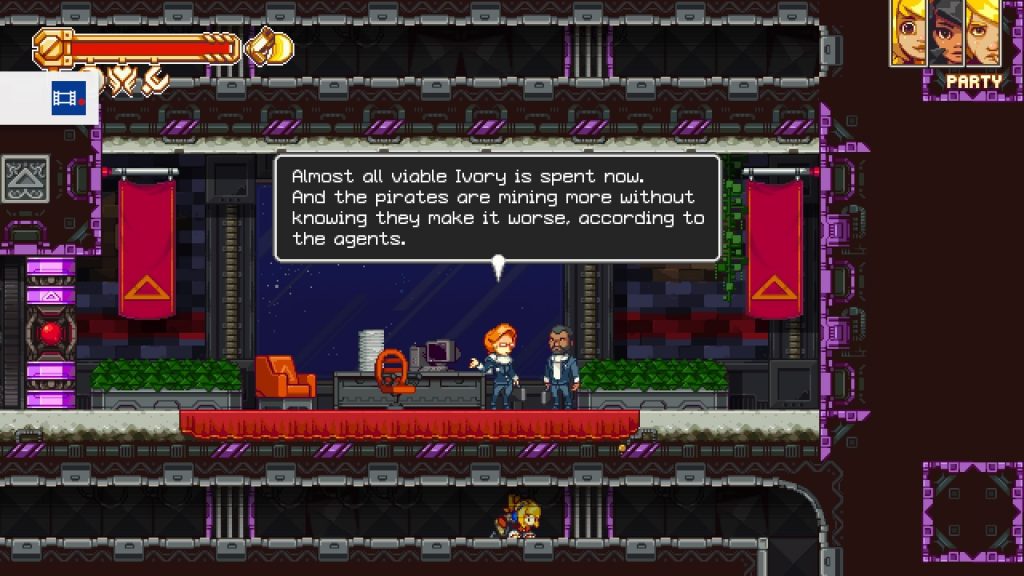
It’s not perfect though. Some of the dialogue goes into ‘anime’ territory for me. There are some overbearing monologues delivered throughout the game and there is a new vocabulary to learn along the way. You’ll have to pay attention and piece together just what the game is talking about when it drops in some of its unique jargon. Personally, I found it worth the effort as Iconoclasts delivered a tale that was much more dramatic and darker than its bright and breezy visuals would suggest.
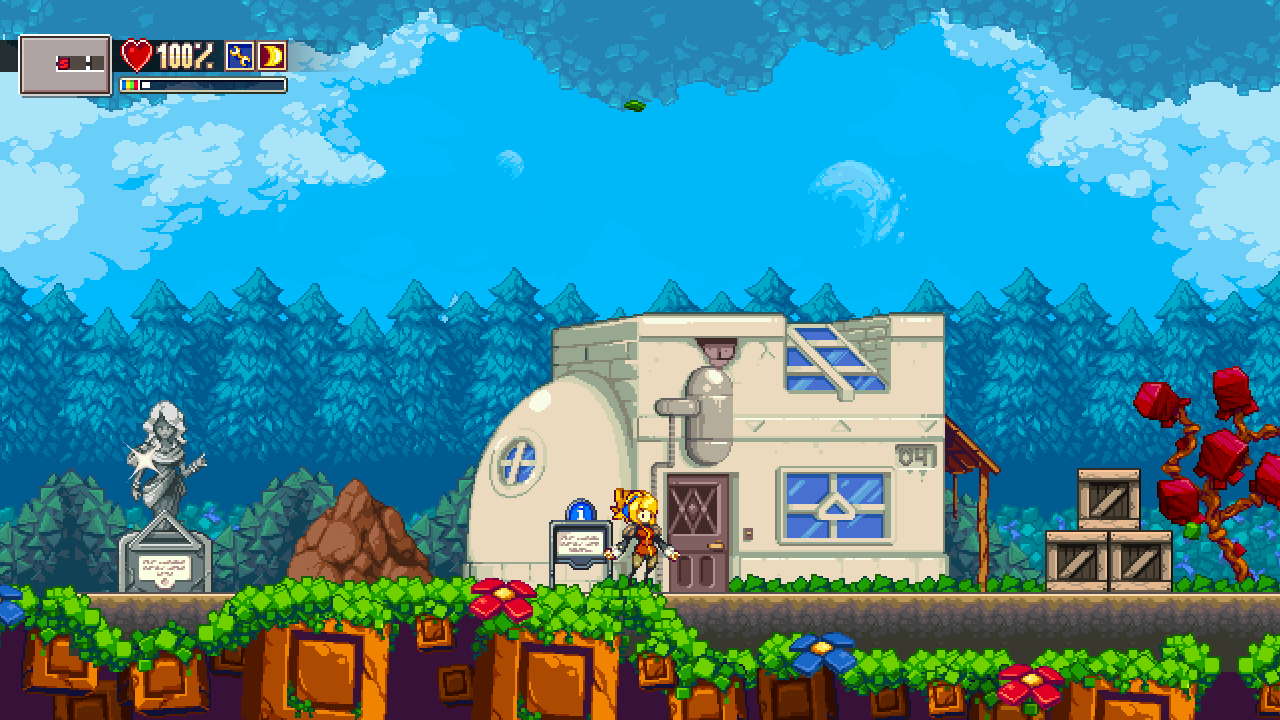
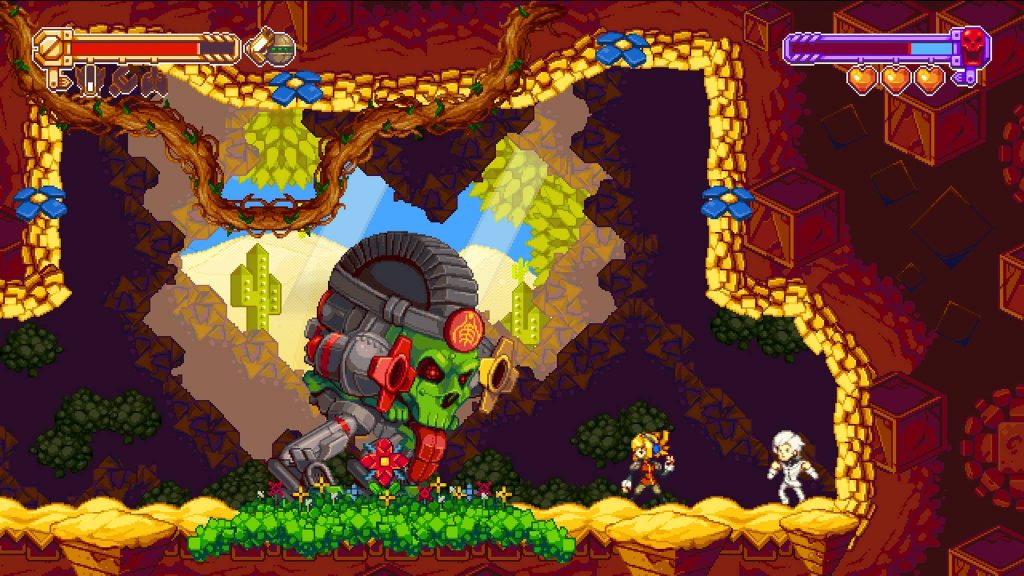
Speaking of which, it’s time I address the well-drawn elephant in the room. Yes – Iconoclasts has some beautiful pixel art.
Everything you get to see throughout the game is brilliantly animated and I can think of no higher praise than to say that quality of the art reminds me of Metal Slug. Enemies bounce, sway and have a real kinetic energy to them that means you can’t keep your eyes off the screen. I may have mentioned how the varied locations are great because they’re well-designed areas to puzzle and platform through, but they’re also really nice to look at and visually varied.
What’s also incredibly wide-ranging is the music. From cheery upbeat numbers to dourer ambient pieces, it’s really impressive to think this was done by one person. Sure, it took this one person 8 years, but you can see where the time has gone and that none of it was wasted!