If you’re a student, summer vacation might be here or just around the corner; or maybe you’re taking a well-deserved break from work.
When I’m travelling, I usually have a book and a portable gaming console in my backpack. I think we all can agree that there are moments in our travelling where we have to just… wait. So, what better way to spend that time than with some good games?
Before I begin, here are some of my criteria for what makes a game suitable for travel:
It has to have a quick and easy save function.
Simple to flip up, easy to put down. It must be easily detachable; can’t really start an adventure on one of Telltale’s games, if you know what I mean.
It has to be fun, of course!
My Top 3 Games For Travelling
I used to have my Nintendo 2DS, but now I am fortunate to have my Nintendo Switch, which brings me plenty of different games to play when I am away from home.
This is my top 3 list of games I like to play when I’m travelling:
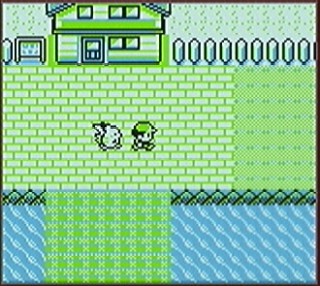
1: Pokémon (Red, Yellow, Blue)
You probably thought I was going to say Pokémon Go, right? Nah. It’s not the real deal. While I quite like Pokémon Go, that is not what I reach for when I choose to play a game from that universe.
I always turn to the classics, and they are so nice to play when travelling. Even though it’s easy to get hooked, it is a game that is easily “detachable,” (unless you’re fighting a gym leader, then everything can wait!) where you can play small parts of the game and leave on short notice if needed.
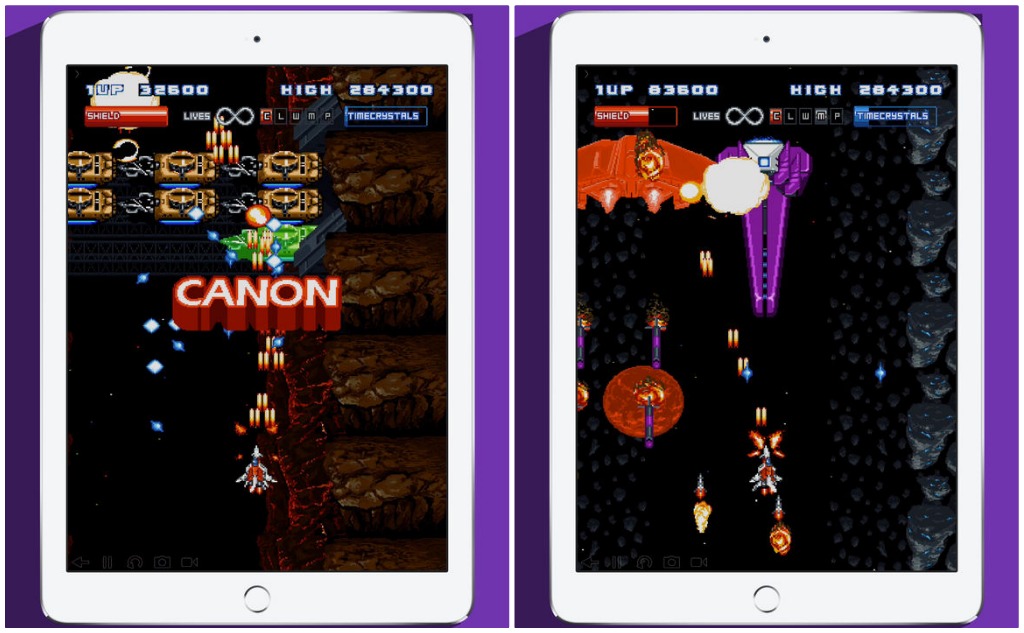
2: Starsceptre
Starsceptre is an excellent action-packed retro shooter where you can play levels without having to worry about losing progress. The levels are fairly short, and it automatically saves after each level. I even wrote a review for it here on Nitchi (even though it has changed quite a bit since then, but for the better, if you ask me!). Excellent if you want something retro, fun and challenging.
Also nice if you’re not in possession of a Switch or another portable console, as Starsceptre is available on your iPhone or iPad.
3: Stardew Valley
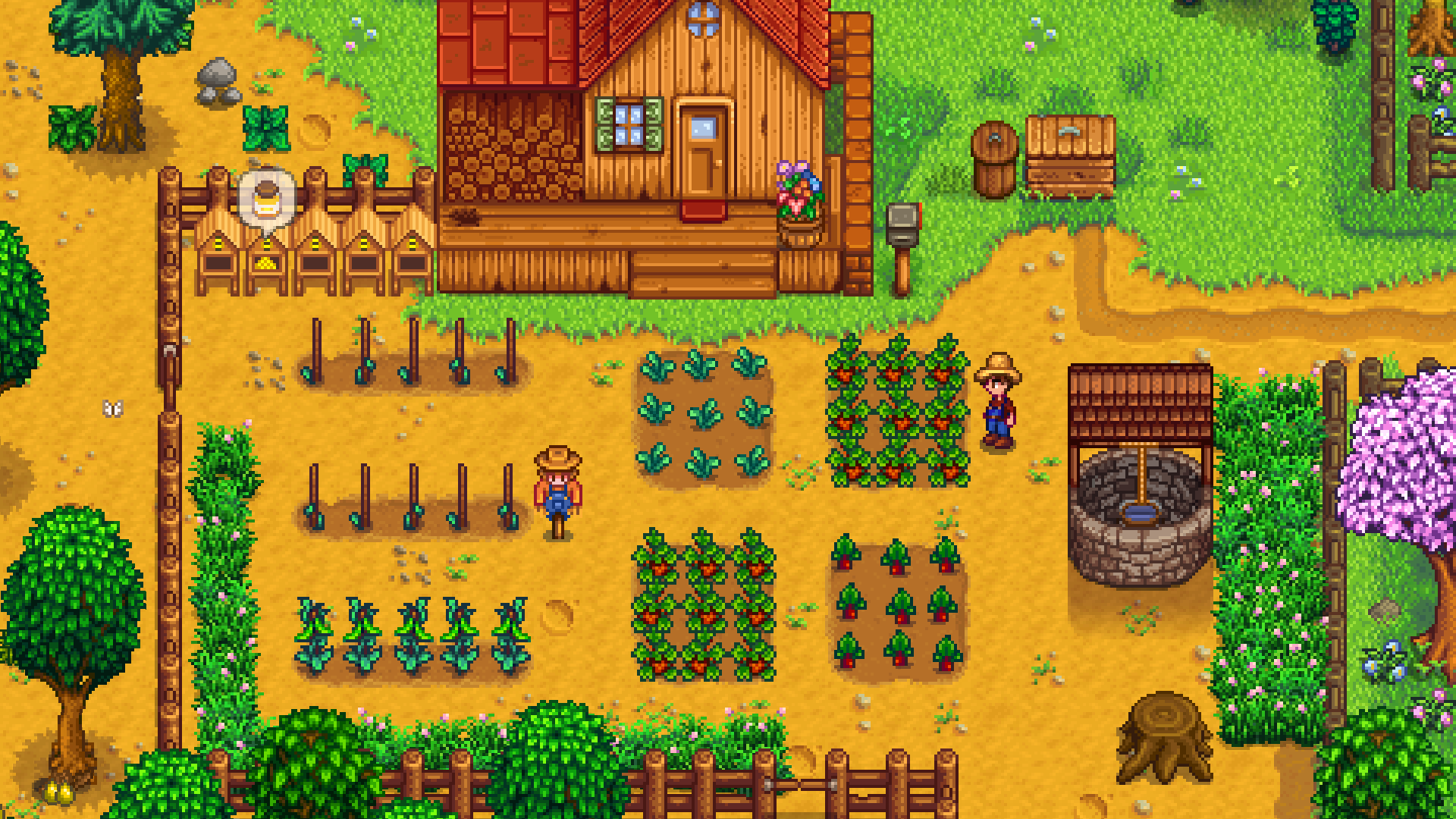
Making this game available on the Nintendo Switch might perhaps be one of the best decisions Chucklefish ever made. If you want something to calm you down after the continual stress involved with travelling, this is the game for you.
Stardew Valley is a slow-paced, farming game, very relaxing when you need a breather. If you need to save quickly, just go to bed (the save function), but on the cost of cutting the day short.
With the Switch, gaming on the go has never been easier. Let us know if you have any suggestions for other games that are nice for playing on the go!
As I approached my favourite stall at the Doncaster Video Game Market, looking at all the obscure splendours, I thought: ‘It’s these obscure games that make me attend these events’. To dig into gaming’s past, games ignored on their release and games still ignored today.
As I’m looking through the PlayStation 2 games I hear my fiancée’s voice staccato with excitement to my left. There in her hand was ‘Bujingai-Swordmaster’, there was one of these obscure splendours. I hand over the game with my money to the merchant.
“You know what, this game should be a hell of a lot more expensive. This is a surprisingly rare game”, says the merchant consciously grinning.
“I know, I’ve been after it for some time,” I say, noticing the crowd look at the case in a curious bewilderment.
“Not got the demand, which is a shame because it’s a really good game”, replied the merchant as he’s bagging it up.
“Well, no one has heard of it”.
“I know, thanks mate,” I said, taking the bag from the merchant.
“Thank you”.
I walk off in search for more obscure splendours.
Bujingai Swordmaster
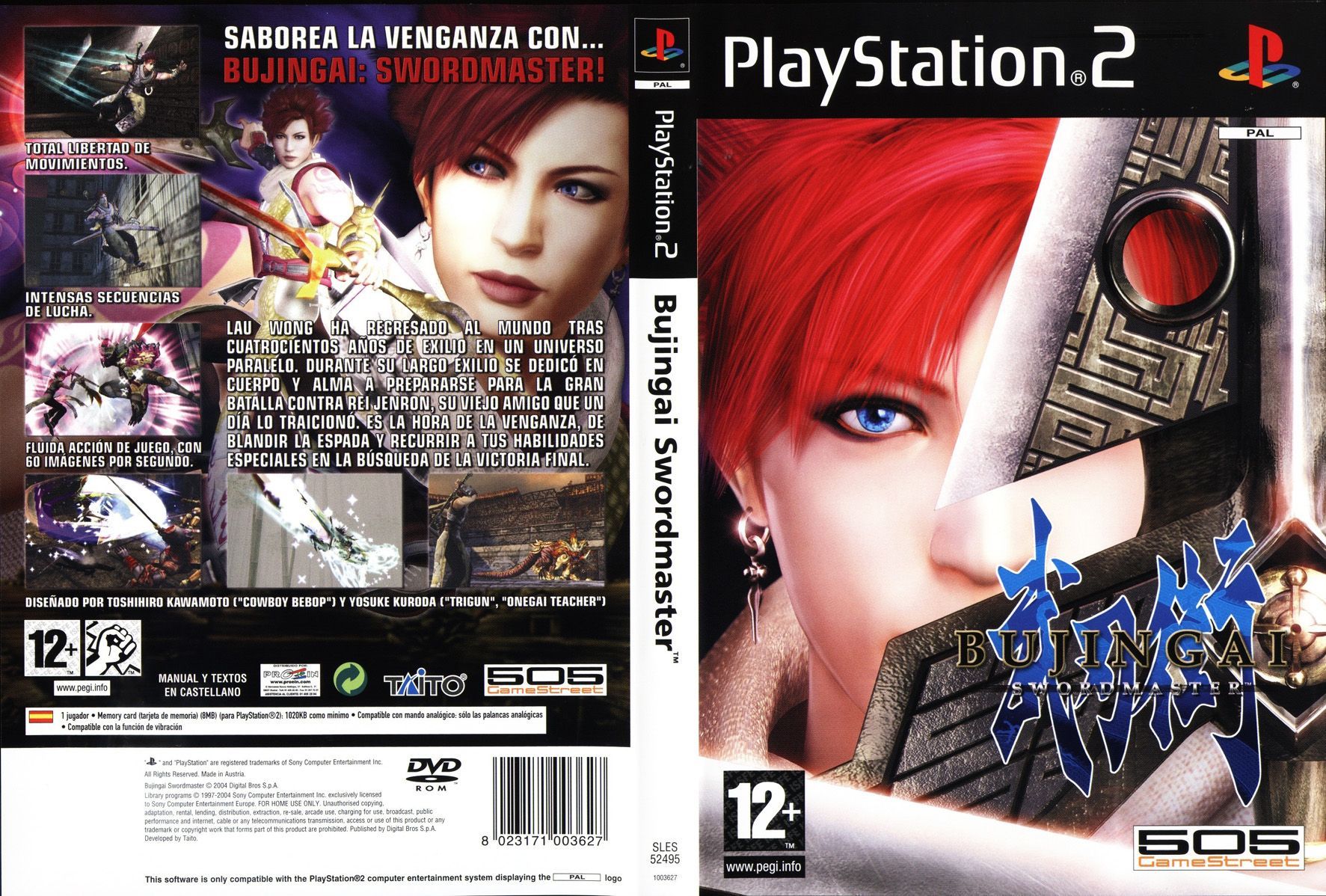
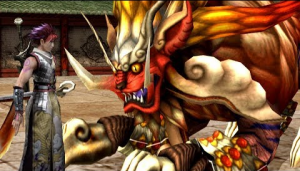
Bujingai, Bujingai: Swordmaster (in Europe) or Bujingai: The Forsaken Forest (North America) is a beat em up/hack and slash game with loose puzzle-solving and platform elements.
It was developed by the legendary Taito Corporation in collaboration with Red Entertainment and published by BAM! Entertainment in North America and 505 Gamestreet in Europe.
The game was exclusively made for the PlayStation 2 and was a celebration of the 50th Anniversary of Taito. Due to the anniversary, some exceptional talent worked on this game, with Toshihiro Kawamoto the character designer for Cowboy Bebop, Yosuke Kuroda the scenario writer Trigun and the main protagonist modelled after J-pop Icon Gackt.
So again, all this talent but I bet you just walked past this game?
Well, here’s what you’ve missed out on or for you retro collectors out there; here is what you can get and get for a reasonable price!
Now when I played this game, I didn’t pay that much attention to the story. I had a vague idea of something going on, but I’ve done some research (I read the Wikipedia page…) and here’s what I’ve got.
A 100 years ago an accident of an environmentally friendly energy source has wiped out 70% of the world’s population and in the process has wiped out the government.
All the remaining survivors have gained special powers from earth’s energy – in swordplay and magic. You play as Lau Wong, a human exile who returns to earth to battle his training partner and friend Rei Jenron – who has been possessed by an ‘Evil Spirit’.
Yohfa has been kidnapped, and numerous portals have been opened allowing demons to take over the Asian city Bujingai; it’s up to Lau Wong, to save Bujingai.
As you can see, not an Oscar-winning narrative, but this game isn’t about the narrative, it’s about gameplay.
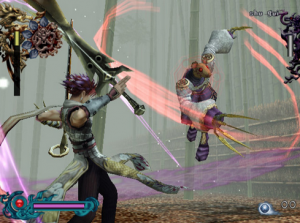
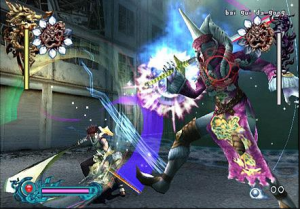
The gameplay is simple, with two attack buttons and a jump button. The jump allows you to glide and run on the wall, then the light attack button acts as a counter if pressed at the right time.
The counter is where the game shines, you have these gems in the corner of the screen based on how many times you can defend before taking damage. When the counter kicks in, your mouth will drop, and you’ll salivate at its splendour.
Like all hack and slashers around this era, you have a combo counter; in this game, the combo counter runs out the more you are on the ground, so the game encourages you to jump around, gliding through the air and running on walls like some crazed Chow Yun-fat.
The unspoken genius of this game lays in the hands of the sound designers. It’s like listening to the nostalgia of old samurai and kung-fu movies. Those vivid swooshes of the sword, that ting and swipe of steel on steel, the swooping of bodies gliding in the air, those synthesized laser beams, and last but not by a long shot least, the sound of the loose fabric clothes contending with the force of its wearer.
It’s in those details in sound that gives the game authenticity.
Bujingai isn’t a masterpiece, the environments aren’t that exciting, the glide mechanic never feels like you have complete control of where Lau will go, and the game is repetitive.
But the excellent sound design mixed with the outstanding choreography of the fighting animations is just a fun gameplay experience; it’s a shame it doesn’t get the credit it deserves.
Well, now I must give it a blast because it was so dirt cheap.
Would you, as a human being, enter a relationship with an android (if it were as real as us)? Would you trust an android with your children? Do you believe technology to be a potential threat to mankind?
With its release a mere month ago, Detroit: Become Human gained instant recognition and fame. If you haven’t played the game yet, I must warn you that this article will contain spoilers.
Thoughts And Reflections On Detroit: Become Human
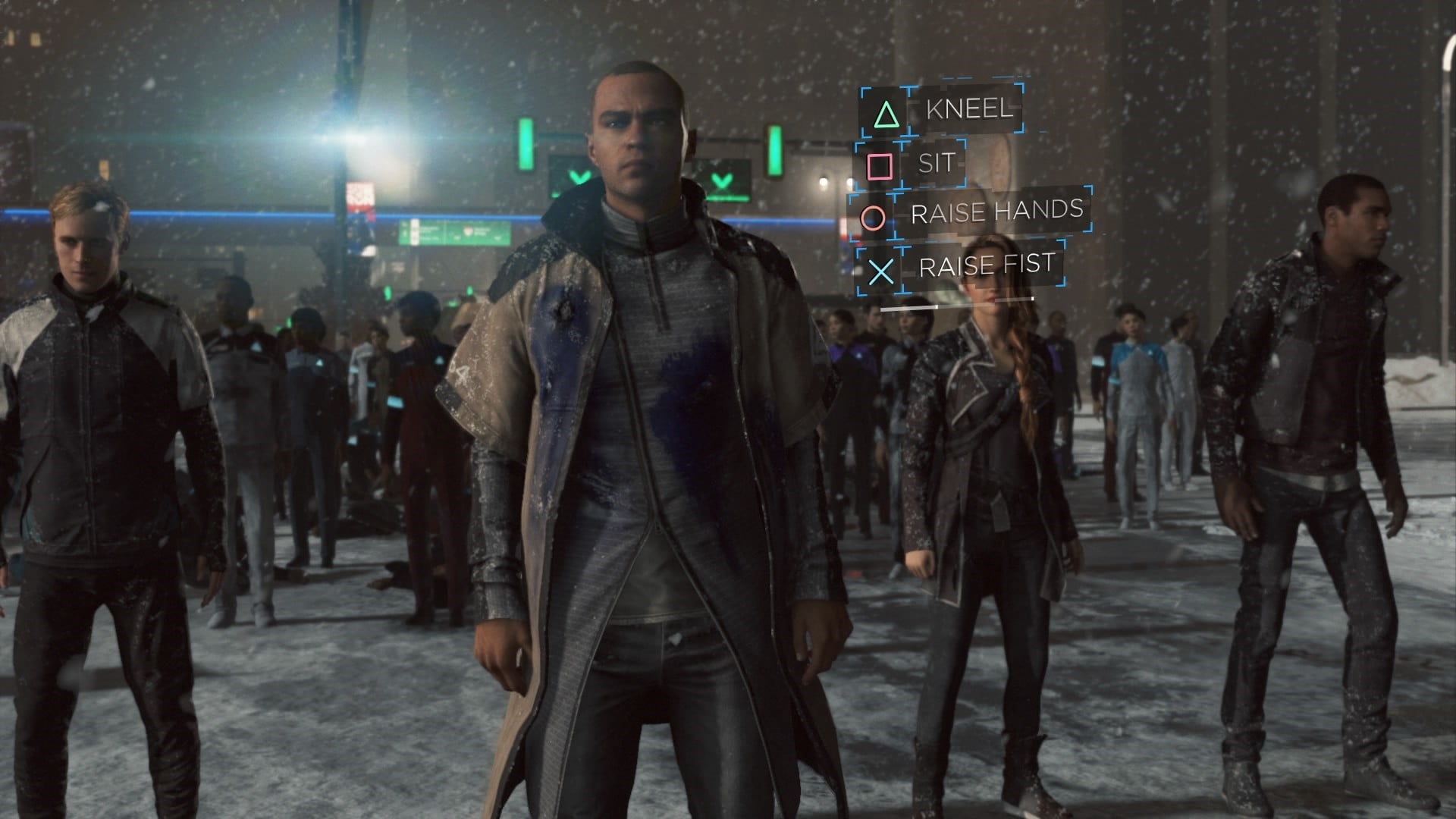
In Detroit: Become Human, we follow the three protagonists Markus, Kara, and Connor. Categorized as “Deviants,” an error in their program allows them to stray from their given tasks, becoming autonomous individuals. They each have their very own personality and unique way of interacting with things, creating three very different stories that eventually intertwine.
The game offers some of the best interactive gameplay and storytelling I’ve experienced in a while, and I was very hesitant to let these androids go when the game was done because I had grown so attached to them. Following their story was much more engaging than I would have imagined, and I genuinely care about each of the protagonists. However, should I feel conflicted that I feel empathy and care for these androids, machines made to serve us?
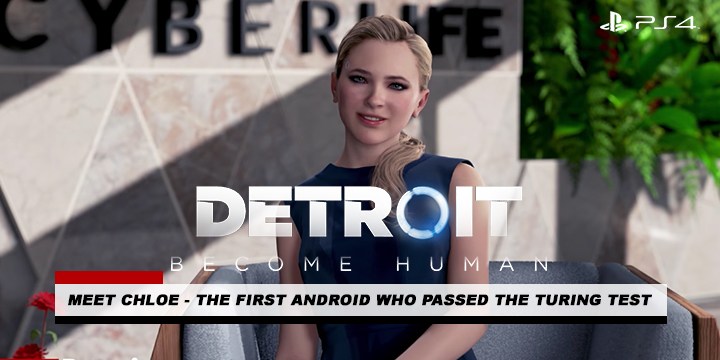
Chloe quickly became one of the most interesting characters in Detroit: Become Human.
I want to shed some light on a different character in Detroit: Become Human. One that surprised me with her presence and unexpected “conversation”. Serving as Elijah Kamski’s servant (the guy who created androids), Chloe is the first female android to pass the Turing Test, a psychological test that checks if a machine may possess the abilities to demonstrate intelligent behaviour equal to a human being.
But that is not what fascinates me. The fact that she was displayed on the menu-screen, she was the first face I met when I entered the game, and the last when I was exiting. She went from being formal, robot-like in her speech and attitude, to becoming a sentient being, commenting and questioning the choices I had made in the game. Even though our meeting with her in-game was brief, Chloe was a character that I continually looked forward to seeing again. Because she was unpredictable. When at one point she asked “are we friends?” my jaw dropped by surprise. I said yes. Yes, we were friends.
After she asked that question it was interesting to just sit there and observe her reaction. When it became clear that she was paying attention to the choices I made in the game, and even giving her own opinions on them, she gradually realized just how much of a self-thinking individual she is. As soon as she realized that she had said something that was outside of her program, her gaze became gradually more unfocused, and her facial expression turned into uncertainty and doubt… and sometimes fear?
These small, yet intriguing interactions with Chloe made me just sit on the menu for several minutes to wait and see if she said something else. That is how involved I got.
The incredibly hostile attitude of the human beings in the game is not necessarily a way that I would have reacted myself, even though I can, in some ways, understand the panic. Some don’t even render it a discussion, because it is easy to just discard the thought as “ridiculous,” and just throw it away.
Aren’t these androids a product of our own mistakes? Will humanity fall by their own hands?
Is the scenario of androids leading a revolution real?
Historically speaking, Homo Sapiens, that’s us, get most of the blame for the extinction of several animal species, including different human species. Being the remaining Sapiens, we are used to being on top of the world. We are used to being the only creatures being able to converse and develop our language as complex as we do.
Many people are afraid of technology going too far; but when is it too far? Take for example Sophia the Robot, the first robot to gain a citizenship in Saudi Arabia, a country that only recently allowed women to drive. Even though Sophia is not nearly as lifelike as the ones in Detroit: Become Human, I think my point still stands. At this rate, the idea of our creations becoming autonomous seems to be a more and more relevant topic of discussion.
Are the androids simply a projection of who we want to be?
The game developers have made sure to portray the androids as “better than us,” both morally and physically, and that may be why the thought of them becoming sentient beings scares us. However, these are all existential questions that might never be answered, but I think it’s fun to contemplate them now and again, anyway.
Detroit: Become Human is a game that discusses these issues thoroughly and, in my opinion, pretty convincingly.
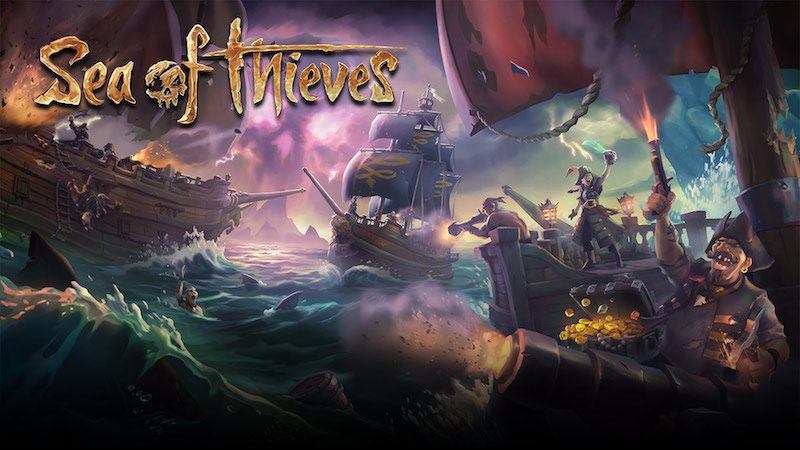
We like to bring you the latest from the indie scene, focussing on the small guys and not just giving the limelight to the big hitters out there. But every now and again, one of the bigger names gets something uniquely right, so much so, that you can’t explain it. For me, personally, it’s Sea of Thieves – if you would allow me to explain why.
I haven’t played much recently, my controllers have sat to one side for longer than they normally would and for longer than I’d normally like them to. What with starting a new job and planning a wedding, my evenings haven’t been as relaxed as they have been in the recent past. But Sea of Thieves has been the one game that has kept me coming back for more and, on some occasions, for a few hours at a time. A few hours these days is a significant thing.
Off You Go!
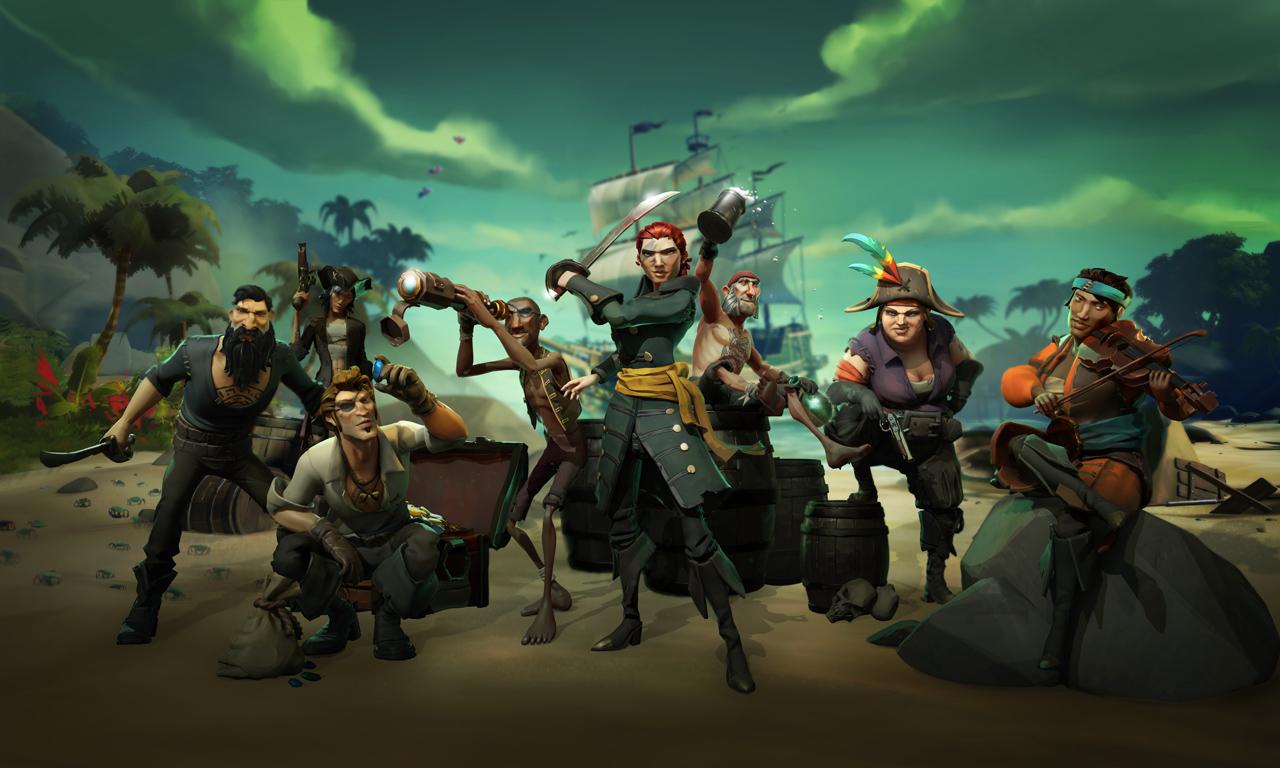
For many, this would probably not seem like a big deal or something out of the unordinary, but I’m not normally one for online gaming, opting for the classic solo experience, or one to play games that don’t really have a ‘point’ or endgame either. When I’m gaming, I like them to have a reason for doing something, making me want to play or justifying what I’m doing pushing me towards the end goal. But Sea of Thieves doesn’t have that. It’s very much a case of ‘here’s the world – off you go’ and allows you to make your own memories and experiences.
What I also like as well is that everything you can collect and buy (using in-game currency) is all cosmetic. There’s no imbalance of power or a shift in dynamic when you level up and, to date, you won’t be on the back foot should you jump in at a later date. This, to me, is gaming done right and fair. No over-powering and no dividing the community and, what’s more, the content that is coming for it is going to be both regular and free. That’s something that can’t be said for most games out there that are hungry for the contents of the wallets of loyal fans.
Don’t get me wrong, Sea of Thieves isn’t without its criticisms as it isn’t the perfect game. The voyages on offer at present can get a little repetitive and until the bigger chunks of content arrive, it is limited in variety. The hungering deep has just arrived though, whereby you can summon a Megalodon which requires the completion of a series of preceding quests before you can do so. Plus there’s still more to come in weekly updates and larger content drops in the Cursed Sails in July and Forsaken Shores in September.
That aside, my enjoyment for the game has not come from the content, more the enjoyment of just playing the game and being able to enjoy it. It’s not a game where it makes you rage or be tempted to throw the controller through the window and has quickly become that title where I send a message to friends asking if they’re going online. When they do, we have a great time exploring and just sailing, chatting whilst we do and playing a shanty or two en route.
The occasional tense moment where you find someone else in your world and don’t know if they will be friendly or hostile also makes you doubt whether or not you should have cashed your booty in sooner. It scratches an itch and allows me to unwind and catch up with some friends, whilst meeting up with some new people should we decide to voyage with them.
It’s hard to pinpoint what the ‘it’ is when a game does it for you and it’s completely subjective, but is there a game that you enjoy playing and keep coming back for more?
Here’s a few random musings on E3, plus stuff you may have missed at the event.
Neil Druckmann, the Vice President of a small company called Naughty Dog, got the chance to meet a hero of his at E3… Can you guess who it was? That’s right, some unknown guy called Shigeru Miyamoto. The bearded Druckmann shared the following enthusiastic tweet of the notable meeting between the pair:
Druckmann And Miyamoto
I’ve been going to E3 since 1997. Every year I was hoping to run into Mr. Miyamoto and let him know how much his games have impacted my life. This year I finally got to sit down and chat with one of my heroes. Big thanks to @DWBakes for setting up our meeting. pic.twitter.com/ogWq6fPIdf
Druckmann himself is a big Super Mario fan, but what about Miyamoto? Has he played The Last of Us and the Uncharted games, for example? At the very least, we’d like to think both of them spoke about their enjoyment in creating some of the highest rated games of all time.
No doubt it’s a great look for the, seemingly, maturing industry.
E3 Is Changing, Reggie And Keighley Play Aces
Aside from the solid showings of Super Smash Bros. Ultimate., the Xenoblade 2 – Torna: The Golden Country DLC and Fire Emblem: Three Houses, it was still a muted E3 for Nintendo.
That might be down to the fact that new games are now announced all year round and, crucially, the old formats are changing – in fact, from everyone. With random Nintendo Directs every few months, loaded PlayStation Experiences at the end of the year (PSX), and other major shows taking announcements away every year, I don’t believe the event carries the same weight it once had.
I know, tell that to Microsoft at E3… hats off, Phil, that was some impressive stuff.
Moving on, another ‘historic’ meeting took place between Nintendo’s Reggie Fils-Aimé and games journalist Geoff Keighley. It’s a tradition at E3 that both of them meet and play against each other. This time they managed to squeeze in some Mario Tennis Aces. You can check out the video here:
We both had crazy schedules this year, but in the last hour of @e3 2018, we made it happen: Geoff vs. Reggie in Mario Tennis Aces! 12 years after our first E3 tennis battle in Wii Sports. pic.twitter.com/7rPkqiDSN3
‘Making political statements are for other people to do. We want people to smile and have fun when they play our games.’
Mario Tennis Aces itself is out this week. Going from the free online tournament demo, it’s much better than whatever the insufficient Ultra Smash was trying to be. The online mode in Aces is stupidly intense, with crazy skill levels on show. The single player RPG-style content seems to have meat on its bones as well (invoking Mario Tennis: Power Tour for the GBA back in 2005).
Anyway, that’s all I have time to muse on, if you got this far, thanks, as always, for reading.
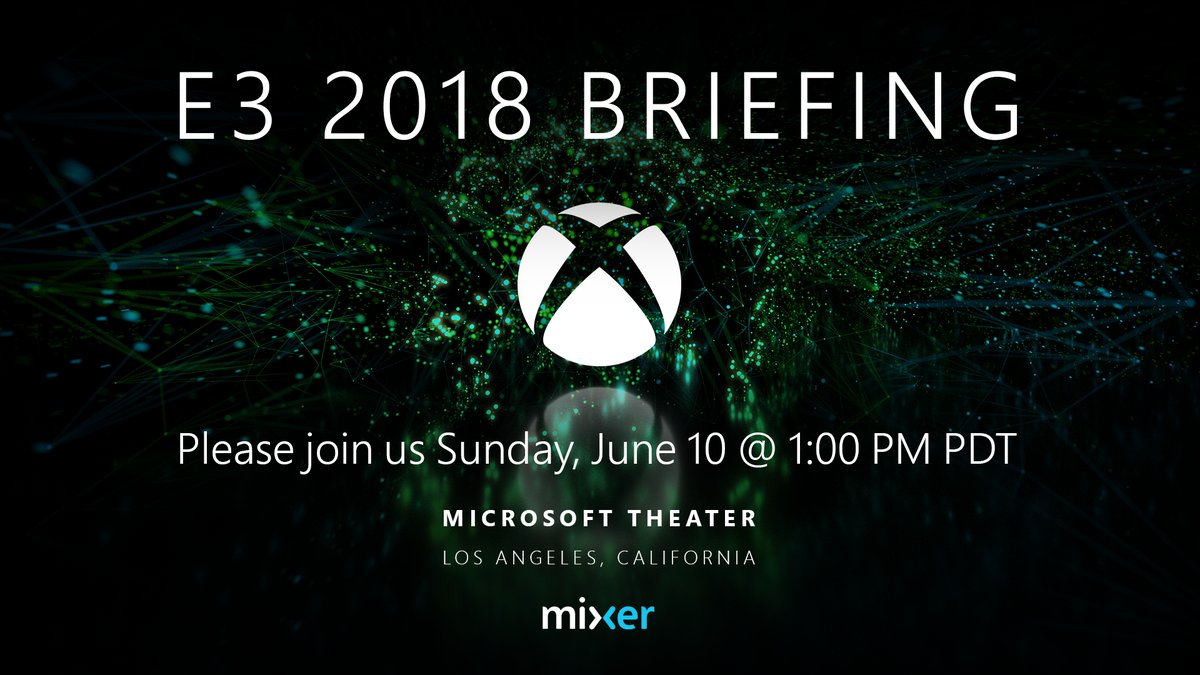
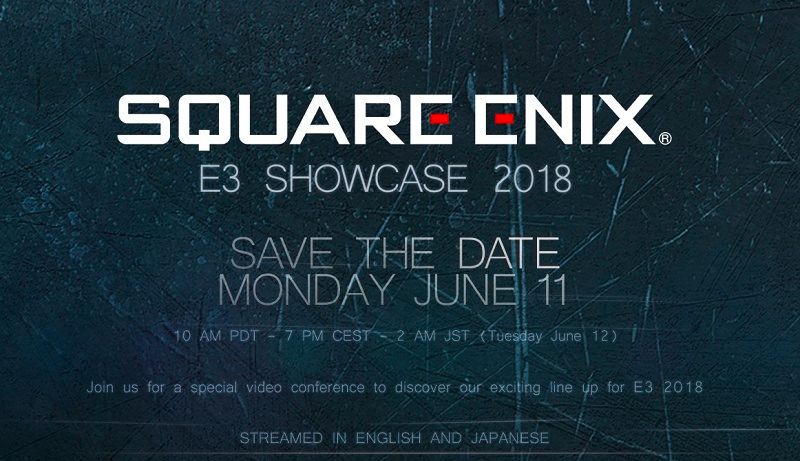
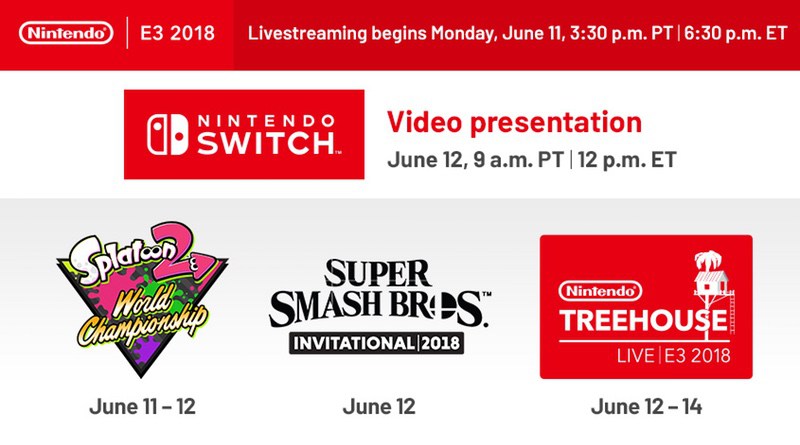
Not sure when everything is happening at E3 2018? Not to worry, we’ve got you covered. You can find the key times and dates below for all the big E3 conferences this year.
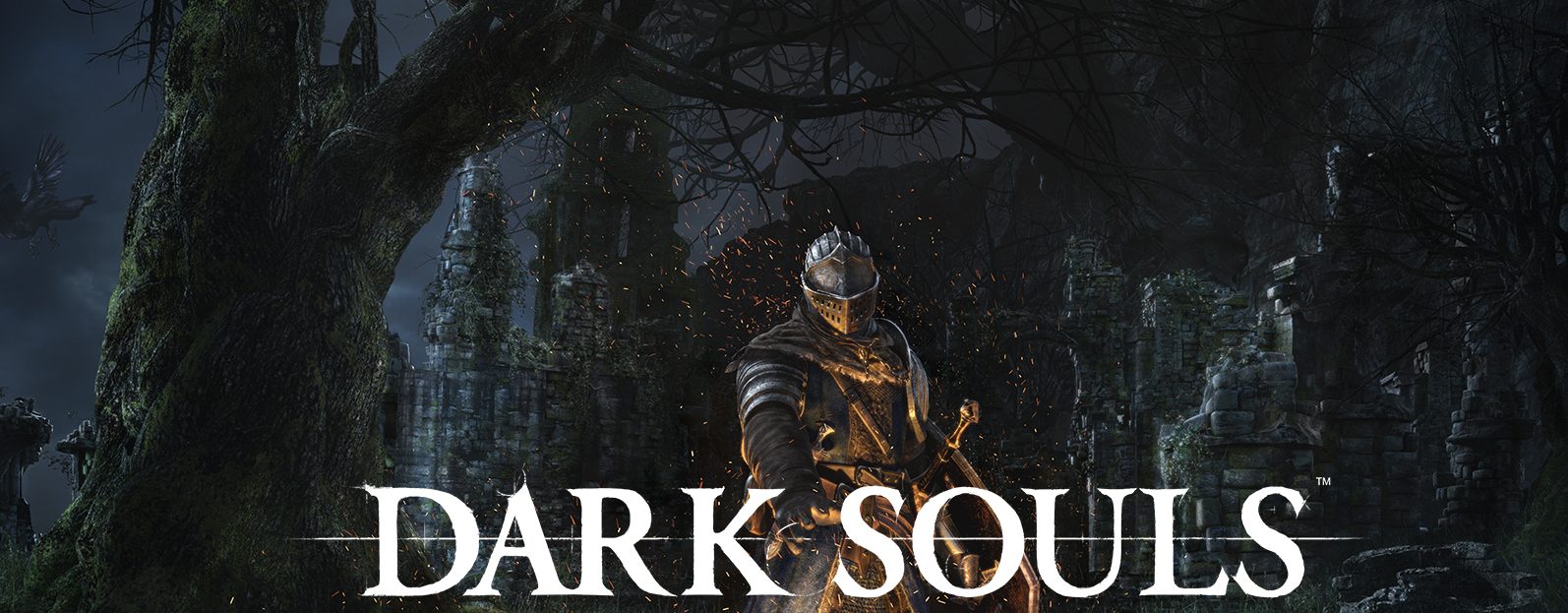
“My name is Jack Boyles, and I am losing my humanity. I am turning Hollow.
“The video game landscape has turned complacent. Years have passed, only to find checkpoints, auto-saved or skippable sections perpetuate. It seems like a lifetime we had limited saves, continues and restarting a game because thou hath used too many bullets early on within a game. We are husks, wielding a controller or keyboard and mouse, burning the cornea of our eyes with our High Definitions and watching lonely individuals on camera talk to themselves like some knight who is hollow; watching them completing videos games for us to throw our loot at them like they are some succubus.”
Turning Hollow: Games And Difficulty
“Some games make us fight off this wretched curse. Allow us to suffer for hours, just for that little sip of euphoria when you finally killed a boss…Ah, Elation!
“Disputes over the ascending trend of difficulty within video gaming has broken out: ‘Should video games be made to suit a mass audience, resulting in a difficulty that is possible for any skill player, so that the ending is always attainable?’.
“Allow me to elaborate, giving me purpose, so I can hold onto my humanity. For just a little longer.
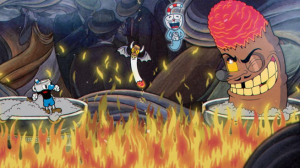
Cuphead, reminding thou of a challenge.
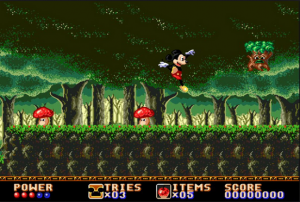
“‘Cuphead’ denies thee access of the last 10% of the game without defeating the game on normal. As a hollowing gamer, my first conquest in gaming dates back to the age of the 16-bit. In those times, a ton of games had this practice. Even those from Disney… Yes, that family-friendly Disney!… That Zipadeedoodah Disney.
“In those days, thou must consider that games were not the mammoth task ye must partake in today. Nevertheless, Big Publishers are questioning the longevity of Linear Single Player Games, saying gamers doth not endure them long enough; ha ha. Does one understand my intentions?
Castle of Illusion on Megadrive – Equip the mighty apples.
“Some spout out rhetorical questions in a delirious pleasure that feels more like a marketing team questionnaire; they are ‘Do developers owe it to consumers to show their full game no matter the skill level?’, ‘Should games be made so everyone can enjoy them?’ and ‘Is a game too difficult for its own good?’. These questions pose that video games should be accessible to everyone and should cater to all skill levels. This is an impossibility.
“I would say I’m a competent gamer. I have played various games, some of which would be unspeakable to most gamers. But even a low soul level gamer can defeat me at FIFA.
“They consistently tell thou video games are the only medium that stops thou from seeing all the content, and they are correct in saying that. But other mediums do challenge thee in other ways, like ones’ intellect. Therefore, diminishing ones’ enjoyment of that content. Many transient beings have tried to fathom James Joyce’s Ulysses and only to be deterred by the stream of consciousness literature. Same can be said for Cinema, if anyone can understand David Lynch’s Inland Empire, I’ll hold them in high regard.
Inland Empire, yes those are rabbits.
“One thing is missed when talking about difficulty within video games, one of the most important life lessons and one I’m thankful for; ‘When you fail, try again until you succeed’. Life can easily defeat thee, that is why thou see those Hollows out there. They were once people like you and I, people who one day gave up hope. We should embrace difficulty in video games and encourage the young to play them. I am certainly gleeful I have this life skill, would thou not agree?
“So why doth these people continue to advocate otherwise? Maybe it’s not their doing? Maybe they have been consumed by a darker force ye or I cannot comprehend…
“Maybe themselves have turned Hollow. A mere shadow of their former selves desperately clutching at any fragment of their humanity. Only for them to fade from view time and time again”.
In a time dominated by an ever-growing number of expansive open world games, it’s occasionally nice to sit back with something simple. There are a lot of small games for the Switch, a good amount of which can, unfortunately, be written off as cash grabs. Simplicity, however, doesn’t always have to mean bad.
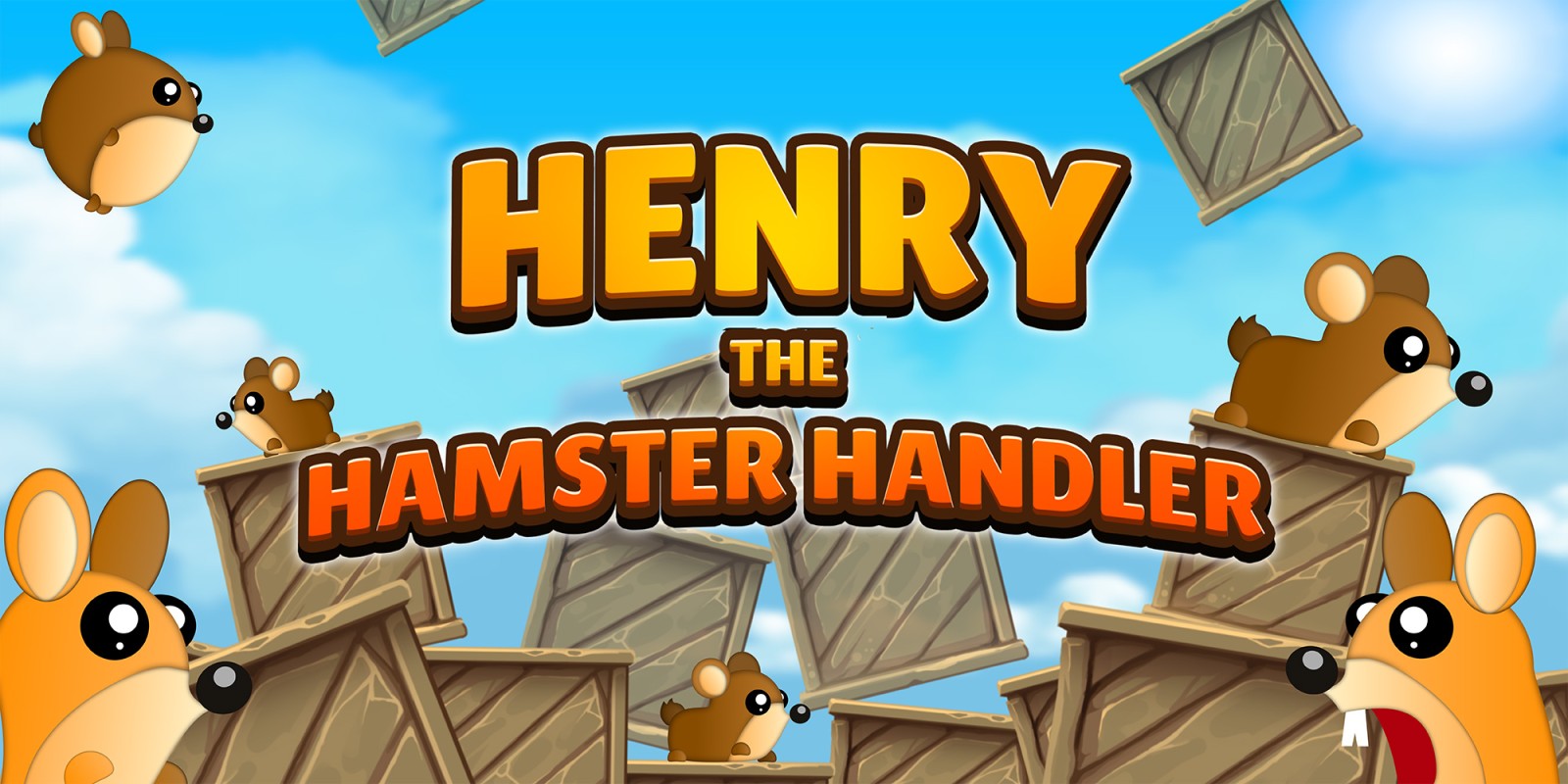
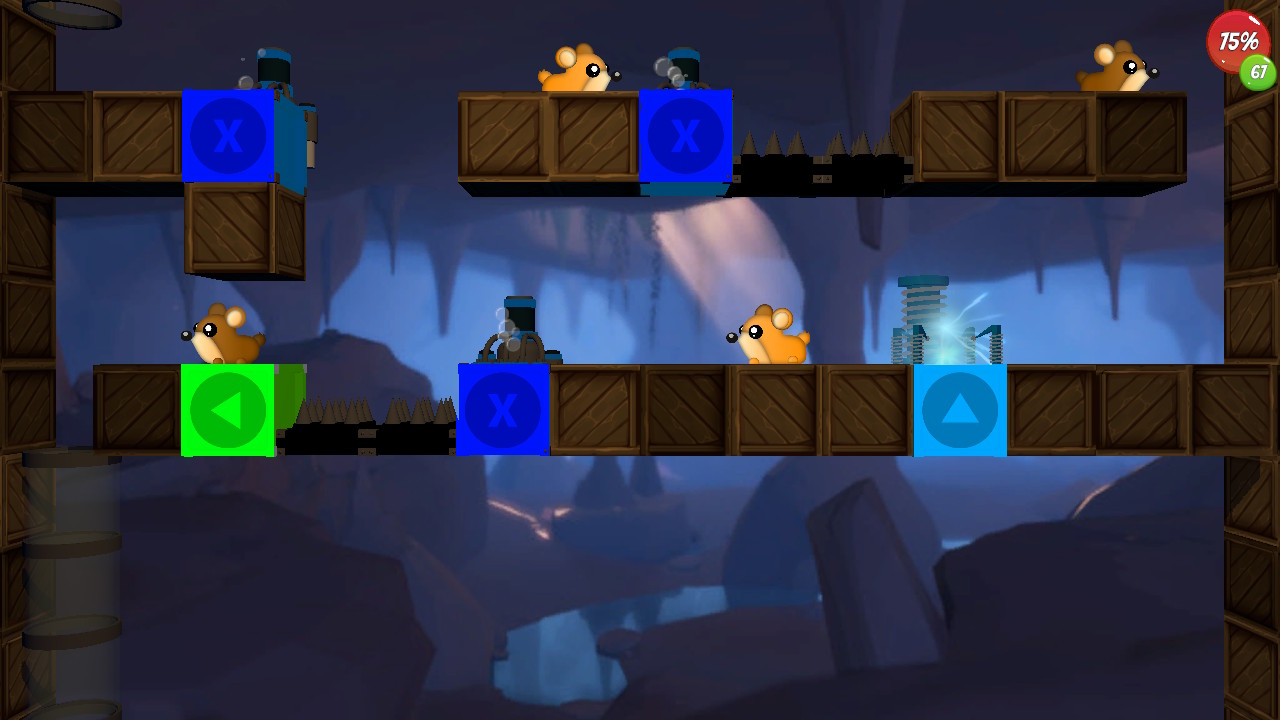
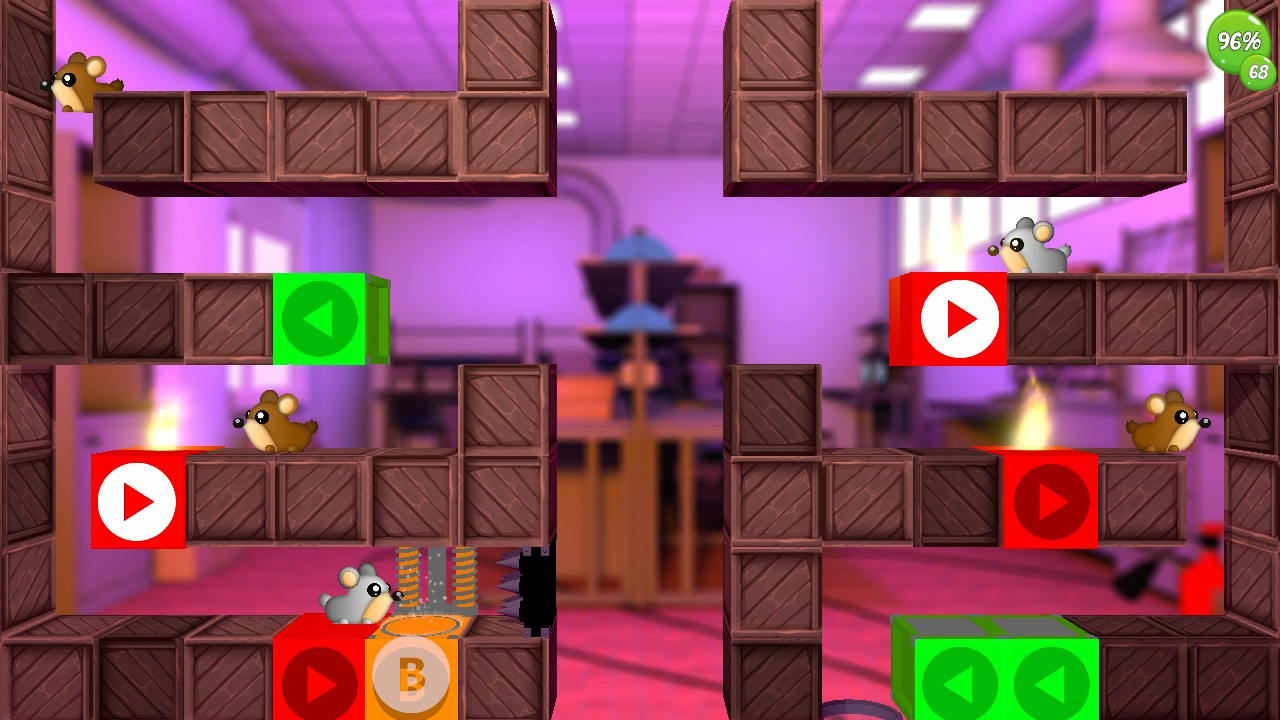
Pong is simple, and yet one of the most iconic games ever created. Henry the Hamster Handler by Pocket Money Games is not going to reach the icon stratosphere like Pong, but it is a simple game that packs in a lot of complex fun.
Henry The Hamster Handler Review
The game’s premise is basic; make sure the furry little nuggets of joy reach their destination without getting eviscerated. The Hamsters walk at an even pace across the stage with various obstacles in their way.
You the player must press the correct Joy-Con button when prompted in order to allow the little ones to proceed without impediment. Fail to do so, and you’ll immediately see your new friends burned, gassed, crushed, vaporized, or fall to their deaths. If a majority don’t make it across the danger zone intact, the stage will automatically be lost.
There are three hundred levels, each one with increasing difficulty and speed. Like most classic rhythm games, you have to get into the groove or you’ll get overwhelmed pretty quickly.
The first couple of levels ease you into the play mechanics, but I found myself scrambling to hit the correct buttons pretty soon out of the gate. As you can guess, the hamsters keep coming, forcing you to act fast or face the consequences. Things got so intense, I definitely became anxiety-ridden on more than a few occasions.
There’s really not much else to the game. Hamsters drop down, and the human must ensure they make it safely to the goal. Fail to do so, and you have to restart the stage. There are no frills, no bonus menus, and no options to speak of. This is as simple as it gets, but don’t let that fool you into thinking it’s not worth your time.
We’re almost halfway through the year which can only mean one thing: inevitable disappointment when the sun doesn’t make a significant appearance again during the summer months.
That and the fact that we are a very short time away from this year’s E3 convention which is already shaping up to be quite the show. We’ve already had some pre-show leaks thanks to the Canadian arm of Walmart listing some potential upcoming games early, but hopefully, there are some big surprises still in store!
There are also many questions that need answering this year; what games will carry the Xbox One X forward? How will Nintendo approach 2018 and will Sony have any surprise hardware up their sleeves?
Battle Royale: The New Zombies?
Alas, this article isn’t just about the big E3 build up. No, it’s about something more concerning; there’s an epidemic on our hands. We thought the zombie craze was bad (somehow there’s life in the old limbering corpse yet) but I feel that the ‘Battle Royale craze‘ is going to be far more significant.
When I say significant, I don’t necessarily mean positive either…
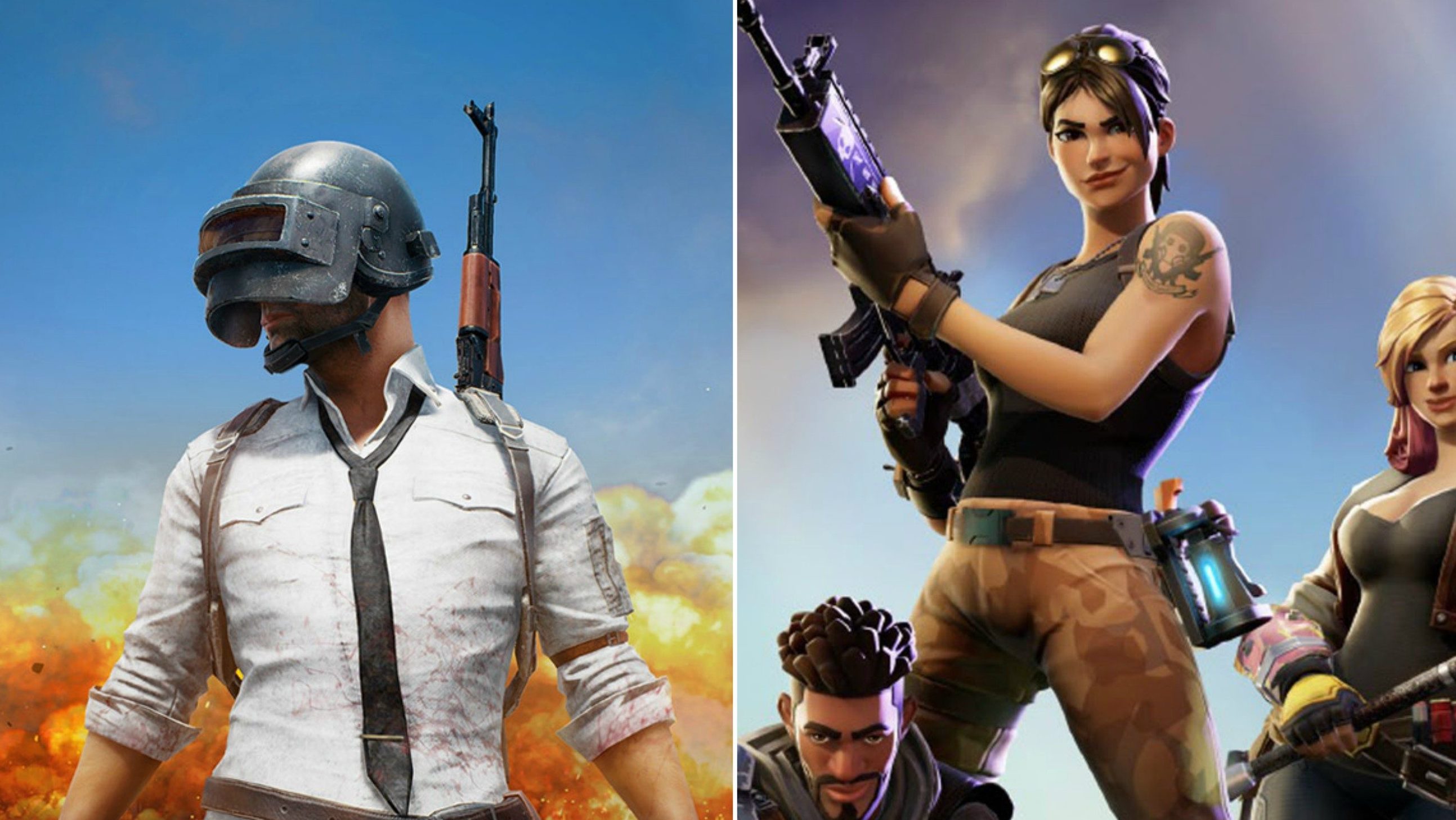
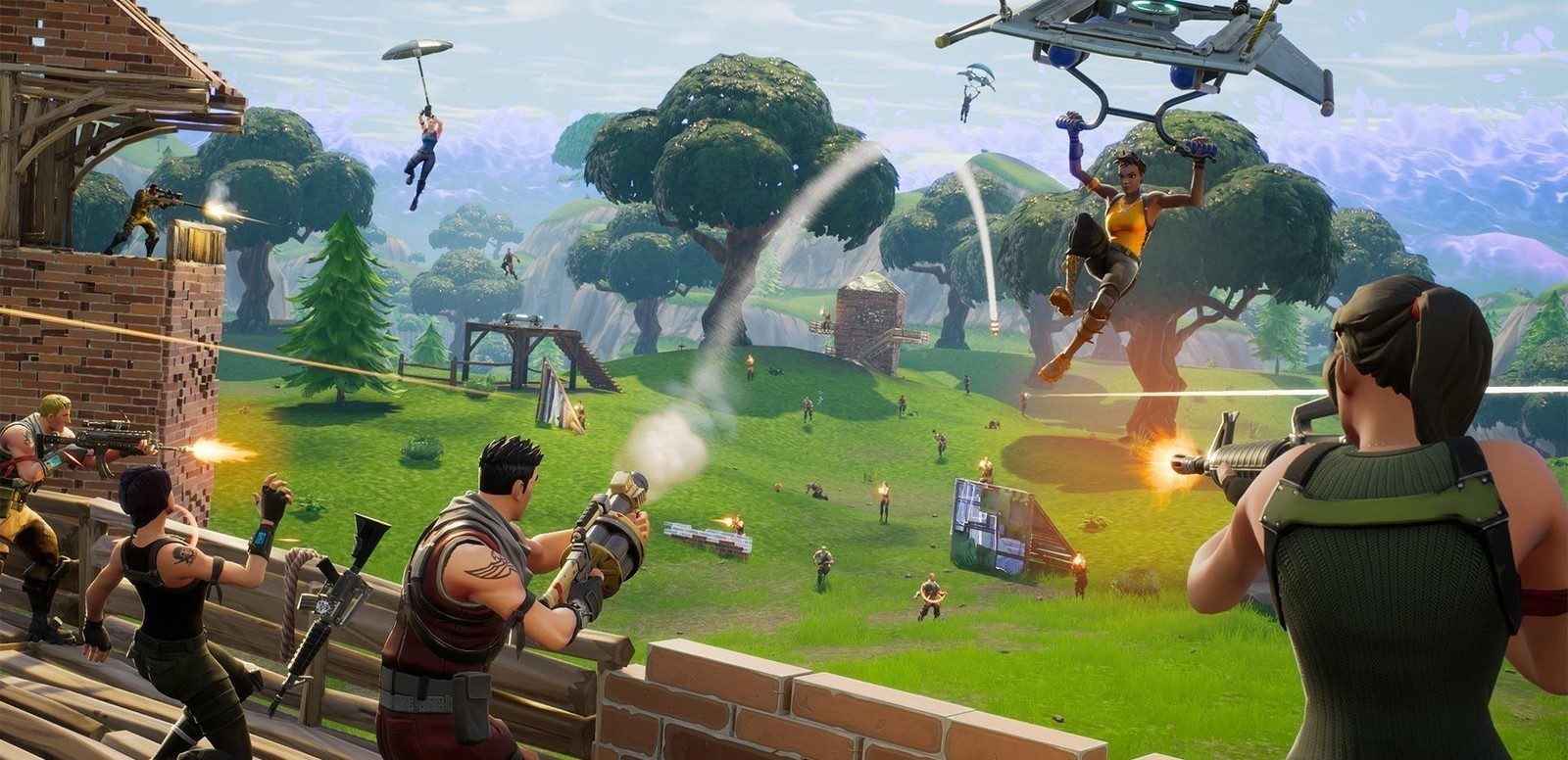
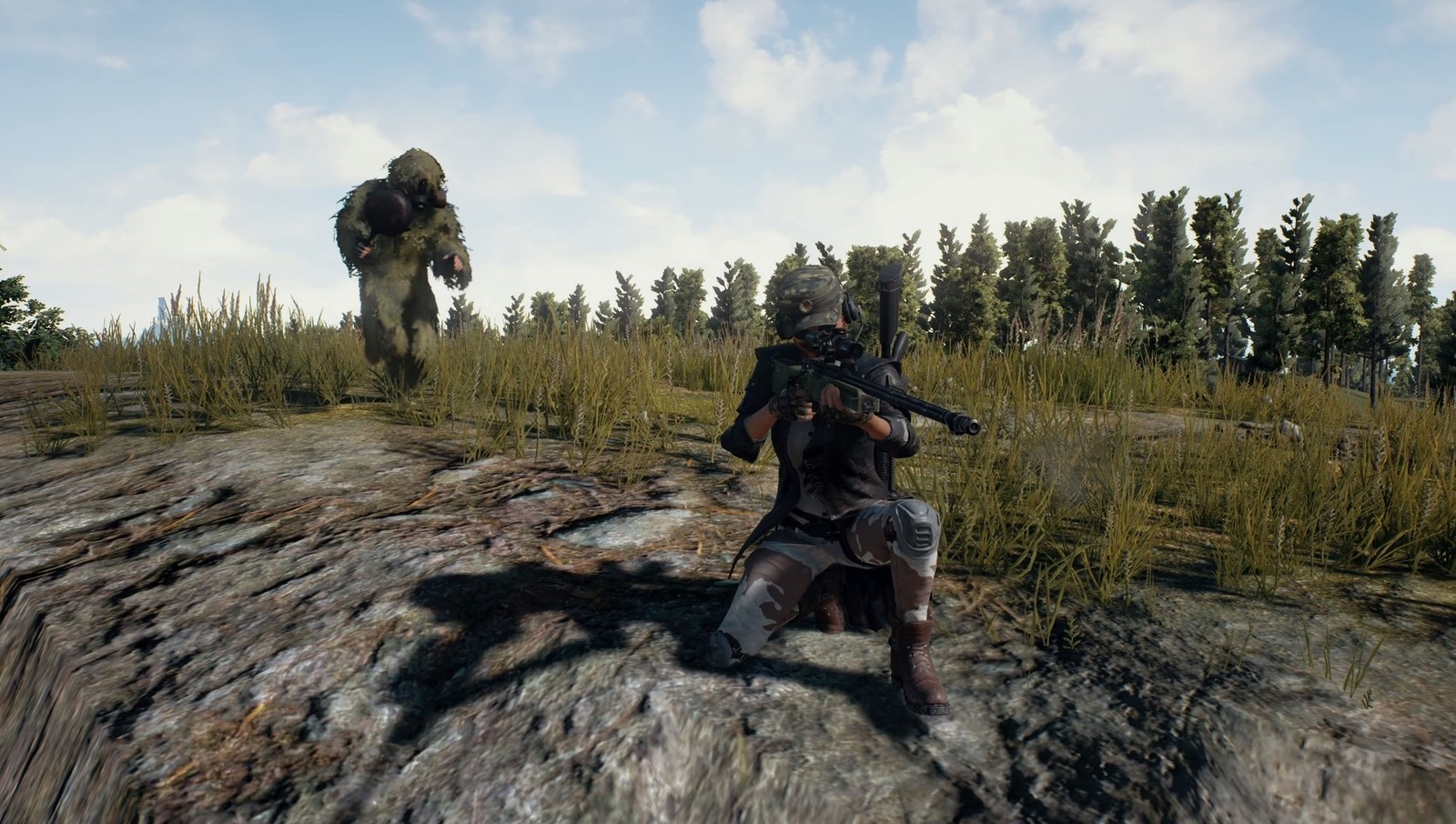
Before we get off on the wrong foot though, I’m not here to deny the popularity or success of the likes of PUBG or Fortnite. They have seen masses of players and followers flood over various platforms and social media alike, which is perfectly acceptable.
Likewise, it’s nice to see something a little different and it gives more people a choice when it comes to their online shooters beyond the likes of the usual Call of Duty or Battlefield.
What I don’t like though, is that we are starting to see people jump on the Battle Royale bandwagon and rush to have their own version of this mode included. From a business perspective, I can see why they would do this. If it brings in the numbers and also the money, then, of course, they will try to get in on the action.
However, when it is a detriment to an existing formula and series, then I don’t think mimicry is the best form of flattery in this instance. You see, it’s all well and good that the upcoming Black Ops game has a battle royale mode, but at what cost?
The single player campaign may be expendable to them, and others, but what about those who want a single player mode? There are some, myself included, who like playing the single player mode from the Call of Duty franchise and, without it, they may not even play it.
Without question, variety is the spice of life and that is certainly true in the games industry as it is nice to have something different and, without innovation, it would be a very boring marketplace indeed. But as Fortnite, or PUBG for that matter, aren’t direct competitors for the big hitters out there and are doing their own thing, just let them be. Appreciate them for what they are, and leave them be.
Others can mind their own business, continue with business as usual and try to innovate rather than renovate which is something that is lacking in the industry if you ask me; innovation. Heck, why can’t we try and innovate when it comes to campaign and single player modes to keep things fresh? Treyarch has said there’s plenty of value in their upcoming outing, but that’s in modes that are looking a little tired now.
Maybe make the campaign more expansive, more dynamic and more engaging. Give it some worth beyond a warm-up or prelude to the online modes perhaps?
But we shall have to wait and see if anyone else jumps on the hype train that is running 24 hours a day to destination Battle Royale. Do you like Call of Duty making this bold move or are you one of those who will refrain from playing Black Ops 4 because of this?
It has been far too long since I experienced a Castlevania game. It wasn’t until I played Bloodstained: Curse of the Moon that I realised the full meaning of that statement either. Regardless of what Konami wants to do with the ‘Castlevania’ name, this is what the real future of the franchise now looks like. And it’s looking bright.
Let me just say, though, that it’s an increasingly common trend in the games industry. That being where the original creator, (Koji Igarashi in this case), has to fight back for the same individual and creative control they once knew. I won’t digress any further on that point, don’t worry, but it’s great to see a positive outcome in such a mad, fickle world.
Bloodstained: Curse of the Moon Review
So, here we are with Curse of the Moon and the short answer is: it’s essentially everything you might expect and want from a ‘classic’ Castlevania game. What I mostly mean by classic is the absence of the Metroidvania exploration and, to a degree, upgrades we all know and love. That’s not a bad thing at all…
What we have instead are levels, with multiple paths within them, that all nevertheless lead to the same ending point. At the end of the levels are challenging bosses that remind you of how tough video games of the past used to be. You’ll have to fight your way through endless creatures of the night and avoid nasty traps to get there as well.
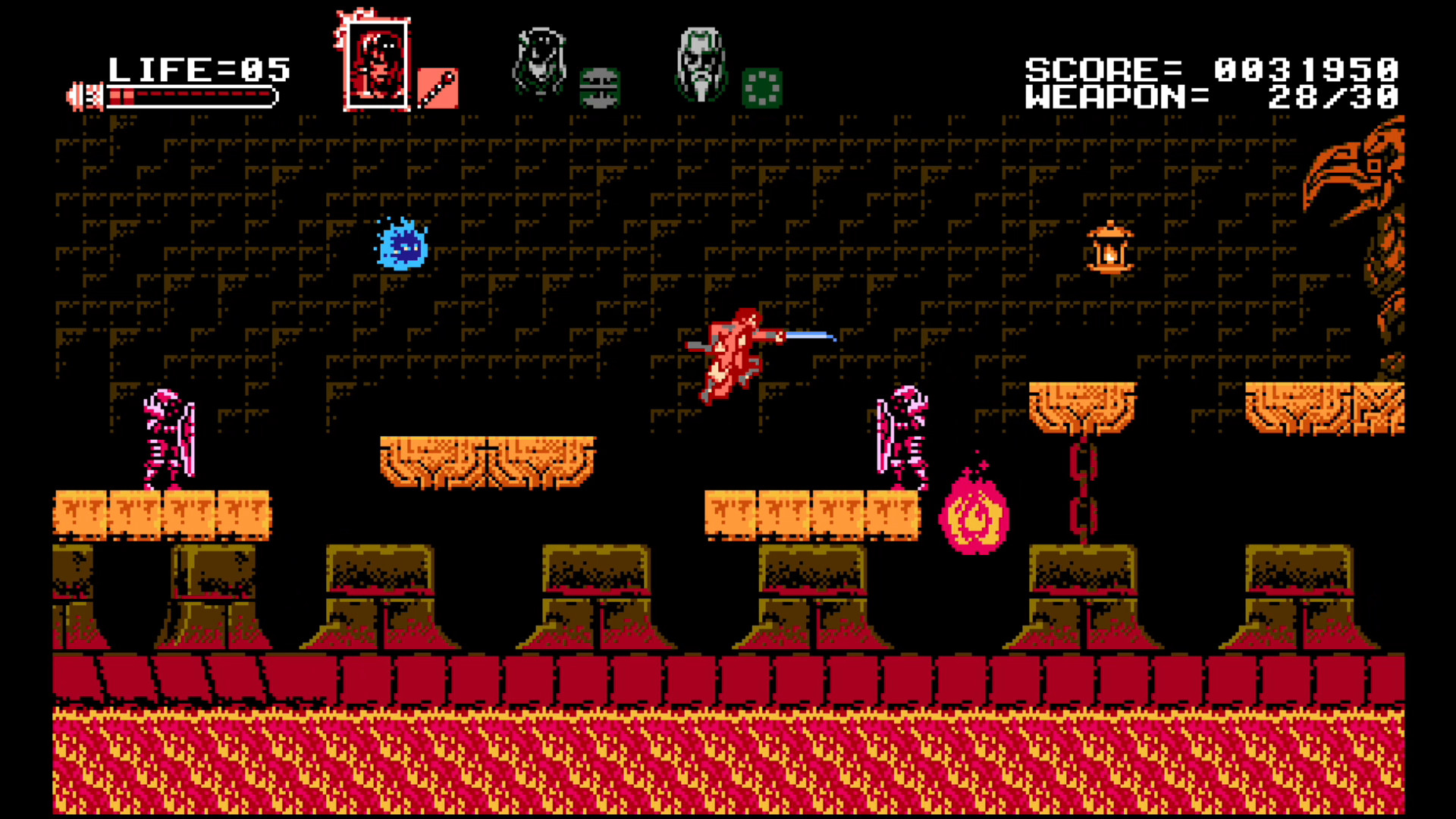
Fundamentally then, what Iga and the extremely talented Inti Creates have produced here recaptures the magic of the very first 2D Castlevania games from the NES and SNES days. That includes an awesome soundtrack (of course), gorgeous 8-bit graphics and the ability to control four different characters. The latter is an area in which Castlevania III: Dracula’s Curse is fondly remembered for.
Four Characters, Eight Stages
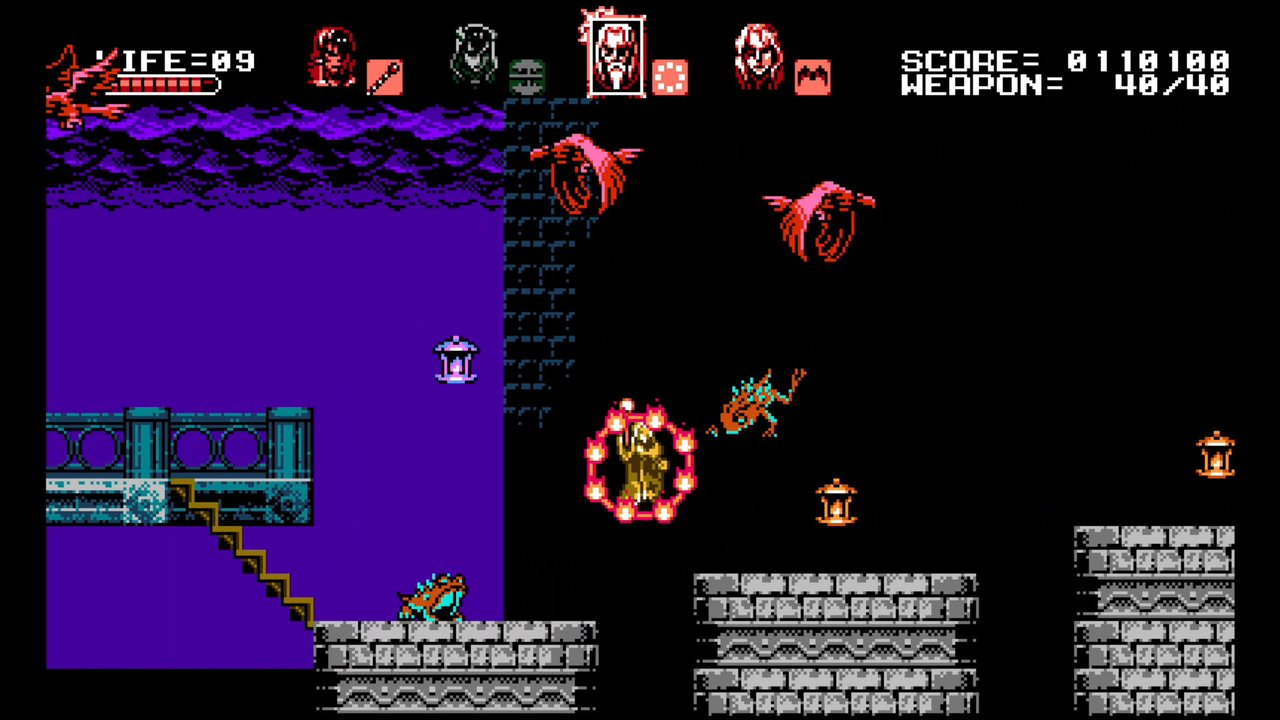
In Curse of the Moon, we have the exorcist Zangetsu who fights with a sword, the heroine Miriam who deploys the classic whip, the latest ‘incarnation’ of Dracula called Gebel, (although not officially), who can turn into a bat or summon them from his cape and, lastly, the alchemist Alfred who can use powerful magic. Each of these characters is unlocked at the end of the preliminary stages. All of them have individual life bars too, making things a bit easier.
You’ll be switching between the group to get through the eight stages, although, for a first playthrough, Miriam’s range of attack with her whip is a safe bet. There are also diverging points on each of the levels that can only be accessed through certain character abilities. Finding these points will take you through a variety of scenarios that keep Curse of the Moon feeling fresh.
This magic spell is essential
It wasn’t until I completed the game twice on ‘Veteran’ (Spoilers: there are multiple endings), that I truly started to understand where each character excelled. Basically, the more deaths I endured, the easier it became. Yes, there is certainly a high difficulty to overcome in Veteran (probably not as tough as some of the older Castlevania titles), but purists will most likely love every masochistic second of it.
Veteran Or Casual?
Have no fear though. Players that are new to the series or just want to take a smoother ride are also well looked after with the ‘Casual’ style of play. Casual removes the dreaded knockback from enemies and lives are unlimited. The game asks you whether you want to change the style frequently, encouraging either more challenge or a break from the stress. This is a great implementation.
I can’t say Bloodstained: Curse of the Moon does anything truly new for the series, but sometimes that’s perfectly ok. What it does do, however:
Recreates the classic games, to brilliant effect
Continues the dormant legacy of the wonderful Castlevania series
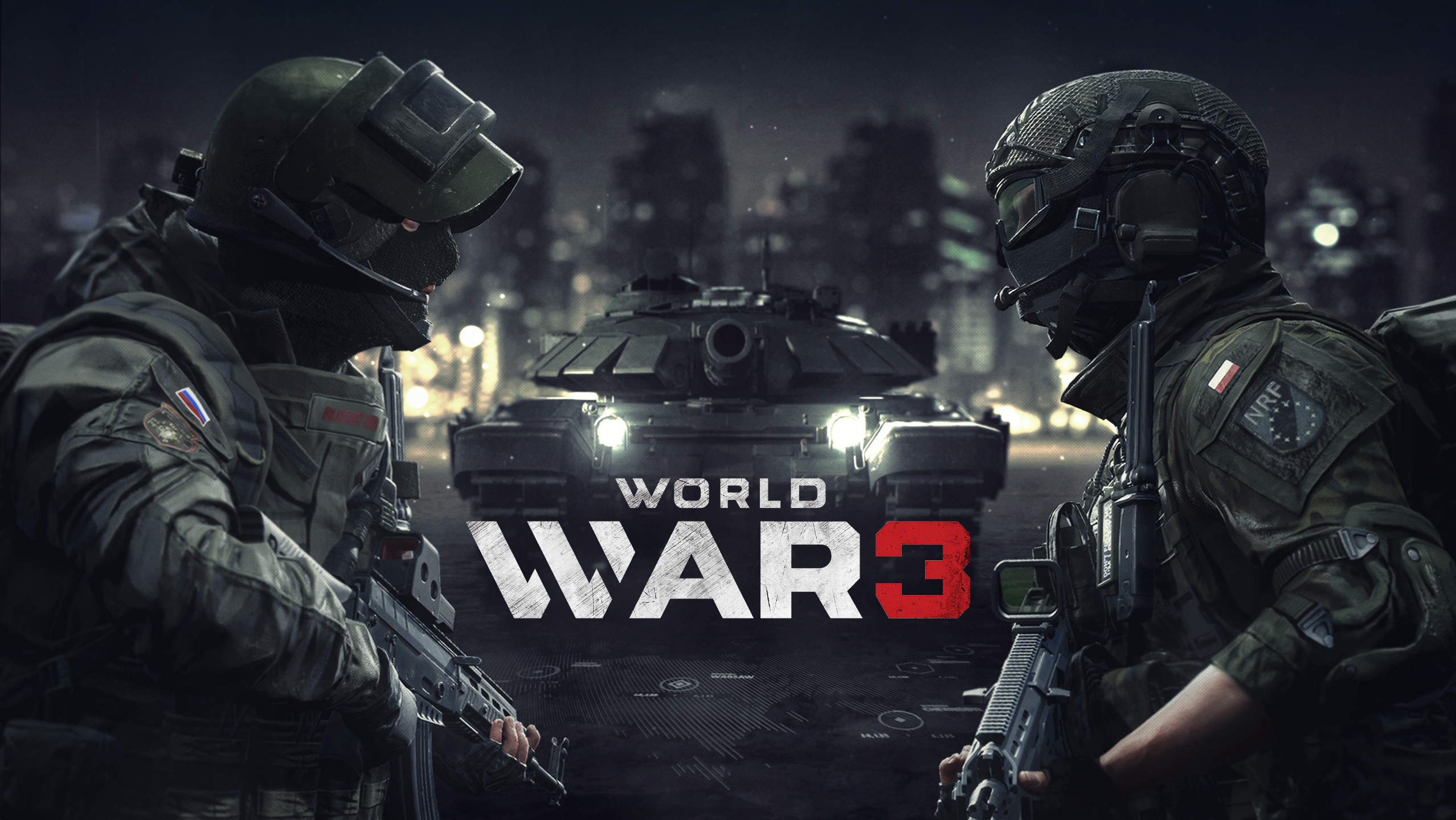
Indie studio The Farm 51 announced their new game this week in World War 3. It’s a large-scale modern day/near future FPS that takes place in… you guessed it, World War 3.
Farm 51 is keeping a tight focus with WW3, the game will only have two different modes at launch. With the first one being a large scale strategic team-based mode called Warzone, that Farm 51 promises will have “large-scale combined arms battles with infantry, armoured vehicles, and drones.”
The second mode will be a Battle Royale mode called Recon. This mode will be smaller in scale compared to the grand size of the Warzone mode and will be focused more on looting, surviving and squad play.
New Kid On The Block
Additionally, WW3 is going to have some unique gunplay that Farm 51 seem to be bragging about.
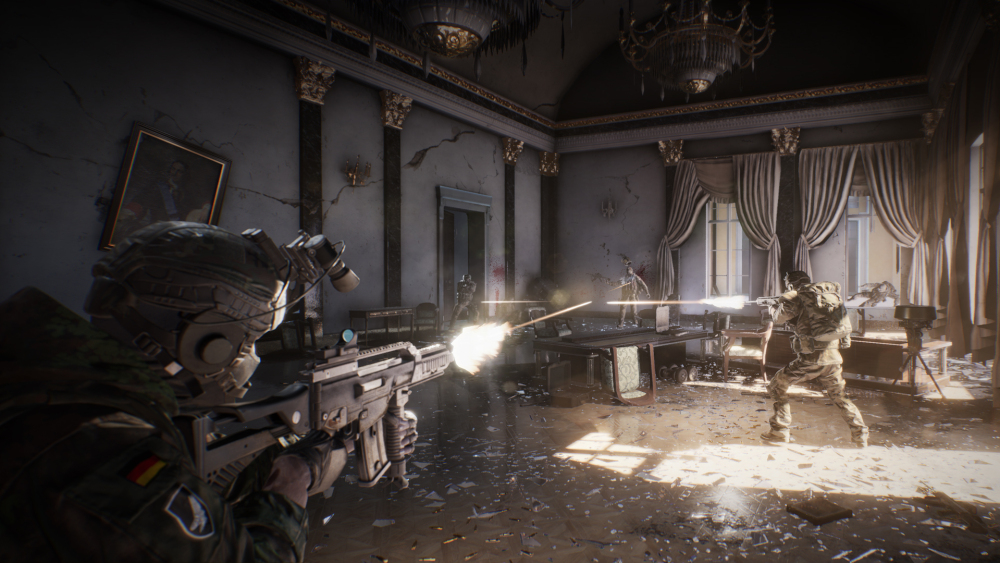
They’re claiming it will be “The most authentic bullet vs. armour system in the FPS genre to date,” that will include “Ballistics, a weight system, full body awareness, and an extensive customization system – all affect the gameplay in a meaningful way.”
However, what I find most interesting about the announcement of WW3, is the fact it was announced right after the very controversial reveal of Battlefield V.
To me, it looks like Farm 51 found a prime opportunity to take the spotlight away from the more mainstream large-scale military shooter, and put their title out in the forefront.
And, their strategy seems to have pulled off. All over the internet, Battlefield fans are saying WW3 looks like the game they wanted BFV to be.
Some are even calling it the spiritual successor to the very well received BF4. What’s even more surprising is that major Battlefield YouTubers in LevelCapGaming and Westie are covering the game, seemingly as a backup plan for their channel just in case BFV does fail.
From the modern setting to the realistic approach, the large-scale warfare, a battle royale mode etc. WW3 seems to be the title that Battlefield fans wanted.
With all this in mind, WW3 has a real chance to seize a large portion of the currently divided Battlefield right from under EA and developer DICE.
The real question is: can Farm 51 pull off this bold move? They have never developed anything this ambitious in scale and scope before, with the other titles they’ve developed being, Get Even, Painkiller: Hell and Damnation, and Necrovision.
None of these titles come close to scale and size of what they’re trying to accomplish with World War 3. It will be very interesting to see if the game will live up to the immense hype that has already been generated in just the past couple of days.
Will Farm 51 actually ‘take down’ the Battlefield franchise? We’ll find out soon when World War 3 launches in Early Access on Steam later this year.
The need for accessibility in games is not exactly a new discussion. AAA titles regularly implement basic accessibility features such as contrast controls, subtitles, and multiple control scheme settings.
However, the need for further improvement in the industry has recently come to the forefront.
This is especially true for indie developers. As indie titles become more important for the long-term future of the gaming industry, accessibility will become something indie developers will need to begin to take into account.
Of course, with all the financial and time constraints on small developers, this is not an easy task.
We recently had the opportunity to speak with Carlos Coronado, developer of recently released indie survival horror, Infernium.
Carlos Coronado
Carlos currently teaches at the University of Barcelona. He began his journey into the gaming industry by making the Warcelona mod for Left 4 Dead 2. He dove into indie game development in 2014 with his award-winning MIND: Path to Thalamus. After that, he developed Annie Amber for Gear VR and then started Infernium. He is also a scuba diving and sailing enthusiast.
Following the recent accessibility update for the Nintendo Switch version of Infernium, we decided to ask Carlos about his interest in accessibility in games: what made him interested in accessibility and what challenges it posed or benefits it brought as an independent developer.
We also got a brief description of what his next project will be after Infernium.
First off, before we get into the topic of accessibility, I have to ask you how you came up with the concept for Infernium? A PAC-Man inspired survival horror is definitely a unique premise.
What caused you to bring those two ideas together?
Well, I had always wanted to make a horror game but none of the ideas I had “clicked” with me. However, while doing my first-night dive in Apo Island (Philippines) I was amazed by how beautiful, calm, and at the same time scary the experience was!
I remember going out to the water and, even before putting on my scuba gear, I said to my diving buddy, “I know my next game is going to be a beautiful horror game where you see the enemies from a mile away!” So yeah, it was then when I had the idea, and the Pac-Man element came naturally while developing it.
The setting and concept of Hell are central to Infernium’s story, though it is certainly a version of Hell which has an element of beauty not commonly associated with purgatorial or eternal punishment.
Why did you choose Hell as a setting, and why did you decide upon this particular imagining of it as opposed to a more traditional, Dante’s Inferno version?
As I said, that diving experience was key. Aside from that, gameplay always comes first in my games, and I always try to think about settings that allow me to be very creative while generating cool gameplay mechanics. Hell was like a big sandbox for me, and the twist of making that Hell beautiful allowed for a greater level of creativity. The beautiful environments add an interesting psychological element. The game teaches you that the more beautiful an environment is, the more dangerous it is! This creates a contrast between what you see and what you feel that really drives players crazy, and I love that.
It is entertaining watching YouTubers and Streamers playing Infernium and witnessing them totally distrust the beautiful environments!
Now, onto accessibility, something you have been very vocal about. I have seen you discuss it with fans on your Twitter account and you have highlighted Infernium’s accessibility features on the game’s Steam page.
Even before your last accessibility update, Infernium offered not only sound but visual cues indicating a nearby enemy, as well as from which direction that enemy was approaching; a feature that is not incredibly common.
With the update, you have allowed more intermediate accessibility settings, including slowing game speed by decelerating enemies, or removing them altogether.
What made accessibility so important to you as an independent developer?
Yes! I must say I had no idea about video game accessibility before meeting Kait Paschall. She moved to Catalonia with her husband and while they were searching for a place to live they stayed in mine. During those months she got really interested in the development of Infernium and she introduced me to accessibility for video games.
She made me see that with a little effort on my part the player base would be much wider, and therefore I could sell more copies! For example, she explained the game would be 100% playable for deaf gamers by simply adding the red screen visual alarm when you start getting chased. This was the first one but the list goes on and on.
After the release of the game, I also experienced something that made me change my mind again and introduce even more accessibility features. For example, I saw my girlfriend (she is not a gamer) playing the game with the PC Mod “No Enemies” downloaded, and she was constantly telling me how great the experience was for her. She didn’t care about the challenge, but just walking in the game and seeing how everything was connected was a huge experience for her.
I also noticed the most downloaded mods for PC were all mods that made the experience more accessible for people, so I thought it was a good idea to make those options available to everyone, and that’s what I did with the accessibility menu. It basically adds 4 new options you can enable and disable anytime: No Enemies, Slower Enemies, More Tutorials, and No “Perma Death”.
Obviously, it is not how I intended players to enjoy the game but, hey, who the f*** am I to tell people how they have to play or enjoy!
After looking more into accessibility in games, I realise I took for granted how many features were already being implemented by AAA titles, such as allowing contrast controls, the ability to remap control schemes, subtitles, and making intractable objects obvious.
Do you think smaller, independent developers have a certain disadvantage when it comes to implanting these types of features?
In the AAA market, everything in terms of game-feel is sorted out. I mean, those are titles developed for really, really wide audiences! That’s why accessibility is taken for granted.
On the other hand, indie titles are more experimental and willing to risk more. I think that’s why most indies don’t think about accessibility features.
However I don’t really think introducing accessibility features is going to make your game ‘less indie’ or worse, and that’s something we all need to work on and spread. If indie devs realise accessibility features = money, more and more indie titles will introduce accessibility features.
Do you think smaller developers have an obligation to make certain their games offer at least basic accessibility features? This would entail at least some of the guidelines outlined here.
I think there is a thin red line between accessibility features and good game design. I think when you are designing good games and mechanics you don’t realise most of the time you are introducing accessibility features without even knowing!
That’s great, but we should work so that aside from good design, game devs also take accessibility into consideration.
What are some elements of Infernium that perhaps have not been mentioned specifically that you implemented to help make the game more accessible for players?
The in-game maps! I love those and no one is talking about them! Every time you visit a new area of the game you can search for a map sketched by someone in the past and if you take your time to read the map you can literally gather all the useful info: where the enemies are, where the light is, where the next map entrance is… It is super helpful if you are willing to invest the time to read the maps. Here is a guide made by a user showing all the maps.
Another “feature” I am really proud of is the crowdsourced Wiki! It’s literally filled with info, including a guide, tips, secrets and even the complete lore story in order. It is a way of getting yourself in the world of Infernium without even buying the game.
Where do you see yourself improving on accessibility in Infernium, or in future titles?
I’d say reducing the number of buttons/controls the player needs to interact with the game.
I’ve already been prototyping my next project. It is going to be a 2D sidescroller game about revitalising corals underwater. Think about Flower but in 2D with Limbo’s art style and controlled with only one joystick!
Where do you think the gaming industry as a whole stands regarding accessibility? Do you think improvements still need to be made and, if so, where do you see a need or needs that have not yet been met?
I see day by day more and more positive messages about accessibility are being spread.
I can say: “Hey! Put accessibility features on your game!” but few will listen. Instead, if I say: “Hey, In the first weekend after the accessibility update on Switch the game has sold as many copies as in all it’s life on sale”. Then more devs will listen.
In the future, I see accessibility features as something being taught at universities and eventually becoming common enough that it will be taken for granted in every game.
Final question: What advice do you have for aspiring independent game developers in general, and then regarding how they might make their games more accessible given the challenges indie developers often face?
My advice is that if they want to implement accessibility features, they need to do so early on in the development. It is easier and more elegant. It is way more complicated to introduce accessibility features once all the design is done and maybe even not worth it depending on the kind of game you are making.
In general, I would advise them to try to have short development cycles and never spend more than one year working on a single project. It makes you go nuts!
Indie Developers At The Forefront
While the gaming industry continues to evolve, concerns over making certain all gamers of all abilities will be able to learn from, play and experience more and more of what the industry has to offer will continue to rise to the forefront. There is always room for change and room to make things better.
If Carlos is any indication, indie developers may once again be at the forefront of the gaming revolution, just as more and more unique and clever content arises not from AAA titles, but from small developers with a passion to make great games that everyone can play.